
About This Worksheet
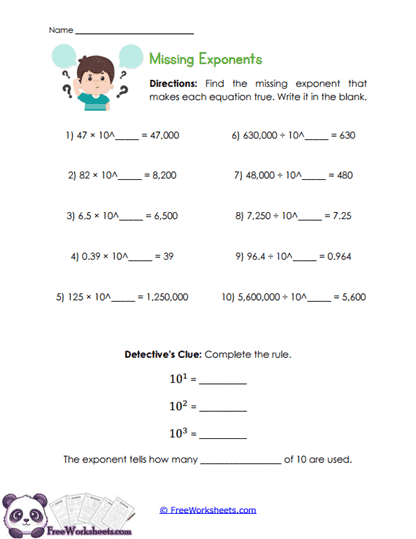
This worksheet helps students find a missing exponent when a number is multiplied or divided by a power of ten. Students use place-value patterns to decide which power of ten makes each equation true. For example, 47 becomes 47,000 when multiplied by 103. The activity gives children practice working backward, which is an important step beyond simply calculating with powers of ten.
Curriculum and Grade Alignment
This worksheet is designed for fifth-grade math and supports CCSS.MATH.CONTENT.5.NBT.A.2. Students should already understand that multiplying or dividing by powers of ten changes the place value of the digits. The next step is using that knowledge to solve missing-value equations and explain how exponents relate to the number of shifts. This page strengthens both place-value reasoning and early algebraic thinking.
Student Tasks
On this worksheet, students will determine the missing exponent in ten multiplication and division equations. They must compare the starting number with the ending number and decide how many place-value shifts occurred. The problems include whole numbers and decimals, so students have to apply the same rule in several different situations. At the bottom, they complete a short clue section about 101, 102, and 103 and explain what an exponent tells us.
Common Challenges
Students may count zeros without first checking whether the equation uses multiplication or division. Another common mistake is shifting the digits in the wrong direction when the result is smaller than the starting number. Decimal problems can also be confusing because the zeros are not always visible. Teachers can help by having students mark the starting and ending place values of one digit before choosing the exponent.
Teaching Tips
This worksheet works well after students have already practiced multiplying and dividing by 10, 100, and 1,000. In class, a teacher can solve one multiplication example and one division example aloud to model the thinking process. At home, a parent can ask, “How many places did the digits move?” before the child writes the exponent. That question keeps the focus on place value instead of guessing from the size of the numbers.
Worksheet Features
The worksheet includes ten missing-exponent problems with a balanced mix of multiplication and division. Whole numbers and decimals are both included, which helps students see that the same power-of-ten rule applies across different number forms. A short clue section at the bottom reinforces the meaning of common powers of ten. The page can be used for independent practice, homework, review, or a quick understanding check.