
Scaling By Fractions Worksheets
5th grade math scaling by fractions worksheets help students predict, compare, calculate, and explain how fractional factors change positive quantities. Free, ready-to-print worksheets in PDF format are designed for immediate classroom use, centers, guided practice, homework, or homeschool lessons. Students strengthen fraction sense, scaling reasoning, and product comparison while developing skills that support curriculum expectations.
About This Collection of Worksheets
Scaling by fractions helps 5th grade students understand how multiplying by a fraction changes the size of a quantity. Students learn that factors less than 1 shrink positive values, factors equal to 1 preserve them, and factors greater than 1 enlarge them. This conceptual understanding makes fraction multiplication more meaningful and helps students predict whether an answer is reasonable before calculating.
The collection includes fraction sorting, product predictions, comparison tasks, structured scaling tables, missing-factor equations, true-or-false statements, error analysis, matching activities, and real-world word problems. Some worksheets require exact multiplication, while others deliberately focus on reasoning about scale factors without solving so students can concentrate on the relationship between the multiplier and the product.
Teachers can use these worksheets for direct instruction, guided math, centers, homework, intervention, enrichment, review, or assessment preparation. Parents, tutors, and homeschool educators can begin with comparing fractions to 1 before moving into predictions, missing factors, error analysis, and contextual scaling problems. The progression helps students connect fraction size, multiplication, and product magnitude with increasing independence.

Paul’s Teacher Tip
Before students multiply, have them classify every fractional scale factor as less than 1, equal to 1, or greater than 1. Then ask whether the product should shrink, stay the same, or grow before any computation begins. This prediction makes it much easier for students to catch unreasonable answers. When comparing two products with the same starting number, encourage students to compare the scale factors first instead of calculating both products. For missing-factor problems, begin by deciding whether the unknown factor must be below, equal to, or above 1.
Worksheet Collection Skill Spotlights
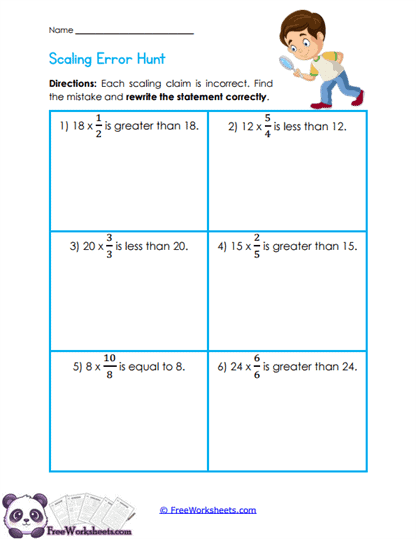
Error Detective
What Kids Do: Students inspect six incorrect claims about whole numbers multiplied by fractional scale factors. They decide what is wrong with each statement, explain why the claimed product relationship cannot be correct, and rewrite the comparison so it accurately describes the effect of the fraction.
Target Skill: This activity develops error analysis and conceptual scaling reasoning. 5th grade students practice using a fraction’s relationship to 1 as evidence and learn to explain why multiplying a positive quantity by a proper, improper, or unit-equivalent fraction changes its size in a predictable way.
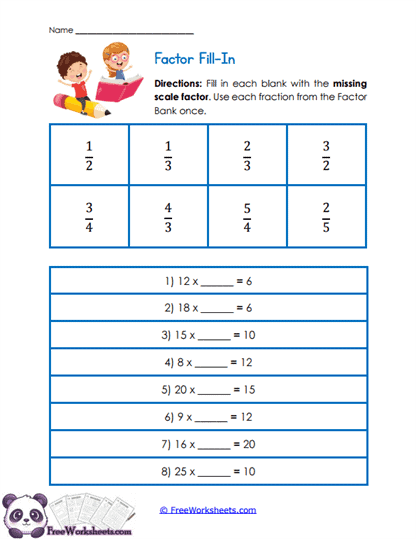
Factor Fill
What Kids Do: Students complete eight multiplication equations by selecting the missing fractional scale factor from a fraction bank. They compare each starting number with its product, decide whether the factor must shrink, enlarge, or preserve the value, and use each choice exactly once.
Target Skill: The worksheet strengthens reverse reasoning with multiplication as scaling. 5th grade students practice inferring whether an unknown factor is less than, equal to, or greater than 1 and connect product size with the fractional multiplier needed to make an equation true.
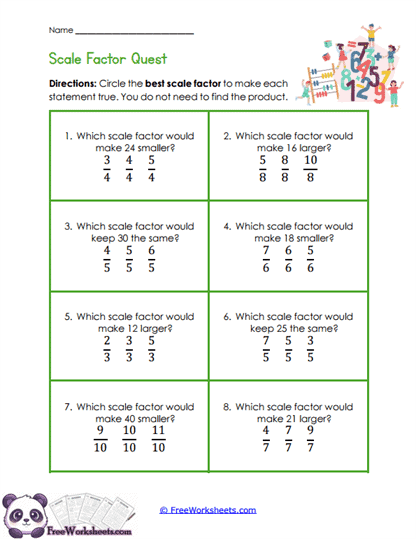
Factor Quest
What Kids Do: Students read eight prompts asking for a scale factor that will make a given number larger, smaller, or unchanged. They compare three fraction choices in each problem and select the one whose value relative to 1 produces the requested effect.
Target Skill: This activity develops scale-factor selection without requiring full computation. 5th grade students practice recognizing proper fractions, improper fractions, and fractions equal to 1 and connect each type with shrinking, enlarging, or preserving a positive starting quantity.
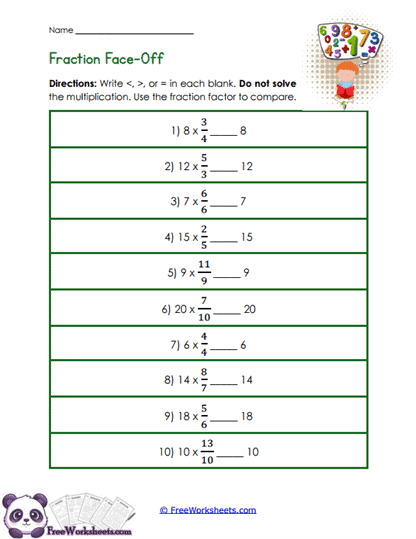
Fraction Faceoff
What Kids Do: Students compare ten fraction multiplication expressions with their original whole numbers and write <, >, or = without solving the products. They focus on whether each fractional multiplier is below, equal to, or above 1 before choosing the comparison symbol.
Target Skill: The worksheet strengthens conceptual product comparison and scaling fluency. 5th grade students learn to determine the direction of change from the scale factor alone and reinforce that multiplication by a fraction does not always make a positive number larger.
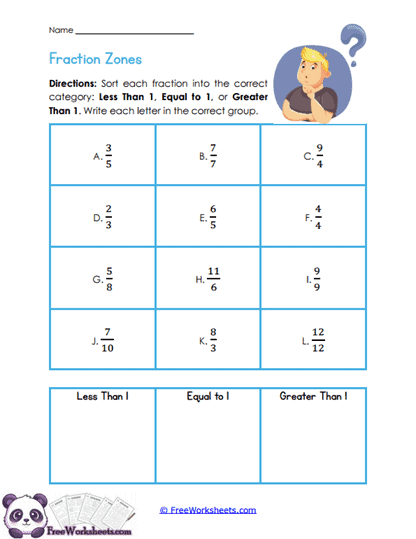
Fraction Sorting
What Kids Do: Students examine twelve fractions and sort their corresponding letters into categories for less than 1, equal to 1, or greater than 1. They compare numerators and denominators directly rather than converting the fractions to decimal form.
Target Skill: This activity builds the fraction-comparison foundation needed for multiplication as scaling. 5th grade students practice recognizing how fraction structure determines value and prepare to predict whether a multiplier will shrink, preserve, or enlarge another quantity.
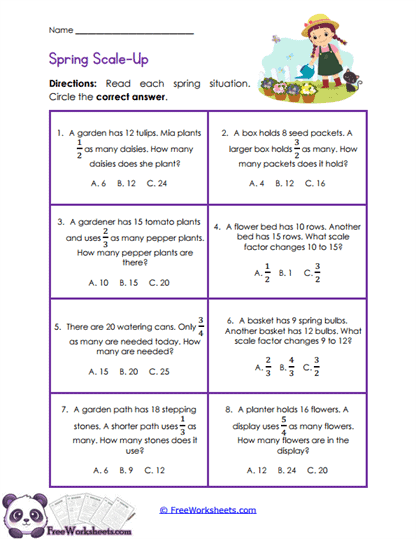
Garden Scaling
What Kids Do: Students solve eight garden-themed multiple-choice word problems involving flowers, seeds, plants, watering cans, bulbs, stepping stones, and planters. They identify a starting amount and fractional relationship, determine the scaled quantity, and select the answer that fits the situation.
Target Skill: The worksheet develops real-world interpretation of fractional scaling. 5th grade students practice translating phrases such as “as many” and “as much” into multiplication and use product-size reasoning to determine whether an answer should be larger or smaller than the original quantity.
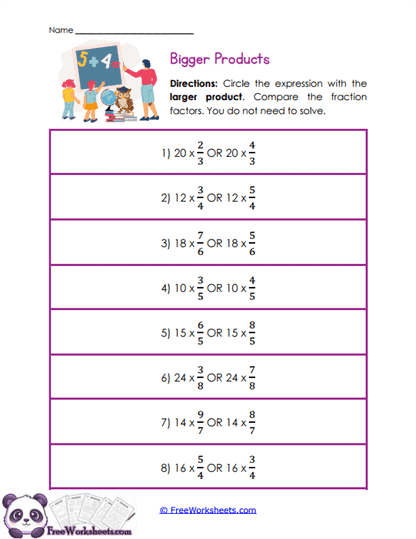
Product Choice
What Kids Do: Students compare eight pairs of multiplication expressions that share the same whole-number factor but use different fractional scale factors. They compare the fractions and circle the expression that will produce the larger product without calculating either value exactly.
Target Skill: This activity strengthens comparative scaling and fraction magnitude reasoning. 5th grade students recognize that when the positive whole-number factor is the same, the larger fractional multiplier produces the larger product, allowing efficient comparison without unnecessary computation.
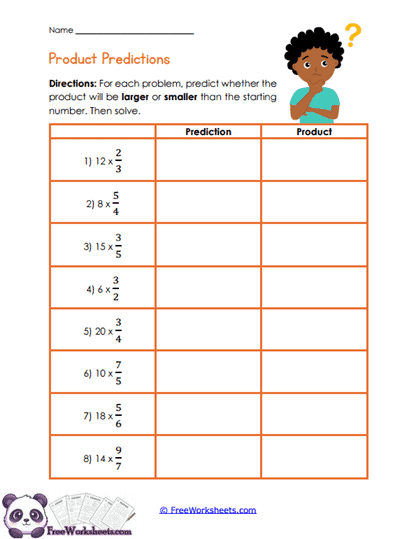
Product Predictions
What Kids Do: Students examine eight whole-number-by-fraction multiplication expressions and predict whether each product will be larger or smaller than the starting number. They then calculate the exact product and compare the result with their prediction.
Target Skill: The worksheet connects estimation, fraction comparison, and exact computation. 5th grade students develop the habit of anticipating product magnitude before multiplying and use the fraction’s relationship to 1 as a reliable way to check whether their final answer makes sense.
Product Scale
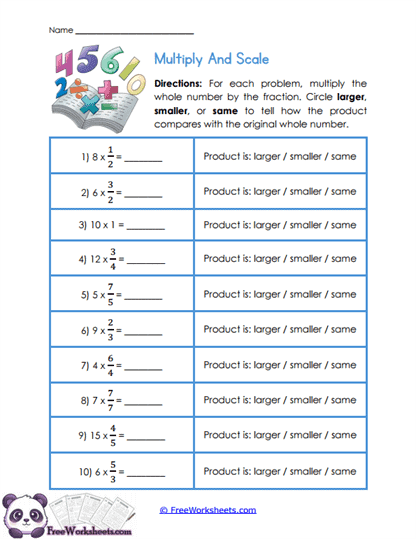
What Kids Do: Students solve ten fraction multiplication problems involving whole numbers and scale factors that are less than, equal to, or greater than 1. After finding each product, they classify it as larger than, smaller than, or the same as the original number.
Target Skill: This activity directly develops multiplication-as-scaling understanding. 5th grade students connect exact products with the size of their fractional multipliers and reinforce the rule that factors below 1 shrink positive quantities while factors above 1 enlarge them.
Scale Match
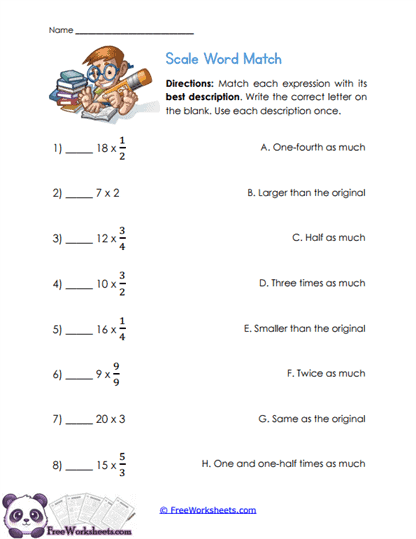
What Kids Do: Students match eight fraction multiplication expressions with verbal descriptions such as half as much, twice as much, the same amount, larger than the original, or smaller than the original. Each description is used once, so students must interpret the multiplier carefully.
Target Skill: The worksheet strengthens mathematical language for scaling relationships. 5th grade students connect fractional multipliers with phrases that describe size changes and develop vocabulary that supports clearer interpretation of fraction word problems and comparisons.
Scale Table
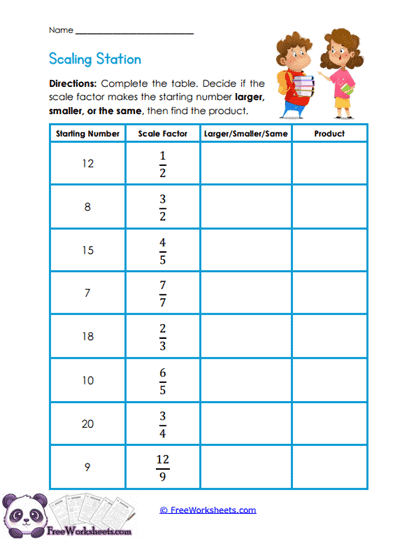
What Kids Do: Students work through eight table rows containing a starting number and a fractional scale factor. They first predict whether the product will be larger, smaller, or unchanged, then multiply to find the exact value and record both parts of their reasoning.
Target Skill: This activity combines conceptual scaling with calculation in an organized format. 5th grade students repeatedly connect fraction size with expected product magnitude and verify their predictions through accurate whole-number-by-fraction multiplication.
Scaling Check
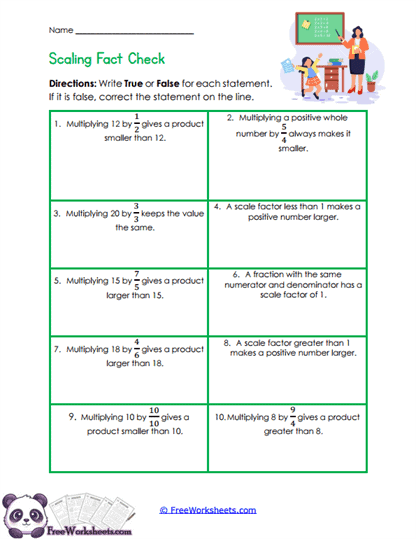
What Kids Do: Students evaluate ten statements about fractional scaling as true or false and correct any statements that are inaccurate. The claims address factors less than 1, equal to 1, and greater than 1 and ask students to reason about how each affects a positive number.
Target Skill: The worksheet develops mathematical verification and explanation. 5th grade students practice judging general scaling claims, correcting misconceptions about multiplication, and using the relationship between a fraction and 1 to justify whether a product grows, shrinks, or remains unchanged.