
Multiply Fractions Worksheets
5th grade math multiply fractions worksheets help students find fractional products, scale quantities, model overlap, and apply multiplication in measurement situations. Free, ready-to-print worksheets in PDF format are designed for immediate classroom use, centers, guided practice, homework, or homeschool lessons. Students strengthen fraction sense, product reasoning, and simplification while developing skills that support curriculum expectations.
About This Collection of Worksheets
Multiplying fractions in 5th grade helps students understand that multiplication can represent finding a part of another amount, not just making a number larger. Students use area models, sets, benchmarks, and real-world contexts to see how fractional quantities combine and scale. This conceptual foundation makes the numerical rule for multiplying numerators and denominators more meaningful.
The collection includes overlapping models, fraction-of-a-set problems, direct fraction products, whole-number and fraction multiplication, model matching, scaling word problems, product comparisons, benchmark estimation, fractional area, error analysis, recipes, and measurement applications. Some worksheets emphasize visual understanding, while others require students to calculate, simplify, estimate, or interpret the meaning of a product.
Teachers can use these worksheets for whole-class instruction, guided math, centers, homework, intervention, review, or enrichment. Parents, tutors, and homeschool educators can begin with models and set problems before moving into symbolic multiplication, estimation, area, and applied measurement. Because the collection combines conceptual and procedural practice, it helps students build both confidence and accuracy with fraction multiplication.

Paul’s Teacher Tip
Before students multiply, ask whether the product should be smaller than, equal to, or greater than the starting quantity. This is especially helpful when multiplying by a fraction less than 1 because it challenges the idea that multiplication always makes numbers larger. With visual models, have students identify the overlapping region before writing the numerical product. Encourage simplification after every exact product and teach cross-canceling once students are comfortable with the basic process. In measurement problems, always have students label the final answer carefully, especially when area requires square units.
Worksheet Collection Skill Spotlights
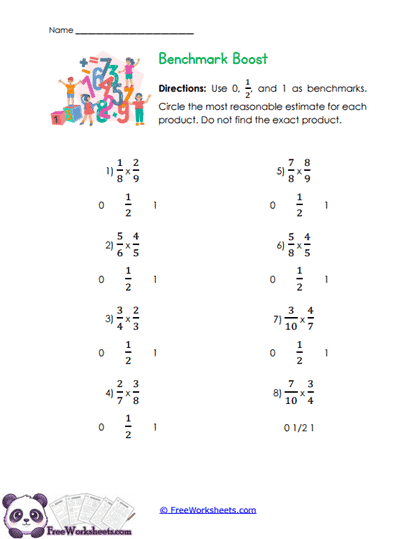
Benchmark Sense
What Kids Do: Students estimate eight fraction products without calculating exact answers. For each pair of fractions, they decide whether the product is closest to 0, 1/2, or 1 by thinking about the size of both factors and how multiplication changes the quantity.
Target Skill: This activity develops benchmark estimation and fraction magnitude reasoning. 5th grade students practice predicting product size, recognizing when two small fractions create an even smaller result, and using 0, 1/2, and 1 as efficient reference points.
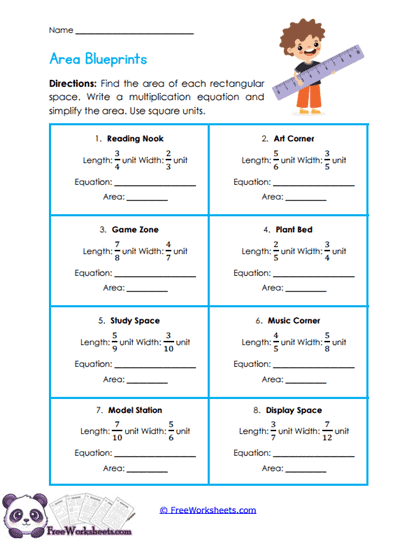
Fraction Areas
What Kids Do: Students solve eight geometry problems involving rectangles with fractional side lengths. They write a multiplication equation for length times width, calculate the product, simplify the fraction, and record each result using square units.
Target Skill: The worksheet connects fraction multiplication with the area formula for rectangles. 5th grade students practice multiplying fractional measurements accurately, simplifying products, and understanding why two-dimensional measurements require square-unit notation.
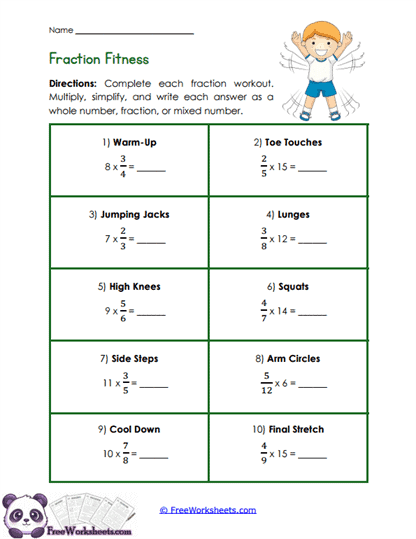
Fraction Workout
What Kids Do: Students solve ten fitness-themed problems that multiply whole numbers by fractions. They rewrite whole numbers over 1 when helpful, multiply, simplify the product, and express each result as a whole number, fraction, or mixed number when appropriate.
Target Skill: This activity strengthens fraction-by-whole-number multiplication and form conversion. 5th grade students practice applying the same multiplication structure to mixed number types and interpreting whether a fractional multiplier should increase or decrease the original value.
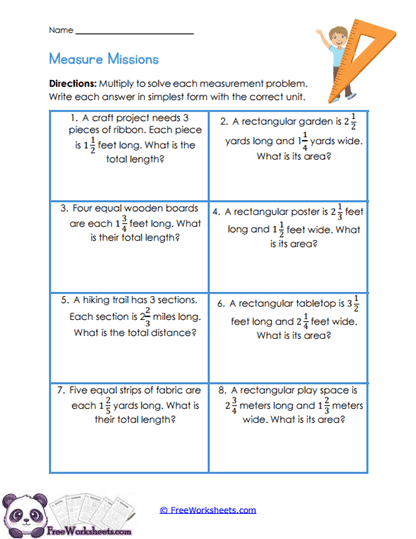
Measurement Products
What Kids Do: Students solve eight measurement problems involving repeated fractional lengths, rectangular dimensions, boards, trails, fabric, and play spaces. They write multiplication equations, simplify the results, and label final answers with appropriate linear or square units.
Target Skill: The worksheet develops applied fraction multiplication in measurement and geometry. 5th grade students practice distinguishing repeated length from area, converting mixed numbers when necessary, and connecting numerical products with the units represented in each situation.
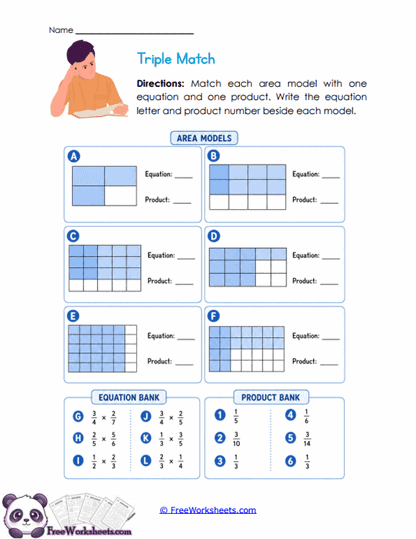
Model Match
What Kids Do: Students study six area models with overlapping fractional shading and match each picture with the correct multiplication equation and product from two answer banks. They identify both shaded fractions and count the overlapping portion before selecting their matches.
Target Skill: This activity strengthens translation between visual models, symbolic equations, and numerical products. 5th grade students learn to interpret overlapping area as a fraction of a fraction and verify that the model, equation, and final product all represent the same relationship.
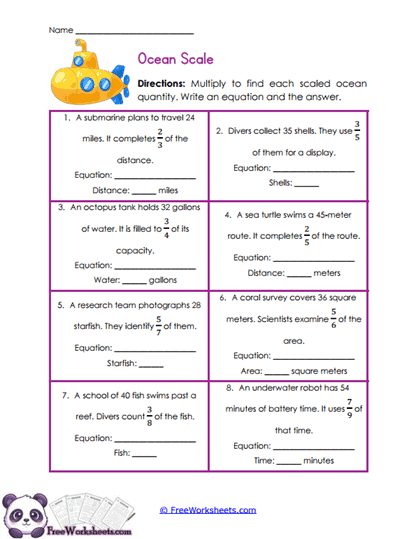
Ocean Scaling
What Kids Do: Students solve eight ocean-themed word problems by finding a fraction of whole-number quantities such as miles, shells, gallons, meters, starfish, square meters, fish, and minutes. They write a multiplication equation and calculate the scaled amount.
Target Skill: The worksheet develops fraction scaling in real-world contexts. 5th grade students practice interpreting “of” as multiplication, finding fractional parts of quantities, preserving units, and checking whether a product less than the original amount is reasonable.
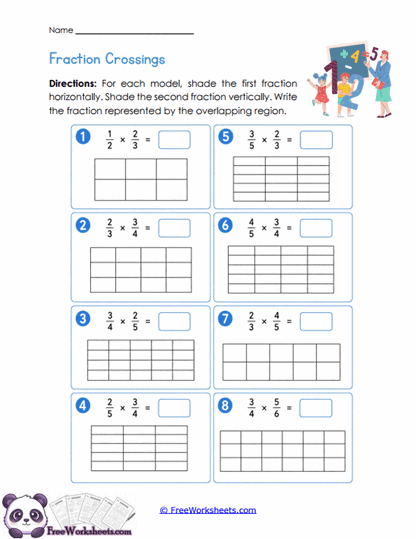
Overlap Models
What Kids Do: Students complete eight visual fraction multiplication models by shading one fraction horizontally and another vertically on rectangular grids. They identify the double-shaded overlap and write the product represented by the shared region.
Target Skill: This activity builds a conceptual foundation for multiplying two fractions. 5th grade students see why numerator-by-numerator and denominator-by-denominator multiplication works by connecting the symbolic rule with the number of overlapping parts in the whole grid.
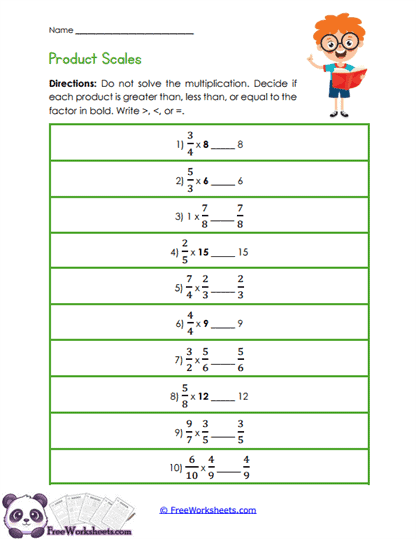
Product Compare
What Kids Do: Students analyze ten multiplication expressions and decide whether each product is greater than, less than, or equal to a highlighted factor. They make the comparison without solving the exact multiplication and record <, >, or =.
Target Skill: The worksheet strengthens scaling and product-magnitude reasoning. 5th grade students practice recognizing how multiplying by a fraction less than 1 changes a value and develop a more accurate understanding that multiplication does not always produce a larger number.
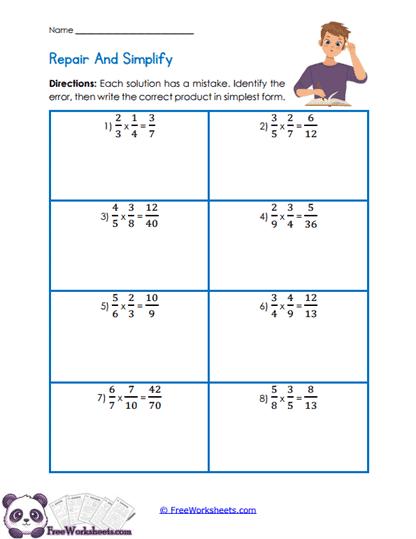
Product Repair
What Kids Do: Students inspect eight incorrect fraction multiplication solutions, determine where each mistake occurred, and write the correct simplified product. They check numerator multiplication, denominator multiplication, and simplification instead of replacing the answer without explanation.
Target Skill: This activity develops error analysis and self-checking with fraction products. 5th grade students learn to isolate multiplication mistakes from simplification errors and reinforce the correct sequence for solving and reducing a product.
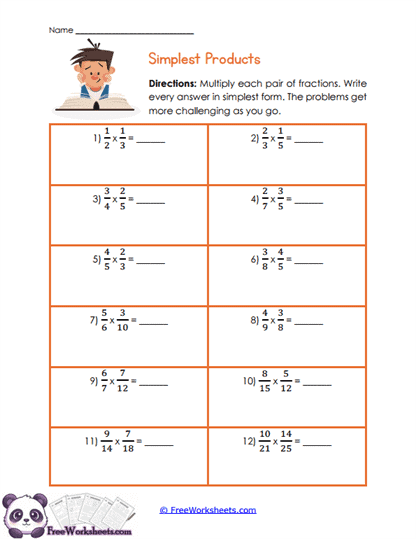
Product Simplify
What Kids Do: Students solve twelve direct fraction multiplication problems of increasing difficulty. They multiply the numerators, multiply the denominators, and then reduce every final product to simplest form using common factors.
Target Skill: The worksheet builds procedural fluency with fraction-by-fraction multiplication and simplification. 5th grade students practice accurate product calculation, factor recognition, and the habit of checking whether numerator and denominator share a common factor before finishing.
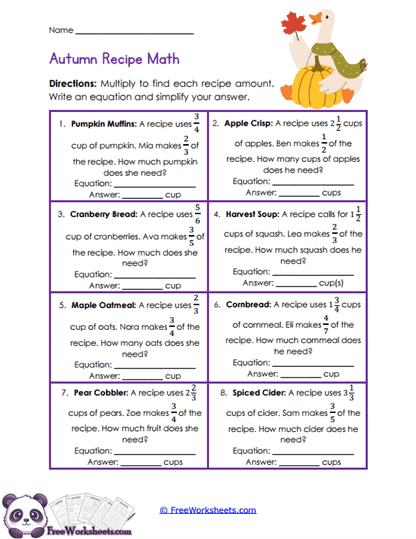
Recipe Portions
What Kids Do: Students solve eight fall-themed recipe problems involving fractional or mixed-number ingredient amounts. They write multiplication equations, convert mixed numbers when necessary, calculate a fraction of each ingredient quantity, simplify the product, and label the result in cups.
Target Skill: This activity develops fraction multiplication in realistic measurement situations. 5th grade students practice interpreting “of” as multiplication, working with mixed numbers, simplifying final quantities, and reasoning about why a fractional portion is usually smaller than the starting amount.
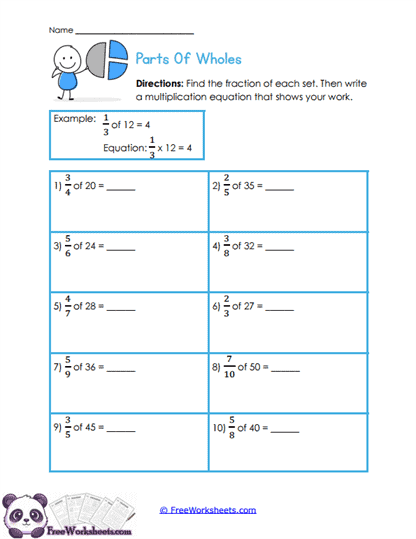
Set Portions
What Kids Do: Students solve ten problems that ask for a fractional part of a whole-number set, such as 3/4 of 20 or 2/5 of 35. They divide the set according to the denominator, take the number of groups indicated by the numerator, and write a multiplication equation.
Target Skill: The worksheet strengthens fraction-of-a-set reasoning and the connection between multiplication and division. 5th grade students learn how denominators determine equal groups, numerators select the desired groups, and the word “of” connects these ideas to multiplication.