
About This Worksheet
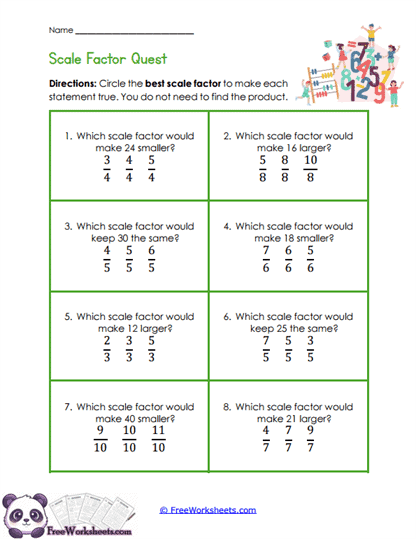
This worksheet helps students choose a fractional scale factor that will make a starting number larger, smaller, or stay the same. Students do not need to multiply each expression, so the real focus is understanding what the fraction itself will do to the number. For example, a scale factor greater than 1 makes a positive number larger, while a scale factor less than 1 makes it smaller. This gives students strong practice with the meaning of scaling before they move into more involved fraction problems.
Curriculum and Grade Alignment
This activity is designed for fifth-grade math and supports CCSS.MATH.CONTENT.5.NF.B.5, which focuses on interpreting multiplication as scaling. Students should already know how to compare a fraction with 1 and recognize when a fraction is less than, equal to, or greater than 1. The next step is using the same reasoning in word problems and multi-step fraction multiplication tasks. This worksheet helps students become more confident choosing scale factors based on the effect they need.
Student Tasks
On this worksheet, students will read eight statements about making a number larger, smaller, or the same. For each one, they choose the best fraction from three possible scale factors. Some choices are less than 1, some equal 1, and some greater than 1. Students must focus on the value of the fraction and connect it to the requested change in the starting number.
Common Challenges
Some students may choose the fraction with the largest numerator instead of comparing the whole fraction to 1. Others may forget that a fraction such as 5/5 keeps a number exactly the same. Improper fractions can also be confusing if students are not comfortable recognizing them as values greater than 1. Teachers can help by having students first label each choice as less than 1, equal to 1, or greater than 1.
Teaching Tips
This worksheet works well after students have learned the basic rule for scale factors. A teacher can complete the first problem aloud and show how to eliminate choices that do not create the requested change. At home, parents can ask, “Do we want the number to grow, shrink, or stay the same?” before the child picks a fraction. That simple question helps keep the reasoning clear and focused.
Worksheet Features
The page includes eight boxed problems with three fraction choices in each one. The questions mix larger, smaller, and same-value situations so students must pay attention to the wording. No full multiplication is required, which keeps the activity centered on conceptual understanding. The worksheet is useful for review, small-group practice, homework, or a quick scaling check.