
About This Worksheet
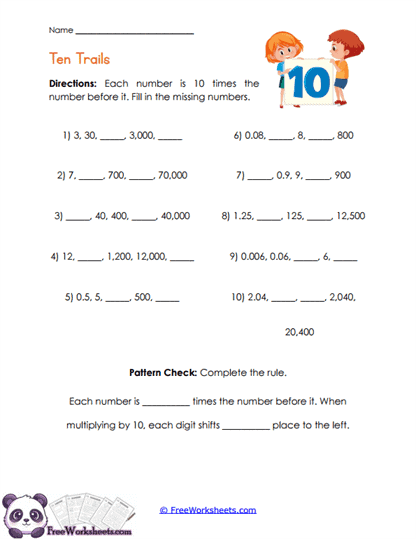
This worksheet teaches students to recognize number patterns created by repeatedly multiplying by 10. Each row begins a sequence, and students use the numbers already provided to figure out what comes next or what is missing. For example, 3 becomes 30, then 300, then 3,000 as each value becomes ten times the one before it. The activity helps children connect powers of ten with place value instead of treating multiplication by 10 as an isolated trick.
Curriculum and Grade Alignment
This activity is designed for fifth-grade math and reinforces CCSS.MATH.CONTENT.5.NBT.A.2 through repeated powers-of-ten patterns. Students should already understand basic place value and multiplication by 10 before tackling the mixed sequences. The worksheet extends that knowledge by including whole numbers and decimals in the same type of pattern. This practice prepares students to reason about powers of ten, decimal movement, and multiplication or division across several place-value positions.
Student Tasks
On this worksheet, students will complete number trails in which every value is 10 times the value immediately before it. Some sequences use whole numbers, while others begin with decimals such as 0.08, 1.25, or 0.006. Students have to work both forward and backward because missing values appear in different positions within each trail. At the bottom, they complete a pattern rule explaining how multiplication by 10 changes a digit’s place value.
Common Challenges
Children may be tempted to simply place another zero at the end of every number, which does not work correctly for many decimal examples. Another common problem is losing track of whether a blank comes before or after one of the given numbers. Students may also move digits several places when the rule only calls for multiplying by 10 once at each step. Have your child read each trail one step at a time and ask, “What number is ten times this number?” before filling the next blank.
Teaching Tips
This page works especially well after students have practiced individual multiplication-by-10 problems and are ready to notice a repeated pattern. In a classroom, teachers can model one trail and have students explain what changed from number to number before beginning independent work. Parents can turn the activity into a simple oral game by choosing a starting number and asking the child to keep multiplying it by 10. For extra practice, reverse the game and have the child work backward by dividing each number by 10.
Worksheet Features
The worksheet contains ten number trails with missing values placed at different points in each sequence. Whole-number and decimal examples are mixed throughout the page, which gives students broader place-value practice. The predictable rule keeps the math focused while the different starting values make students apply the idea rather than memorize one sequence. A final pattern check asks students to state how many times larger each number becomes and how far a digit shifts.