
About This Worksheet
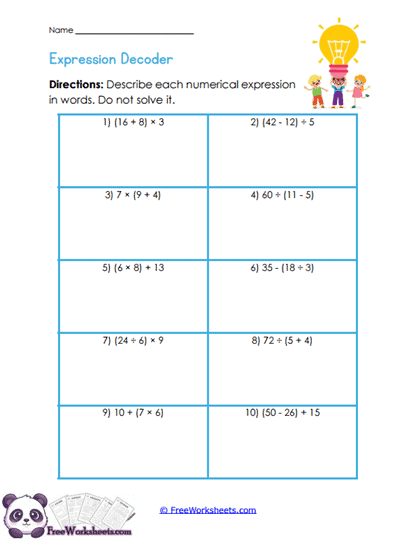
Math Translator reverses the usual expression-writing task by asking fifth grade students to describe numerical expressions in words. Each problem provides an expression containing addition, subtraction, multiplication, division, or parentheses. Students study its structure and write a clear verbal description of what the expression tells them to do. This helps children understand that mathematical symbols communicate a sequence of operations and that grouping symbols can change the meaning of an expression.
Curriculum and Grade Alignment
This worksheet is intended for fifth grade learners who are strengthening their ability to interpret numerical expressions. The main goal is to help students connect symbolic notation with mathematical language. Before beginning, your child should understand the meanings of common operation symbols and grouping symbols. The next step is moving flexibly between written descriptions and numerical expressions and eventually evaluating those expressions correctly. This activity supports mathematical communication, operation vocabulary, grouping symbols, and structural reasoning.
Student Tasks
Students will describe ten numerical expressions in words without solving them. Examples include (16 + 8) × 3, (42 − 12) ÷ 5, 7 × (9 + 4), 60 ÷ (11 − 5), (6 × 8) + 13, and 10 + (7 × 6). Students must explain which calculation happens first and how that result is then combined with the remaining number or operation.
Common Challenges and Misconceptions
Some students may simply read the symbols from left to right without communicating the effect of the parentheses. Others may confuse terms such as sum, product, difference, and quotient or reverse subtraction language. Encourage your child to describe the grouped portion first. For example, (16 + 8) × 3 can be read as “multiply the sum of 16 and 8 by 3,” which clearly preserves the structure.
Implementation Guidance
Teachers can use this worksheet alongside expression-writing lessons to show that students should be able to move in both directions between words and symbols. Parents can ask the child to point to the part that must happen first before describing the whole expression. Encourage more than one correct wording when it communicates the same mathematical structure accurately. This reinforces meaning rather than memorizing one sentence pattern.
Details and Features
This worksheet includes ten blue-bordered numerical expressions arranged in a two-column grid with large writing spaces beneath each one. Students describe rather than calculate, so the emphasis stays on interpretation and mathematical language. The problems include all four operations and several grouped expressions. The printable supports numerical-expression reading, vocabulary, parentheses, and written mathematical communication.