
About This Worksheet
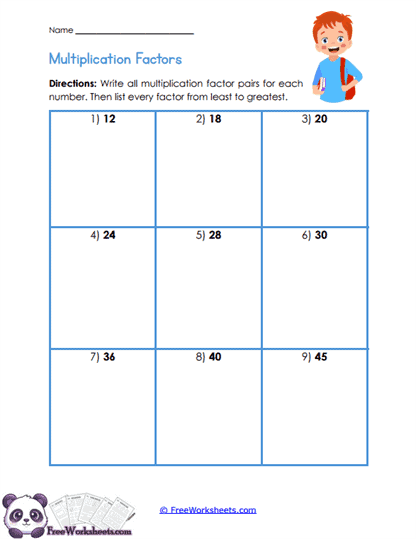
Factor Pairs is a fifth grade activity that asks students to find every multiplication pair that makes a given number. Instead of listing factors randomly, students think about the numbers that multiply together to create each target. For example, 12 can be made with 1 × 12, 2 × 6, and 3 × 4. After finding the pairs, students list every factor from least to greatest. This helps children see factors as connected multiplication relationships rather than isolated numbers.
Curriculum and Grade Alignment
This worksheet is made for fifth grade learners who are strengthening factor knowledge and multiplication reasoning. The main goal is to help students identify all factor pairs of a whole number and then organize the full factor list. Before using this page, your child should know basic multiplication facts and understand that a factor divides a number evenly. The next step is using factor lists to find common factors, greatest common factors, and prime factorization. This activity supports multiplication fluency, divisibility, and number structure.
Student Tasks
Students will work with nine target numbers: 12, 18, 20, 24, 28, 30, 36, 40, and 45. For each number, they write all possible multiplication factor pairs and then list the individual factors from least to greatest. The large work boxes give students room to organize their thinking and check whether any factor pairs were missed.
Common Challenges and Misconceptions
Some students may stop after finding only one or two factor pairs. Others may list repeated factors or forget to include 1 and the number itself. A child may also confuse factors with multiples. Encourage your child to begin with 1 × the number and then test 2, 3, 4, and so on in order. Once the factor pairs begin reversing, they know the list is complete.
Implementation Guidance
Teachers can use this worksheet as direct factor practice before introducing GCF or prime factorization. Parents can ask the child to say each multiplication fact aloud while writing the pair. If a number does not divide evenly, move on to the next possible factor. This helps make the process systematic and prevents skipped factors.
Details and Features
This worksheet includes nine large blue work boxes arranged in a three-by-three grid. Each box gives one target number and enough space for students to record factor pairs and complete factor lists. The printable supports factor identification, multiplication facts, divisibility, and organized number reasoning.