
Grade 5 Vocabulary Worksheets
Choosing a precise word requires understanding its meaning, intensity, and relationship to surrounding language. These grade 5 vocabulary worksheets have students determine unfamiliar meanings from passages about bees, arrange synonyms from mild to strong, and match academic verbs such as analyze and evaluate with their definitions. Other activities involve correcting inappropriate word choices in sentences and paragraphs. The free printable PDFs suit readers expanding their academic and descriptive vocabulary. Ask students to explain which contextual clues support their choices before checking a definition.
About This Collection of Worksheets
A strong vocabulary gives students more ways to understand what they read and express what they mean. Looking at context, word parts, and shades of meaning helps them work through unfamiliar terms and choose words that fit a particular sentence or idea.
The collection includes varied vocabulary tasks: students use prefixes and suffixes to decode words, rank synonyms by intensity, select precise antonyms, interpret words in context, and distinguish multiple-meaning words. Other activities focus on academic verbs, science and social studies terms, correcting words that do not fit, improving a paragraph, and using vocabulary in written responses.
Teachers can use the worksheets for direct instruction, word study, reading centers, writing lessons, homework, or review across subject areas. Parents and tutors can talk through a sentence together, asking which clue reveals a word’s meaning or why one choice is more precise than another. Students can also read their revised sentences aloud to check that a new word sounds natural.
The activities help students move from recognizing a definition to applying it. They use context clues to make meaning, break words into parts, compare related terms, and try vocabulary in original writing. Practicing these skills in different formats builds flexible strategies students can carry into new reading and writing tasks.
Paul’s Teacher Tip
When introducing an unfamiliar word, first ask students to explain what the sentence or passage is saying overall. Then have them look at nearby clues, word parts, or related terms before consulting a definition. For shades of meaning, place synonyms on a mild-to-strong continuum and ask what situation would call for each one. Encourage students to explain why an answer fits, especially when two options seem plausible. To extend practice, invite them to revise a sentence from their own writing with a more precise word.
Worksheet Collection Skill Spotlights
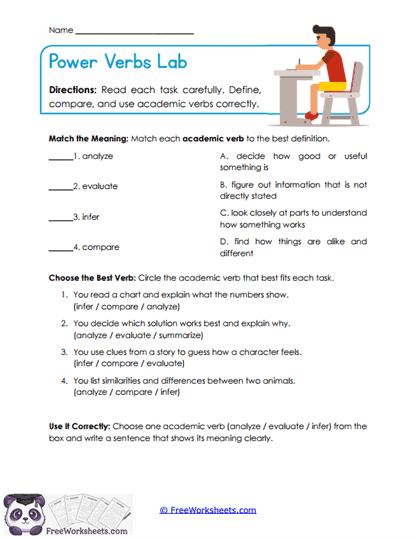
Academic Verb Practice
What Kids Do: Students match analyze, evaluate, infer, and compare to their definitions, then choose the verb that best describes each classroom task. They finish by writing a sentence that shows the meaning of one academic verb.
Target Skill: Understanding task words helps students interpret directions across subjects and respond to them accurately. Distinguishing actions such as examining parts, making a judgment, drawing a conclusion, or noting similarities and differences builds academic vocabulary and independence.
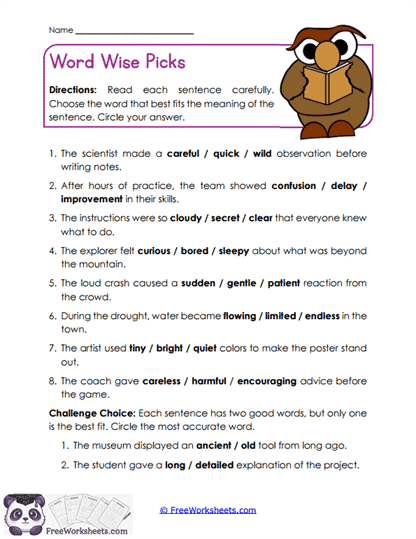
Best Word Fit
What Kids Do: Students read eight sentences and choose the most accurate word from three options, with examples involving observations, instructions, emotions, drought, and advice. Two challenge items ask them to select the more precise choice when both words could work.
Target Skill: Selecting the strongest fit requires students to consider the exact meaning and context of a sentence. Comparing related words builds precision, supports reading comprehension, and helps students make deliberate vocabulary choices in their own writing.
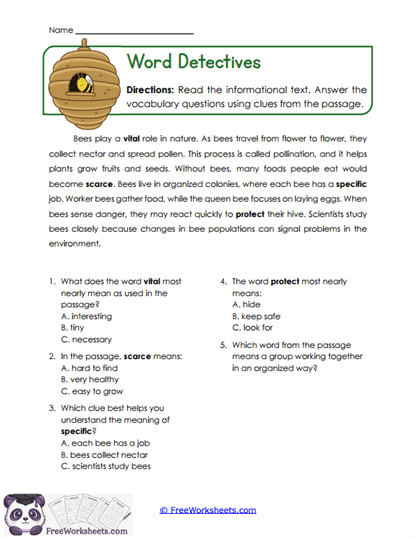
Context Clue Detectives
What Kids Do: Students read an informational passage about bees and their role in nature, then answer vocabulary questions about words such as vital, scarce, specific, and protect. They use details in the passage to determine meanings and identify helpful clues.
Target Skill: Inferring word meaning from definitions, examples, and surrounding details helps students read nonfiction more independently. Explaining which clue led to an answer strengthens comprehension and encourages students to base their interpretations on the text.
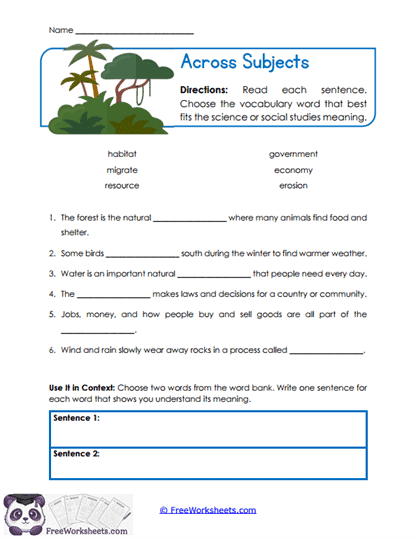
Cross-Subject Vocabulary
What Kids Do: Students use a word bank containing terms such as habitat, migrate, resource, government, economy, and erosion to complete six science and social studies sentences. They then select two words and write original sentences that show their meanings.
Target Skill: Applying academic vocabulary across subject contexts helps students connect terms to the ideas they represent. Using sentence clues and writing original examples supports comprehension, vocabulary retention, and clearer communication in science and social studies.
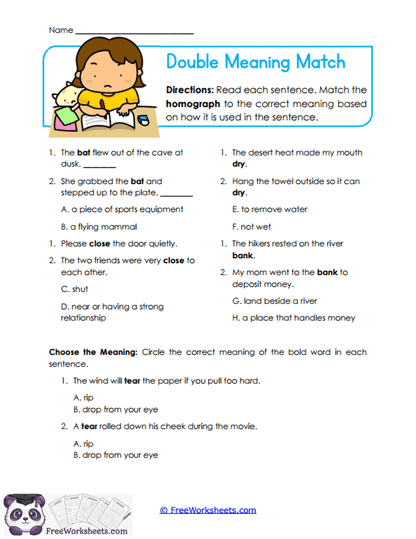
Multiple Meaning Match
What Kids Do: Students compare pairs of sentences that use words such as bat, close, dry, and bank in different ways. They match each use to the correct definition and answer additional questions by checking how the bold word functions in its sentence.
Target Skill: Recognizing that one word can have several meanings helps students avoid relying on a familiar definition when the context points elsewhere. Comparing sentences develops flexible word knowledge and strengthens close reading.
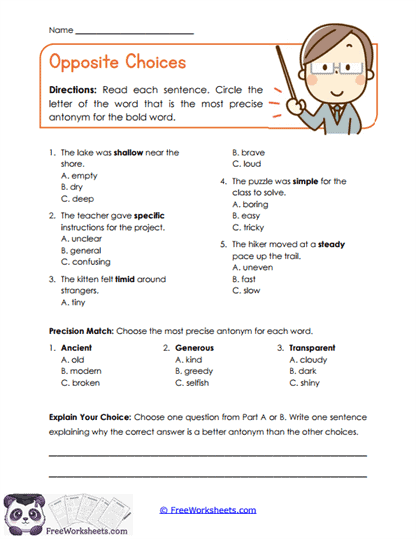
Precise Antonym Choices
What Kids Do: Students read sentences featuring words such as shallow, timid, and steady, then select the most exact antonym from several choices. They also complete a precision match for ancient, generous, and transparent, explaining why one answer is the better fit.
Target Skill: Distinguishing a true opposite from a merely unrelated word develops deeper understanding of word relationships. Considering context and comparing answer choices builds vocabulary precision and gives students practice explaining their reasoning.
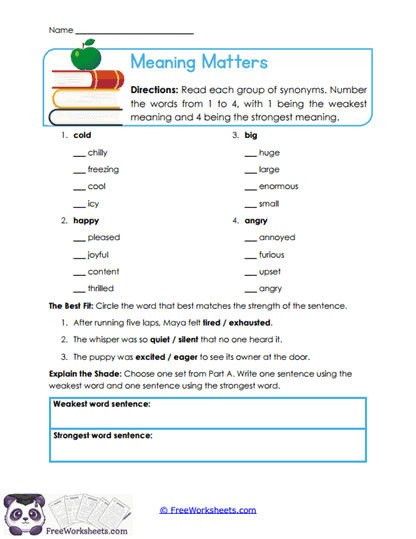
Shades of Meaning
What Kids Do: Students rank four groups of related words from weakest to strongest, including terms for coldness, happiness, size, and anger. They choose words that fit sentence contexts, then write two sentences using the mildest and strongest words from one group.
Target Skill: Comparing intensity among synonyms helps students recognize that related words can carry different levels of meaning. Applying those distinctions in sentences supports descriptive writing, comprehension, and more deliberate word choice.
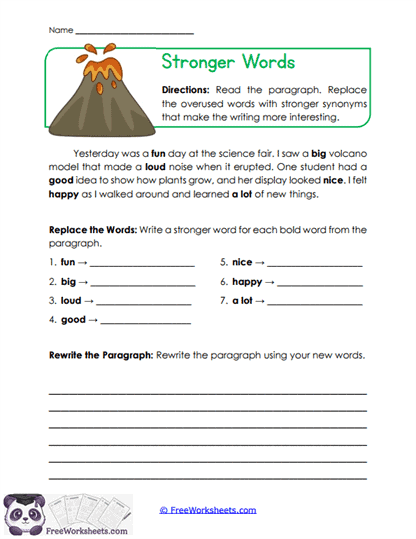
Stronger Word Choices
What Kids Do: Students revise a science-fair paragraph by replacing seven weak or overused words, including fun, big, loud, and a lot, with stronger synonyms. They then rewrite the full paragraph, keeping its basic meaning while making the description more vivid.
Target Skill: Choosing more descriptive synonyms helps students see how vocabulary affects tone, detail, and reader interest. Revising a connected paragraph gives them a chance to check that each replacement is both precise and natural in context.
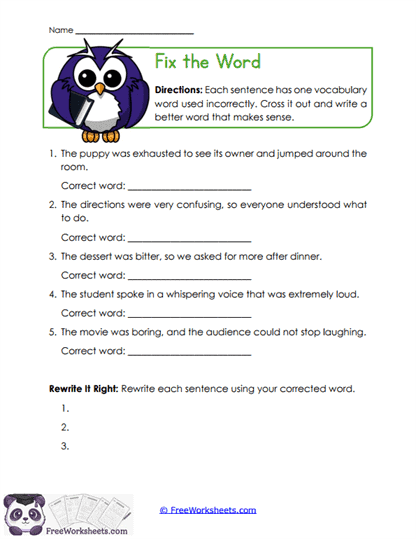
Vocabulary Repair
What Kids Do: Students read five sentences containing a vocabulary word that does not fit the situation. They cross out the mismatched word, write a better choice, and then rewrite three sentences using the improved vocabulary.
Target Skill: Checking whether a word makes sense in a sentence strengthens students’ understanding of meaning and context. Replacing an inaccurate choice and revising the sentence builds vocabulary flexibility and careful editing habits.
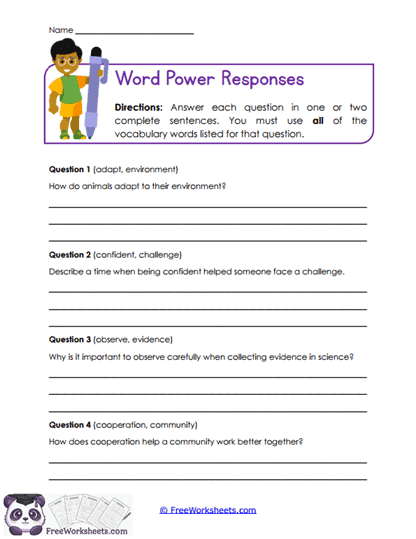
Vocabulary Response Writing
What Kids Do: Students answer four short-response questions in complete sentences, using both required words in each response. Prompts ask about how animals adapt to an environment, how scientists observe and gather evidence, and how cooperation supports a community.
Target Skill: Using paired vocabulary terms in meaningful responses shows whether students understand their meanings and relationships. Writing complete answers develops vocabulary application, sentence construction, comprehension, and evidence-based reasoning.
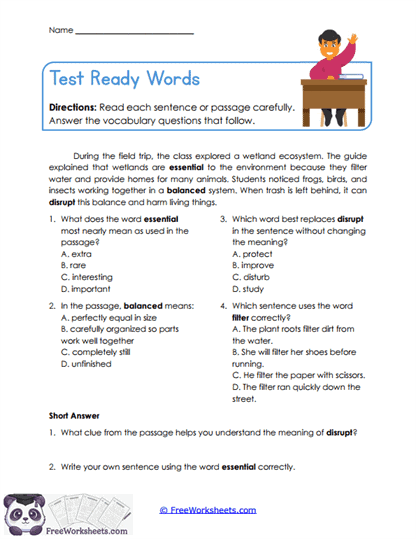
Vocabulary Test Prep
What Kids Do: Students read an informational passage about wetlands and use context to answer questions about essential, balanced, and disrupt. They complete four multiple-choice questions, explain a clue that reveals a word’s meaning, and write an original sentence using essential.
Target Skill: Working with vocabulary inside a full passage helps students practice the kind of meaning-making needed for reading assessments. Choosing synonyms, checking usage, and citing context clues strengthens comprehension and precise word use.
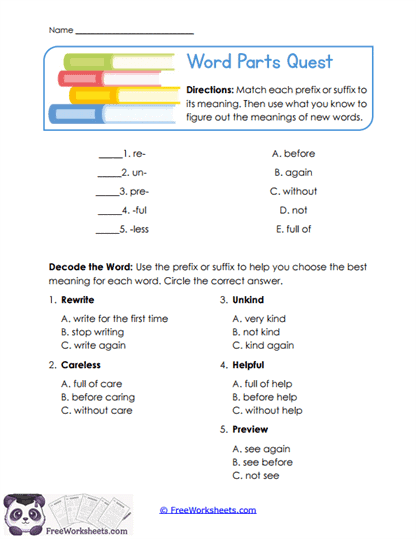
Word Parts Quest
What Kids Do: Students match the affixes re-, un-, pre-, -ful, and -less to their meanings, then use those parts to interpret words such as rewrite, careless, and preview. Multiple-choice questions move from affix recognition to word meaning.
Target Skill: Breaking a word into a base and an affix gives students a strategy for decoding unfamiliar vocabulary. Connecting each word part to meaning supports morphology, reading comprehension, and independent word analysis.