
Grade 5 Language Arts Review Worksheets
Strong language arts skills involve connecting reading comprehension, vocabulary knowledge, grammar, and written expression. These grade 5 language arts review worksheets ask children to examine character decisions in a robotics story, determine unfamiliar words using context clues in archaeology passages, and revise sentences or paragraphs for clarity. Other activities explore figurative language, parts of speech, and opinion writing. The free printable PDFs suit learners reviewing several skills together. Encourage students to explain their revisions and use specific text evidence when supporting interpretations.
About This Collection of Worksheets
Strong readers and writers draw on several skills at once: they interpret details, analyze how ideas are presented, understand unfamiliar words, and communicate their own thinking clearly. This collection gives students varied opportunities to revisit those skills through both informational passages and fiction.
Reading activities cover main idea and supporting details, context clues, Greek and Latin roots, figurative language, point of view, character choices, and theme. Grammar and writing pages invite students to identify parts of speech, combine short sentences, edit a paragraph, and plan an opinion response with supporting reasons.
Teachers can use the worksheets for reading groups, grammar lessons, writing centers, independent review, homework, or cross-curricular connections with science, history, and environmental topics. Parents and tutors can support students by asking them to point to text evidence, explain a revision, or talk through an idea before writing.
The collection supports learning by asking students to use each skill in context, explain their reasoning, and return to the text when they need evidence. Moving between reading, language, and writing tasks gives them practice transferring what they know, while the mix of response formats helps them build confidence and notice which strategies they can use independently.
Paul’s Teacher Tip
Invite students to mark the passage before answering: underline evidence, circle unfamiliar words, or note a character’s important choice. When reviewing responses, ask how a detail supports the answer instead of accepting a correct guess without explanation. For sentence combining and editing, read the revised writing aloud so students can hear whether it is clear and fluent. If a task feels challenging, model one example and think through the decision together before students continue on their own. Extend learning by having students apply the same skill to a book or informational text they are already reading.
Worksheet Collection Skill Spotlights
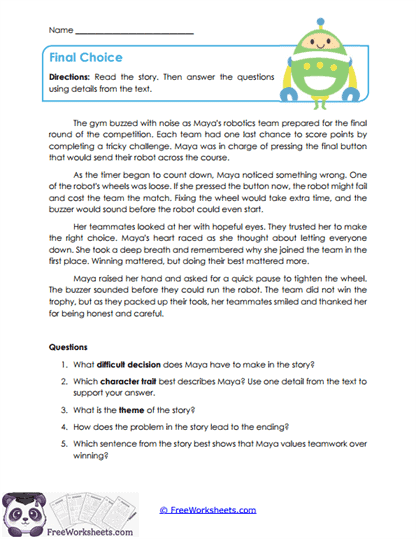
Character Choice Analysis
What Kids Do: Readers follow Maya and her robotics team through a competition problem, then answer five questions about her decision to stop and repair a loose wheel. They describe her trait, explain the conflict and ending, identify the theme, and choose evidence about teamwork.
Target Skill: Analyzing a character’s choices helps students infer traits and connect actions to a story’s larger message. Using details to explain how one decision shapes the ending strengthens evidence-based interpretation and supports deeper literary comprehension.
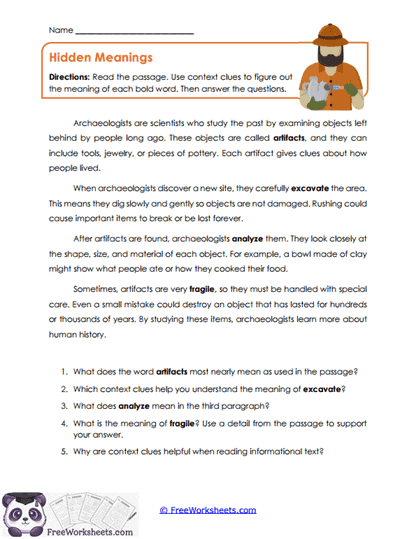
Context Clue Dig
What Kids Do: Students read an informational passage about archaeology and use surrounding sentences to work out the meanings of bold words such as artifacts, excavate, analyze, and fragile. Five questions ask them to explain meanings and identify the clues that helped.
Target Skill: Determining word meaning from context builds vocabulary and helps readers approach unfamiliar academic language independently. Explaining which details reveal a definition strengthens close reading and encourages students to support interpretations with evidence from the passage.
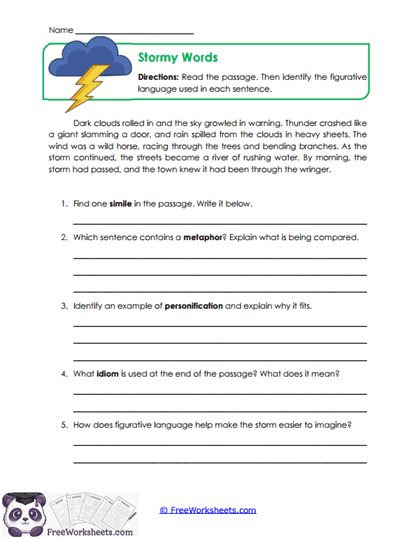
Figurative Language Hunt
What Kids Do: After reading a dramatic passage about a storm, students find examples of simile, metaphor, personification, and idiom. They answer five questions by quoting expressions, explaining comparisons or human qualities, interpreting an idiom, and describing how the language shapes the scene.
Target Skill: Identifying figurative language helps students distinguish literal meaning from an author’s imaginative choices. Explaining the images or feelings created by specific phrases builds literary analysis and helps readers understand how descriptive language affects tone and meaning.
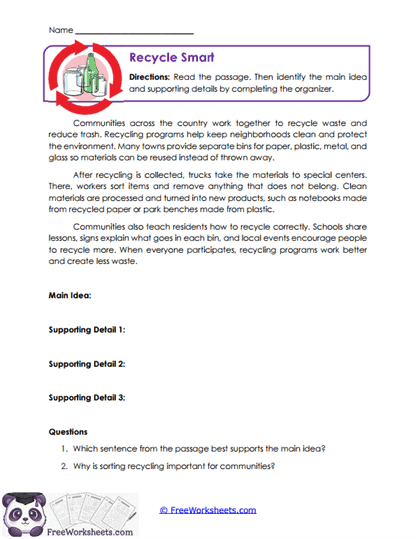
Main Idea Organizer
What Kids Do: Students read an informational passage about how communities collect, sort, process, and reuse recyclable materials. They record the main idea and three supporting details in an organizer, then answer two questions about the strongest evidence and the value of sorting.
Target Skill: Separating a passage’s central point from its supporting facts strengthens nonfiction comprehension. Selecting details that relate directly to the main idea helps students organize information, summarize accurately, and explain how evidence supports a broader claim.
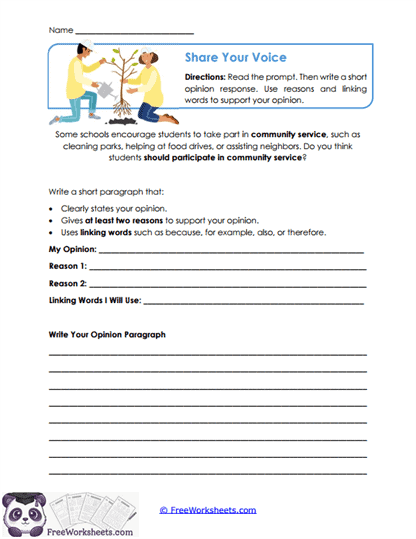
Opinion Writing Plan
What Kids Do: Students respond to a prompt about whether young people should take part in community service, such as park cleanups or food drives. They state an opinion, plan two supporting reasons, select linking words, and use those ideas to write a complete paragraph.
Target Skill: Planning before drafting helps students develop an opinion and support it with relevant reasons. Choosing transitions to connect ideas builds paragraph organization and written reasoning, while the structured process gives students a repeatable approach to opinion writing.
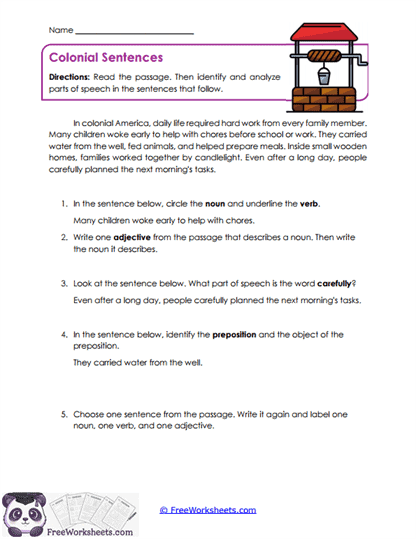
Parts of Speech Search
What Kids Do: Students read a passage about daily life in colonial America and complete five grammar tasks. They find nouns and verbs, identify an adjective and its noun, classify an adverb, locate a preposition and its object, then rewrite a sentence and label selected words.
Target Skill: Identifying parts of speech in connected text helps students see how words function within complete sentences. Distinguishing describing words, actions, and prepositional relationships strengthens grammar knowledge and supports clearer reading and writing.
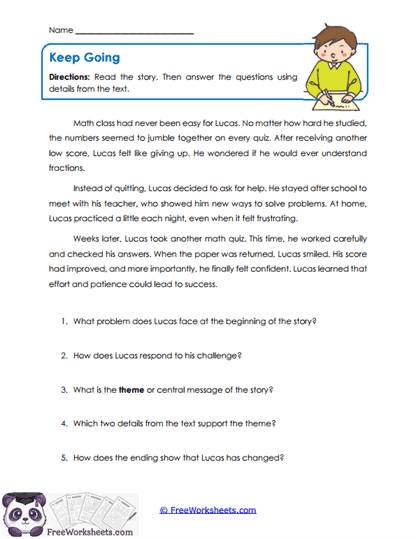
Perseverance Theme Study
What Kids Do: Students read about Lucas, who struggles with math before seeking help and practicing regularly. Five questions guide them to describe his challenge and response, identify the theme, choose two supporting details, and explain how the ending shows character growth.
Target Skill: Moving from a story’s topic to its theme develops students’ ability to identify a message that extends beyond the characters. Citing details about Lucas’s actions and change helps them build evidence-based interpretations of fiction.
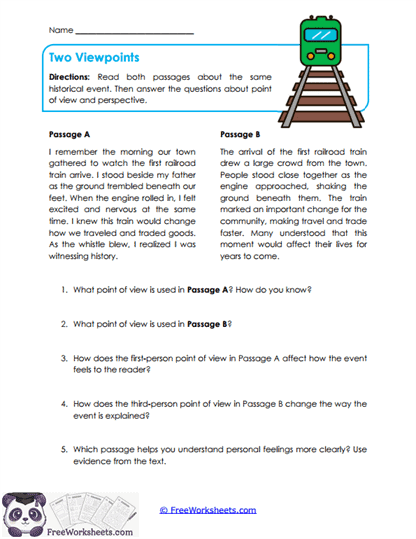
Point of View Compare
What Kids Do: Students read two accounts of the same historical event, the arrival of the first railroad train: one narrated by a person who experienced it and one by an outside narrator. Five questions compare perspective, emotional detail, and what each account helps readers understand.
Target Skill: Comparing first-person and third-person narration helps students recognize how a narrator shapes the information and feeling in a text. Pointing to pronouns and passage details builds perspective analysis and supports thoughtful paired-text reading.
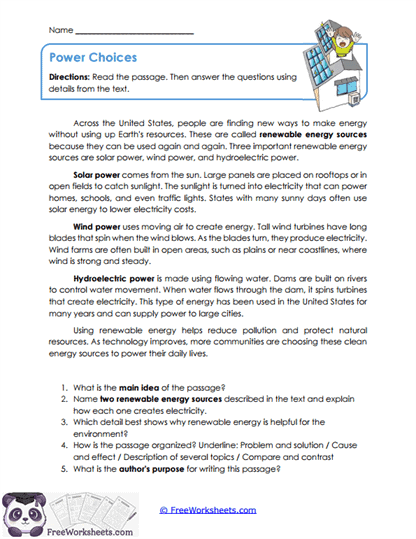
Renewable Energy Reading
What Kids Do: Students read an informational passage explaining how solar panels, wind turbines, and flowing water generate electricity. They answer five questions about the main idea, supporting details, environmental benefits, text structure, and author’s purpose, returning to the passage to support their responses.
Target Skill: Bringing together several comprehension strategies helps students understand how informational texts develop and present ideas. Identifying structure and purpose, then citing evidence, strengthens analytical reading across science, social studies, and language arts.
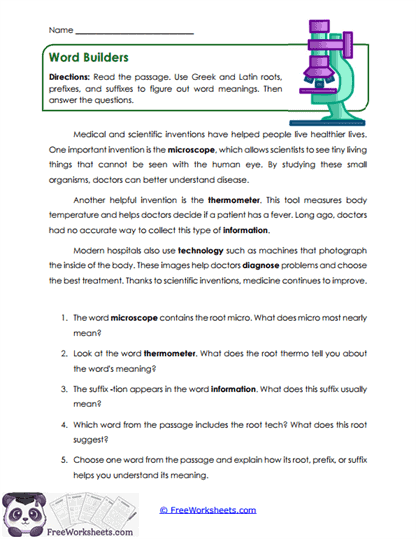
Root Word Lab
What Kids Do: Students read about scientific tools such as microscopes and thermometers, then answer five questions about meaningful word parts. They interpret roots such as micro, thermo, and tech, consider the suffix -tion, and apply a root, prefix, or suffix to another word in the passage.
Target Skill: Breaking words into roots and affixes gives students a practical strategy for understanding unfamiliar vocabulary. Connecting each word part to the whole meaning builds morphology awareness, decoding, and comprehension of academic language.
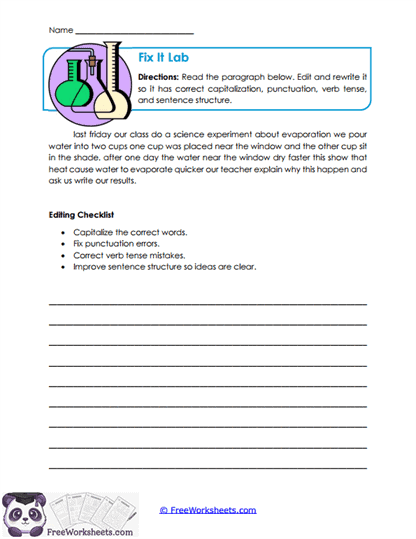
Science Paragraph Repair
What Kids Do: Students revise a science experiment paragraph using an editing checklist. They look for problems with capitalization, punctuation, verb tense, and sentence structure, then rewrite the full paragraph while preserving its meaning and improving its clarity.
Target Skill: Editing a complete paragraph helps students apply grammar and writing conventions together. Checking different kinds of errors and revising awkward sentences builds careful proofreading habits and strengthens the clarity of written communication.
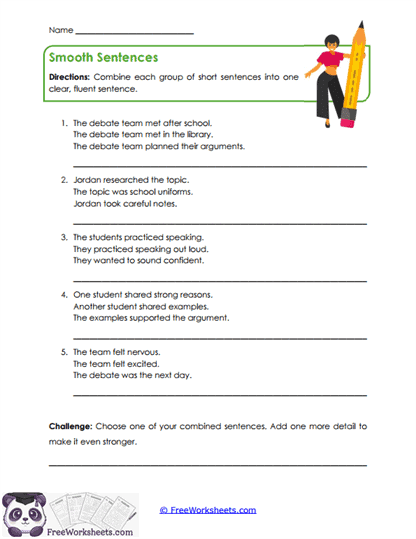
Sentence Combining Practice
What Kids Do: Students read five groups of short sentences about a debate team, research, and practice, then combine each group into one fluent sentence. They preserve important details and finish by adding a new detail to strengthen one of their combined sentences.
Target Skill: Combining related ideas helps students vary sentence structure and improve flow without losing meaning. Choosing how to connect clauses builds sentence fluency and prepares students to write smoother, more developed paragraphs.