
Grade 5 Spelling Worksheets
Understanding why a word is spelled a certain way helps fifth graders handle unfamiliar vocabulary and recognize mistakes in their writing. These grade 5 spelling worksheets explore consonant doubling, silent-e changes, and prefixes and suffixes through word-building exercises, homophone choices, and proofreading passages. Students also distinguish commonly confused words and apply spelling patterns in original sentences. The free printable PDFs support both focused word study and editing practice. Encourage learners to explain the spelling rule or contextual clue behind each correction rather than simply memorizing the answer.
About This Collection of Worksheets
Spelling becomes more reliable when students understand how words are built and why their letters change. Recognizing patterns such as consonant doubling, changing y to i, and dropping a silent e gives students strategies for spelling unfamiliar words instead of relying only on memorization.
The collection includes varied word study and writing tasks. Students identify spelling rules, build words with prefixes and suffixes, match words to definitions, choose between homophones, and distinguish commonly confused words. They also correct errors in sentences and a full passage, write a story using spelling words, and explore how syllable stress can support spelling multisyllabic words.
Teachers can use the pages for focused word study, proofreading lessons, spelling centers, homework, or a mixed skills review. Parents and tutors can ask students to explain the pattern behind a spelling choice or use a word in a sentence that shows its meaning. These discussions help reveal whether a student understands the word or has simply memorized its appearance.
Students get to apply spelling knowledge in increasingly meaningful ways: first noticing patterns, then building and checking words, and finally using them in complete sentences and paragraphs. The range of tasks gives them practice retrieving spellings, checking meaning and context, and editing their own work. That variety helps students strengthen accuracy and carry spelling strategies into everyday reading and writing.
Paul’s Teacher Tip
Ask students to explain what changed between a base word and its new form, such as hop and hopping, instead of asking them to memorize a rule in isolation. When a word looks unfamiliar, have them break it into syllables or meaningful parts and compare it with a related word. For homophones and commonly confused words, students should read the entire sentence and explain which meaning fits. During proofreading, invite them to make one pass for spelling patterns and another for overall accuracy. To extend practice, have students collect examples of a spelling rule from their own reading.
Worksheet Collection Skill Spotlights
Commonly Confused Words
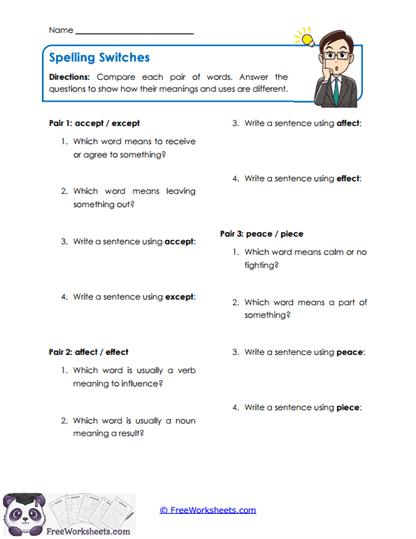
What Kids Do: Students work with pairs such as accept/except, affect/effect, and peace/piece. They answer questions about meaning and usage, decide how each word functions in context, and write sentences that demonstrate the difference between the words.
Target Skill: Understanding the distinction between similar-looking or similar-sounding words supports accurate spelling and clear communication. Applying each meaning in an original sentence helps students connect vocabulary, grammar, and context instead of relying on sound alone.
Correct Spelling Choices
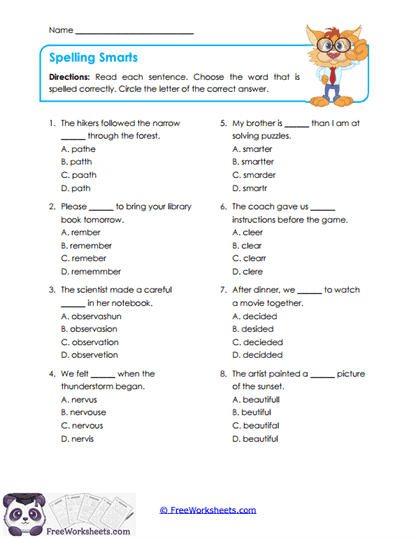
What Kids Do: Students read eight sentences and compare four spelling options for each target word, including remember, observation, and beautiful. They circle the correctly spelled choice, paying attention to small differences in vowels, consonants, syllables, and familiar word patterns.
Target Skill: Comparing similar spellings develops visual attention to letter patterns and helps students make informed choices when a word sounds the same across options. Seeing each word in a sentence also strengthens proofreading and reinforces spelling in context.
Homophone Meaning Choices
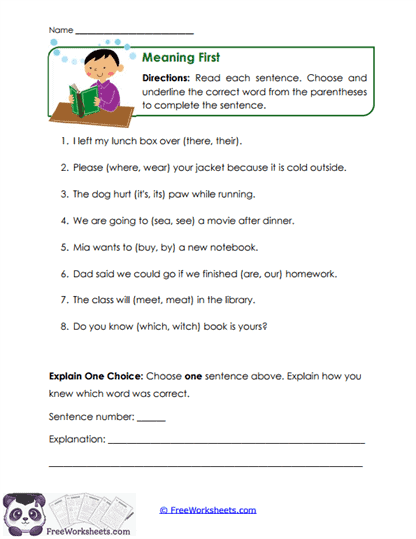
What Kids Do: Students read eight sentences containing pairs such as there/their, where/wear, its/it’s, and sea/see. They choose and underline the word that fits each sentence, then explain how meaning or context helped them decide.
Target Skill: Choosing between homophones requires students to consider both spelling and meaning. Using sentence clues to justify a choice strengthens vocabulary knowledge and helps students proofread words that sound alike but serve different purposes.
Meaning and Spelling Match
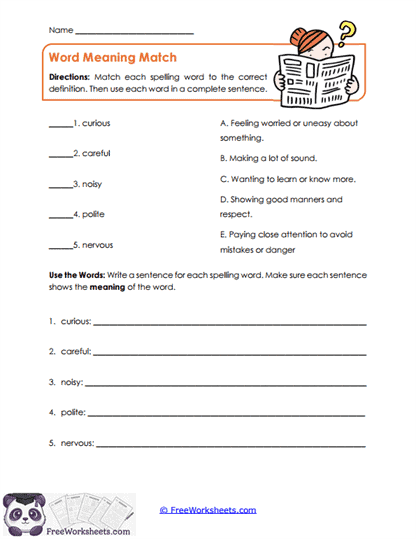
What Kids Do: Students match five spelling words-including curious, careful, noisy, polite, and nervous-with their definitions. Then they write an original sentence for each word, making sure the sentence shows what the word means.
Target Skill: Connecting a word’s spelling to its definition and use gives students a fuller understanding than memorizing the letters alone. Writing meaningful sentences reinforces vocabulary, grammar, and accurate spelling through active use.
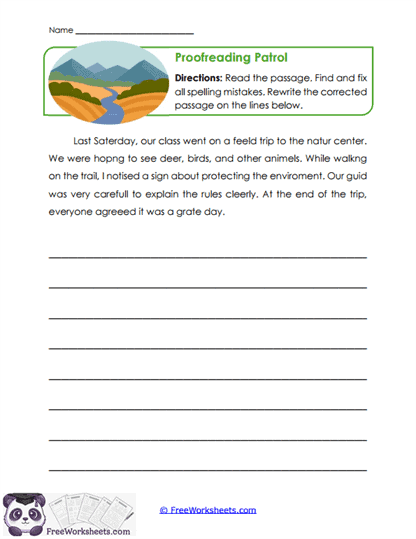
Proofreading Passage Patrol
What Kids Do: Students read a complete paragraph about a class field trip to a nature center, locate the misspelled words, and rewrite the passage with the corrections. They preserve the original meaning while checking the spelling of words within connected writing.
Target Skill: Proofreading a passage helps students notice spelling errors during authentic reading, where meaning and sentence flow also matter. Rewriting the corrected text builds careful editing habits that students can use when revising their own work.
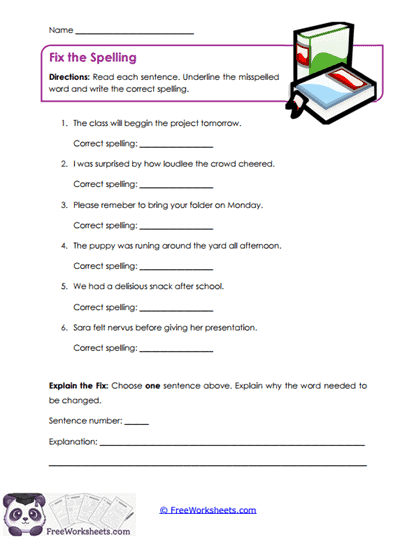
Spelling Error Repair
What Kids Do: Students read six sentences, underline the misspelled word in each one, and write its correct form on a line. After repairing the errors, they select one example and explain why the spelling needed to change.
Target Skill: Finding and correcting words in context strengthens students’ ability to notice errors and apply familiar spelling patterns. Explaining one correction builds awareness of the rule or letter pattern behind the change rather than relying on guesswork.
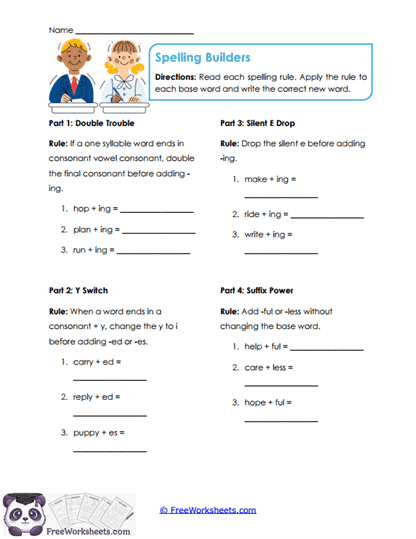
Spelling Rule Builders
What Kids Do: Students apply four rules to base words: doubling a consonant, changing y to i, dropping a silent e, and adding suffixes such as -ful or -less. They build words in four sections and check each completed form.
Target Skill: Making spelling changes while adding endings helps students understand how word structure affects spelling. Comparing several rules in one activity builds flexible word-building skills and prepares students to spell unfamiliar forms more independently.
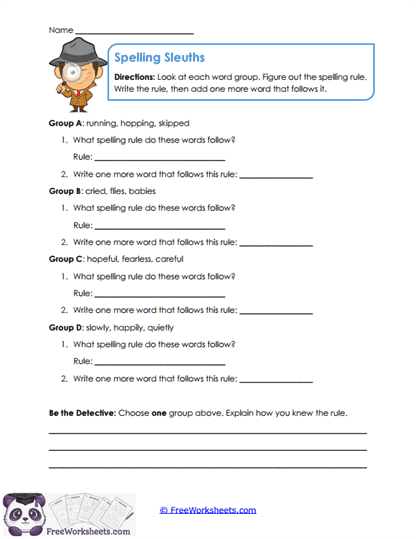
Spelling Rule Detectives
What Kids Do: Students study four groups of related words, including running, cried, hopeful, and quietly. They explain the spelling pattern in each group, add a new word that follows the same rule, and describe how they recognized one of the patterns.
Target Skill: Explaining a pattern and applying it to a new example shows whether students understand a spelling rule beyond memorizing a list. The task develops word analysis and helps students use rules with unfamiliar words.
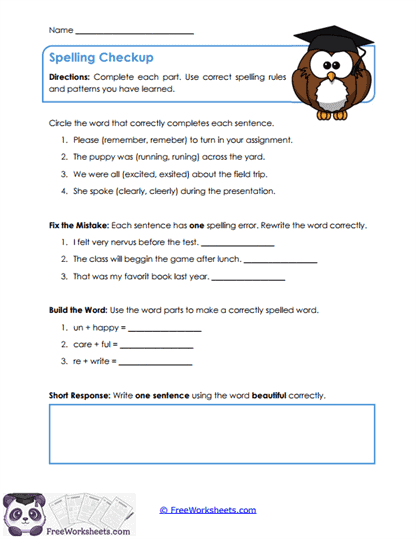
Spelling Skills Check
What Kids Do: Students complete a mixed review with four tasks: choose correct spellings in sentences, repair misspelled words, build words from parts such as un + happy, and write a sentence using beautiful correctly.
Target Skill: Switching among word choice, error correction, word building, and sentence writing helps students retrieve spelling strategies without a rule being named for them. This broad review highlights strengths and areas that may need more practice.
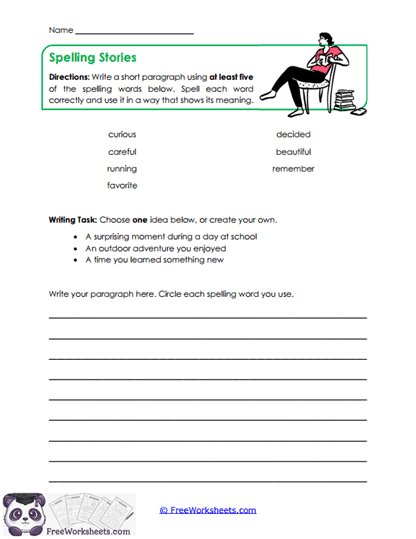
Spelling Story Challenge
What Kids Do: Students choose one of several prompts or create their own topic, then write a short paragraph using at least five words from a spelling bank. They circle each spelling word they include and check that it fits the story naturally.
Target Skill: Using spelling words in original writing helps students connect accurate spelling with meaning, sentence structure, and paragraph development. Planning how the words fit the story encourages natural use rather than inserting vocabulary without context.
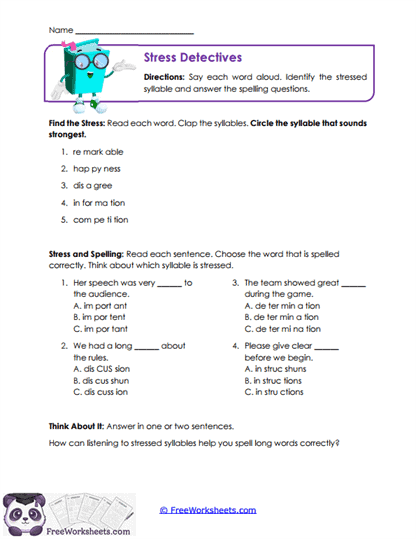
Syllable Stress Search
What Kids Do: Students say multisyllabic words such as remarkable, happiness, and competition aloud, clap the syllables, and circle the stressed one. They then choose correct spellings in four sentences and explain how stress can help with spelling.
Target Skill: Listening for syllables and stress helps students notice the sound structure of longer words. Connecting pronunciation to written forms supports spelling and decoding, while the reflection encourages them to consider how listening strategies can guide word study.
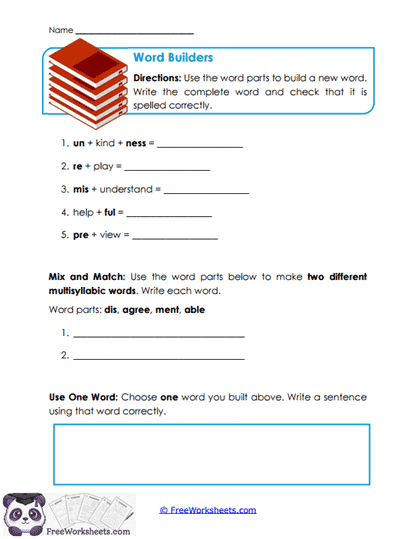
Word Part Builders
What Kids Do: Students combine prefixes, base words, and suffixes to form words such as unkindness, replay, and helpful. They use a word-part bank to create additional multisyllabic words, then choose one of their new words for a sentence.
Target Skill: Building words from meaningful parts strengthens spelling and morphology at the same time. Students see how prefixes and suffixes change a base word’s meaning and practice carrying the correct spelling of each part into a complete word.