
About This Worksheet
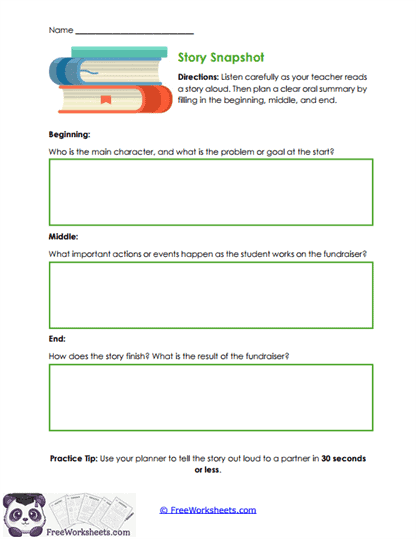
This Grade 5 listening and speaking worksheet helps students listen to a story and organize the most important events into a clear beginning, middle, and end. The teacher reads a story aloud about a student working on a fundraiser, and students use the large boxes on the page to capture the main character, the problem or goal, the important actions, and the final result.
This is useful because students often remember many little details from a story but have trouble deciding which ones matter most. The activity teaches them how to sort what they hear into a simple structure they can use for a short oral summary.
Learning Goals
The main goal is to help students listen for the most important parts of a narrative and summarize them in order.
Students practice identifying the character and goal, tracking the main events, and explaining how the story ends.
They also build speaking fluency by using their notes to retell the story clearly in a short amount of time.
What Students Will Do
Students listen carefully as the teacher reads the story aloud.
In the Beginning box, they write who the main character is and what problem or goal appears at the start.
In the Middle box, they record the important actions or events that happen while the student works on the fundraiser.
In the End box, they explain how the story finishes and what the final result is.
After completing the organizer, students use their notes to tell the story aloud to a partner in 30 seconds or less.
Common Challenges
Some students may try to write every detail they hear instead of choosing only the most important events.
A teacher or parent can ask, “If you could only tell someone three parts of this story, what would they need to know?”
Another challenge is making the summary too long. The 30-second speaking goal helps students practice being brief and focused.
Teaching Suggestions
Before reading, remind students to listen for three things: what starts the story, what important events happen, and how it ends.
Teachers can read the story once for understanding and again for note-taking if needed.
For stronger students, ask them to give the oral summary without looking at the organizer after practicing once.
Worksheet Features
The page includes three large sections labeled Beginning, Middle, and End, followed by a short speaking challenge.
This worksheet works well for narrative listening, summarizing, partner retells, or speaking fluency practice.