
About This Worksheet
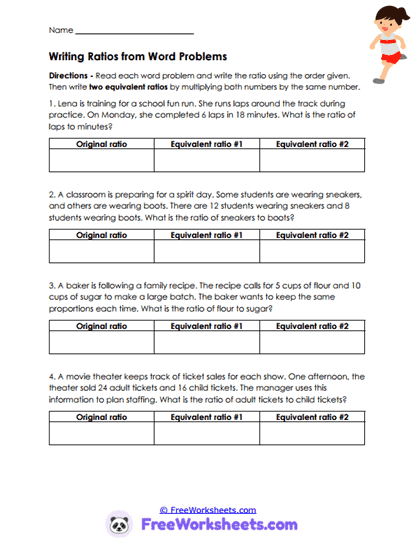
This worksheet helps students understand how numerical relationships can grow or shrink while staying proportional. Learners practice identifying equivalent forms and scaling values correctly. Understanding scaling patterns helps students prepare for proportions, geometry, and algebraic reasoning. For example, students may multiply both quantities by the same number to create a larger but equivalent relationship. This activity strengthens multiplication fluency and proportional thinking.
Curriculum and Grade Alignment
This worksheet focuses on scaling numerical relationships and recognizing equivalent forms. Students should already understand multiplication, division, and equivalent relationships before beginning this activity. The primary learning goal is helping learners recognize how proportional relationships stay balanced when scaled equally. After mastering this skill, students are better prepared for proportions, graphing, and algebraic modeling. The worksheet aligns with Common Core standards 6.RP.A.1 and 6.RP.A.3, along with TEKS 6.4A involving proportional relationships and scaling concepts.
Student Tasks
On this worksheet, students will
multiply and divide related quantities to create equivalent forms. Students identify scaling patterns and apply them consistently across problems. Learners solve numerical and real-world comparison activities involving proportional growth. Several activities encourage students to explain how they know the relationships stay equivalent. Students also practice checking their work by simplifying scaled forms back to the original relationship.
Common Challenges and Misconceptions
Many students scale only one quantity instead of both parts equally. Some learners use different operations on each side of the relationship. Others may reverse the order of the quantities when rewriting scaled forms. Students can also struggle with recognizing when two relationships are already equivalent. Teachers can help by modeling scaling patterns visually before independent work begins.
Implementation Guidance
Teachers may use this worksheet during lessons on proportional reasoning, scaling, or equivalent relationships. The structured practice helps students build confidence with multiplication and proportional thinking. Parents and homeschool educators can complete one scaling example together before assigning independent work. Students often benefit from writing the scaling factor beside each problem. This worksheet also works well for intervention, homework, or enrichment activities.
Details and Features
This printable worksheet includes scaling and equivalence activities involving multiplication, division, and proportional reasoning. The organized layout supports logical thinking and mathematical accuracy. Friendly graphics create an engaging learning environment while maintaining focus on mathematics. Problems are designed to strengthen scaling fluency and algebra readiness. The worksheet prints clearly for classroom instruction, tutoring sessions, or homeschool use.