
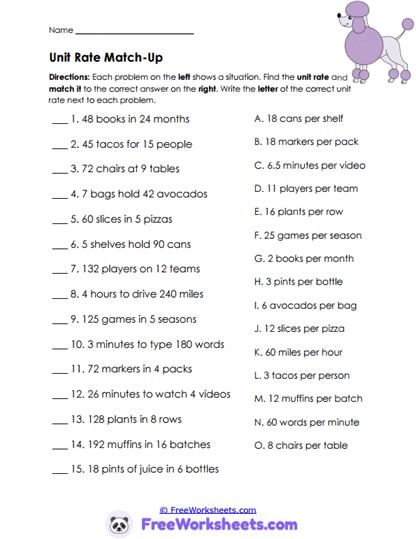
About This Worksheet
This worksheet helps students practice finding unit rates and matching them to real-world situations. Learners calculate rates such as miles per hour, books per month, and slices per pizza by dividing one quantity by another. Unit rates help students compare situations fairly and understand how much happens for one unit. For example, if 90 cans are placed on 5 shelves, students find the unit rate by dividing to get 18 cans per shelf. This activity builds strong problem-solving and proportional reasoning skills.
Curriculum and Grade Alignment
This worksheet focuses on solving and identifying unit rates using real-world examples. Students should already understand division and ratios before beginning this activity. The primary learning goal is helping learners calculate rates per one unit and connect them to meaningful situations. After mastering this skill, students are better prepared for proportional relationships, graphing, and algebraic reasoning. The worksheet aligns with Common Core standard 6.RP.A.2 and TEKS 6.4B involving ratios, rates, and unit rate reasoning.
Student Tasks
On this worksheet, students will
calculate unit rates from real-world situations involving distance, cost, quantity, and time. Students match each calculated unit rate to the correct description. Learners divide quantities carefully to determine rates per one item, person, hour, or group. Several problems encourage students to identify the correct units while solving. Students also practice checking whether answers make sense within the situation provided.
Common Challenges and Misconceptions
Many students forget to divide correctly when finding the rate per one unit. Some learners reverse the quantities and create incorrect units. Others may focus only on the numbers and ignore labels such as miles per hour or dollars per item. Students can also struggle with matching similar answers. Teachers can help by encouraging students to write the units beside every answer.
Implementation Guidance
Teachers may use this worksheet during ratio and rate lessons, math centers, or guided review sessions. The matching format supports both computation practice and reasoning skills. Parents and homeschool educators can complete one example together before assigning independent work. Students often benefit from underlining the “per” relationship in each situation before solving. This worksheet also works well for intervention, homework, or enrichment activities.
Details and Features
This printable worksheet includes matching activities involving unit rates and real-world situations. The organized layout supports clear problem solving and proportional reasoning. Friendly graphics create an engaging learning environment while maintaining focus on mathematics. Problems involve everyday contexts such as driving, shopping, sports, and organizing items. The worksheet prints clearly for classroom instruction, tutoring sessions, or homeschool use.