
About This Worksheet
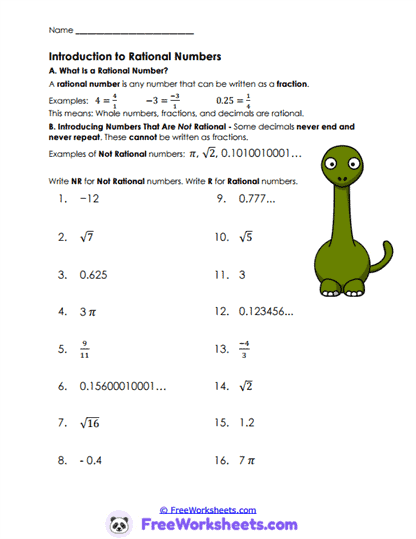
This worksheet introduces students to rational and irrational numbers. Learners discover that rational numbers can be written as fractions, including integers, terminating decimals, and repeating decimals. Irrational numbers cannot be written as exact fractions because their decimals never end or repeat. For example, 0.25 is rational because it equals 1/4, while π is irrational because its decimal never repeats. This activity helps students build a strong foundation for understanding number systems.
Curriculum and Grade Alignment
This worksheet focuses on identifying and classifying rational and irrational numbers. Students should already understand fractions, decimals, and integers before beginning this activity. The main learning goal is helping learners distinguish between rational and irrational values using definitions and decimal patterns. After mastering this skill, students are better prepared for algebraic reasoning and advanced number system concepts. The worksheet aligns with Common Core standard 8.NS.A.1 and TEKS 8.2A involving rational and irrational number classification.
Student Tasks
On this worksheet, students will
read explanations about rational and irrational numbers and examine several examples. Students classify numbers as rational or not rational using definitions and decimal behavior. Learners analyze fractions, repeating decimals, square roots, integers, and irrational constants such as π. Several problems encourage students to think about whether a decimal terminates or repeats. Students also practice recognizing common irrational square roots.
Common Challenges and Misconceptions
Many students think all decimals are rational without checking whether they repeat or terminate. Some learners confuse square roots of perfect squares with irrational roots. Others may incorrectly assume irrational numbers can eventually be written as fractions. Students can also struggle with identifying repeating decimal patterns. Teachers can help by reviewing decimal expansion examples slowly before independent work begins.
Implementation Guidance
Teachers may use this worksheet during number system lessons, guided instruction, or review sessions. The introductory explanations support both direct teaching and independent learning. Parents and homeschool educators can discuss the examples together before assigning practice problems. Students often benefit from creating a chart comparing rational and irrational numbers visually. This worksheet also works well for intervention, homework, or enrichment activities.
Details and Features
This printable worksheet includes explanations, examples, and classification practice involving rational and irrational numbers. The organized layout supports clear mathematical reasoning and concept development. Friendly graphics create an engaging learning environment while maintaining academic focus. Problems gradually strengthen understanding of number classifications and decimal patterns. The worksheet prints clearly for classroom instruction, tutoring sessions, or homeschool use.