
About This Worksheet
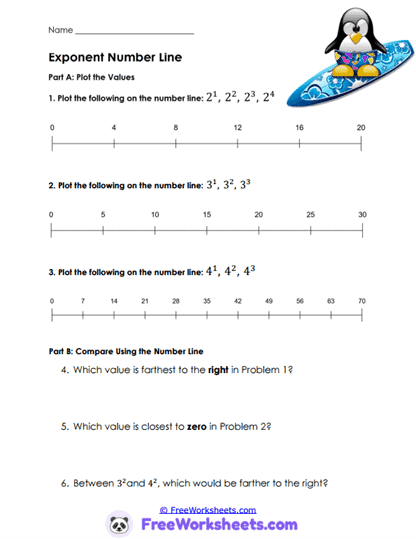
This worksheet helps students place numerical powers on number lines and compare their values visually. Learners evaluate powers and then locate each value in the correct position on a number line. Number lines help students see how repeated multiplication changes the size of numbers. For example, 2¹, 2², and 2³ become 2, 4, and 8, which move farther to the right as the value grows. This activity strengthens number sense, comparison skills, and understanding of powers.
Curriculum and Grade Alignment
This worksheet focuses on evaluating powers and representing numerical values on number lines. Students should already understand repeated multiplication and basic power evaluation before beginning this activity. The learning goal is helping learners connect numerical powers to visual number representations and comparisons. After mastering this skill, students are better prepared for graphing, inequalities, and algebraic reasoning. The worksheet aligns with Common Core standards 6.EE.A.1 and 6.NS.C.6, along with TEKS 6.7A involving numerical expressions and number sense.
Student Tasks
On this worksheet, students will
evaluate powers and plot the resulting values on number lines. Students compare which values are larger or closer to zero based on position. Learners solve powers involving different bases and identify patterns in how powers grow. Several questions encourage students to compare values visually after plotting them correctly. Students also practice reasoning about which powers create the greatest numerical values.
Common Challenges and Misconceptions
Some students place values incorrectly because they solve the powers inaccurately. Others may confuse the order of numbers on the number line. Learners sometimes think larger powers always create larger values without evaluating the base number. Students can also struggle to space plotted points evenly between intervals. Teachers can help by encouraging students to evaluate each power fully before graphing.
Implementation Guidance
Teachers may use this worksheet during algebra readiness lessons, number sense review, or math center activities. The visual number-line format supports students who learn best through spatial reasoning. Parents and homeschool educators can complete one plotting example together before assigning independent practice. Students often benefit from writing evaluated values beside each power before graphing. This worksheet also works well for intervention, enrichment, or homework review.
Details and Features
This printable worksheet includes numerical power evaluation, graphing, and comparison activities using number lines. The organized layout supports visual learning and clear mathematical reasoning. Friendly graphics create an engaging learning environment while maintaining focus on mathematics. Problems are designed to strengthen number sense and understanding of repeated multiplication. The worksheet prints clearly for classroom instruction, tutoring sessions, or homeschool use.