
About This Worksheet
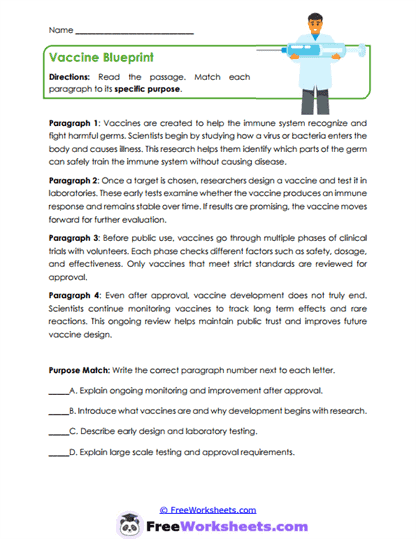
This is one of those quietly powerful worksheets that builds a skill students will use across every subject area-understanding how information is organized and why. On the surface, students are matching paragraphs to purpose. But underneath, they are learning to recognize how authors structure ideas in a logical sequence.
If you’re a teacher, this is where you can really push students beyond “reading to get answers” and into “reading to understand design.” The passage walks through how vaccines are developed-from research to testing to approval to monitoring. That sequence matters. Students begin to see that informational texts are built with intention, not just written randomly.
For parents, I’d frame it this way: your child is learning how to break down complex information into steps and understand what each part is doing. That’s a life skill, not just a reading skill.
Curriculum and Grade Alignment
This worksheet aligns strongly with Grade 8 standards around text structure and author’s purpose. Students analyze how paragraphs contribute to the overall development of ideas. It supports Common Core RI.8.5 and TEKS ELAR 8.6(C).
Student Tasks
Students read a multi-paragraph informational text about vaccine development. Then they:
- Identify the purpose of each paragraph
- Match paragraphs to specific roles (introduction, process, testing, follow-up)
- Think about how the structure supports understanding
- Recognize how ideas build logically from one step to the next
This is structured thinking-not just comprehension.
Common Challenges and Misconceptions
Students often treat paragraphs as isolated chunks instead of connected steps. Some will match based on keywords instead of meaning. Others may not recognize subtle differences between purposes (like testing vs. approval). This is where guided discussion really matters.
Implementation Guidance
A strong move here is to map the structure visually-have students draw arrows or label the sequence. You can also ask, “Why does this paragraph come here?” That question shifts them into deeper thinking.
For support, model one paragraph together and talk through your reasoning out loud. Once students hear that thinking process, they’re much more likely to replicate it.
Details and Features
- Clear sequential structure (great for modeling)
- Real-world science connection
- Strong focus on organization and purpose
- Easy to extend into writing activities