
About This Worksheet
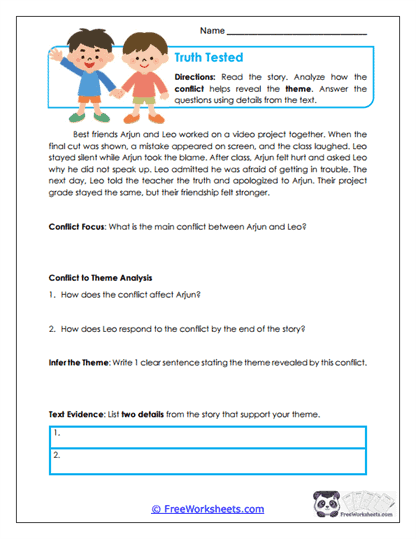
Every story has problems that characters must face, but those problems often reveal important lessons. In this worksheet, students read about two friends whose project presentation does not go as planned. One friend makes a mistake, chooses not to admit it right away, and later must decide how to handle the situation. Through this conflict, students explore how challenges can reveal a story’s deeper theme.
Students will examine both the conflict itself and the way the characters respond to it. They will think about how honesty, responsibility, and friendship influence the outcome. Rather than simply identifying the problem, students will connect the conflict to the lesson the author wants readers to learn.
Many students enjoy discussing disagreements and misunderstandings because they can relate them to their own experiences. This worksheet uses that natural connection to help students understand how authors build themes through character choices and consequences.
Curriculum and Grade Alignment
This worksheet is designed for Grade 6 reading instruction focused on theme, conflict, and character development. Students analyze how a conflict influences characters and reveals a larger lesson. This activity aligns with CCSS RL.6.2 and RL.6.3.
Student Tasks
Students identify the main conflict, analyze how it affects each character, infer the theme, and support their ideas with evidence from the story.
Common Challenges and Misconceptions
Students may focus only on the conflict itself and overlook the lesson that grows from it. Encourage them to ask what the characters learned and how the situation changed them.
Implementation Guidance
Teachers can use this worksheet when teaching conflict, theme, or character growth. Parents can connect the story to real-life situations where honesty, responsibility, or communication helped solve a problem.
Details and Features
The worksheet blends conflict analysis, character study, and theme development. Students practice explaining how specific events contribute to a story’s overall message.