
About This Worksheet
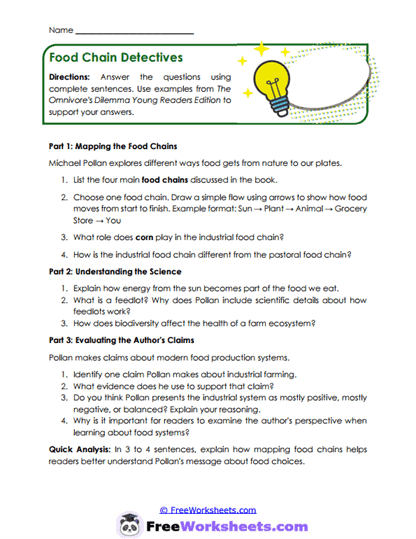
This worksheet focuses on analyzing how food moves through different food chains and how authors use scientific explanations to support larger arguments. In The Omnivore’s Dilemma Young Readers Edition, Michael Pollan explores the journey food takes from nature to our plates and examines the choices people make about what they eat. Sixth-grade students strengthen critical reading skills when they connect scientific information with an author’s claims and opinions. This activity helps readers understand how nonfiction authors use evidence to support important ideas. Students learn to think critically about both food systems and informational writing.
Curriculum and Grade Alignment
This worksheet is designed for Grade 6 students studying informational texts, science-based nonfiction, and author’s claims. The primary learning goal is analyzing scientific explanations and evaluating how evidence supports an author’s message. Students should already understand basic food chains and informational text structures. The next progression involves evaluating arguments and supporting evidence across complex nonfiction texts. This activity aligns with CCSS RI.6.1, RI.6.2, RI.6.3, and RI.6.8.
Student Tasks
Students identify and compare food chains described in the book, explain scientific concepts such as feedlots and biodiversity, and evaluate the author’s claims about food production systems. Learners create simple visual food-chain models and support their answers with evidence from the text. The worksheet concludes with a written response connecting scientific understanding to the author’s overall message. Students practice both informational reading and analytical writing.
Common Challenges and Misconceptions
Many students focus only on the science details and overlook the author’s broader message. Some learners summarize food chains without explaining why Pollan includes them. Others may confuse facts presented in the text with the author’s opinions and conclusions. Readers sometimes struggle to support evaluations with evidence. Teachers should encourage students to examine how facts and opinions work together throughout the book.
Implementation Guidance
Teachers can use this worksheet during nonfiction reading units, environmental science lessons, or discussions about food systems. Parents may connect the topic to everyday food choices and grocery shopping. Homeschool educators can extend learning by researching local food sources or comparing different farming methods. The worksheet supports both literacy and science learning while encouraging critical thinking.
Details and Features
The worksheet combines informational reading, science concepts, author’s purpose, and evidence-based analysis. Students complete both short-answer and extended-response questions. The format encourages deeper engagement with nonfiction texts. The printable design supports classroom instruction, homework assignments, and independent learning. Its real-world topic helps students connect reading to everyday life.