
About This Worksheet
This worksheet is great for helping students understand how a text is organized, not just what it says. That’s a big shift in Grade 6. I’d tell a colleague this is where students start noticing patterns like problem and solution, which really helps with comprehension. The environmental topic also gives it a real-world connection that students can relate to and discuss.
Curriculum and Grade Alignment
This activity supports Grade 6 skills in analyzing text structure. The goal is for students to identify how a text is organized and explain how that structure helps them understand the topic. It aligns with Common Core Standard RI.6.5 and supports TEKS 6.9(C), analyzing organizational patterns in informational texts.
Student Tasks
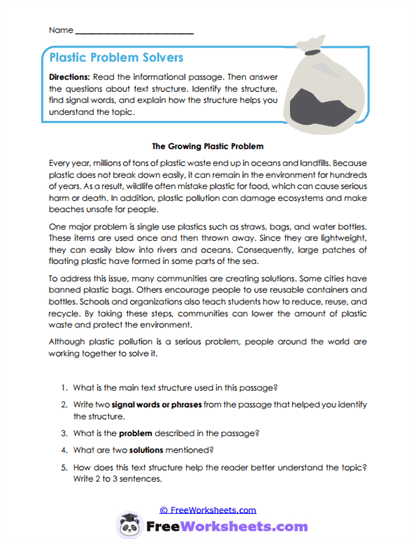
Students read a passage about plastic pollution. Then they identify the text structure, find signal words that support that structure, and explain how it helps them understand the problem. They also answer comprehension questions about the topic.
Common Challenges and Misconceptions
Students may confuse text structures like cause/effect and problem/solution. Some might list signal words without explaining their purpose. Others may not connect the structure to understanding the text. I usually ask, “How is the author organizing the ideas?”
Implementation Guidance
This worksheet works well as a mini-lesson on text structure. I’d model identifying one structure and pointing out signal words. It’s also great for partner discussions where students explain their thinking. At home, parents can ask how the text is organized.
Details and Features
The worksheet includes a clear informational passage with a real-world topic. It provides structured practice identifying text structure and signal words. The questions guide deeper thinking. It builds strong comprehension and analysis skills.