
Factors And Multiples Worksheets
Exploring factors and multiples reveals how multiplication facts connect to divisibility and repeating number patterns. These grade 4 factors and multiples worksheets have children build factor pairs using dot arrays, highlight overlapping multiples on hundreds charts, and solve number riddles using mathematical clues. The free printable PDFs combine visual models with classification and reasoning challenges for students developing multiplication fluency. When a child identifies a factor, ask for a multiplication equation proving the relationship, then compare that reasoning with finding multiples through skip counting.
About This Collection of Worksheets
Factors and multiples help students describe the relationships between whole numbers. Finding factor pairs connects multiplication facts to the numbers that divide evenly into a whole number, while identifying multiples helps students recognize and extend number patterns. These ideas support later work with prime and composite numbers, common factors, common multiples, and fractions.
The collection includes visual, hands-on, and reasoning-based activities. Students build factor pairs with arrays, test whether numbers are factors, classify prime and composite numbers, sort factors and multiples, and continue patterns on a hundreds chart. Other pages invite them to solve number riddles, match factor pairs, evaluate statements, and compare lists for shared factors and patterns.
Teachers can use the worksheets for direct instruction, math centers, partner work, independent practice, enrichment, or review. Parents, tutors, and homeschool educators can model a multiplication or division check, then have students explain how they know a number fits. Counters and drawn arrays can help make the ideas concrete, while challenge questions encourage students to look for patterns and justify their reasoning.
Paul’s Teacher Tip
Start by contrasting the two ideas with a target number: factors divide it evenly, while multiples are products in its skip-counting sequence. Use counters or a rectangular array to show how rows and columns create factor pairs, including the pair where both factors are the same. When students sort or test numbers, ask them to prove each choice with a multiplication or division equation. Watch for the common mix-up where students assume every smaller number is a factor or every larger number is a multiple. For an extension, have students create a mystery number using clues about factors, multiples, or prime status.
Worksheet Collection Skill Spotlights
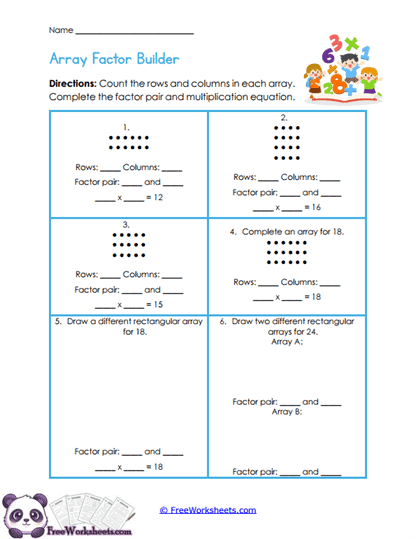
Array Factor Builder
What Kids Do: Students count rows and columns in dot arrays, record each factor pair, and write the matching multiplication equation. They also complete a partial array and draw their own rectangular arrangements for target numbers such as 18 and 24.
Target Skill: Connecting arrays to multiplication helps students understand why row and column counts are factors of the total. The activity builds visual multiplication reasoning and reinforces that a number may have several factor pairs, including reversed row and column arrangements.
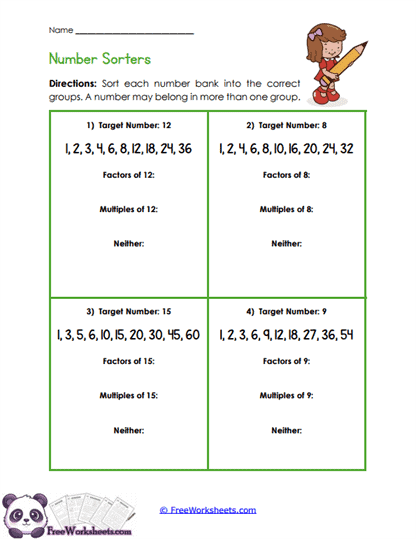
Factor and Multiple Sort
What Kids Do: Students examine number banks for four target numbers and sort each choice into one of three groups: factors, multiples, or neither. They repeat the classification process for each target, using multiplication and division facts to decide where the numbers belong.
Target Skill: This activity helps students distinguish two related but different number relationships. Checking whether a number divides evenly or is produced by multiplying the target builds conceptual understanding, reduces common mix-ups, and strengthens number reasoning.
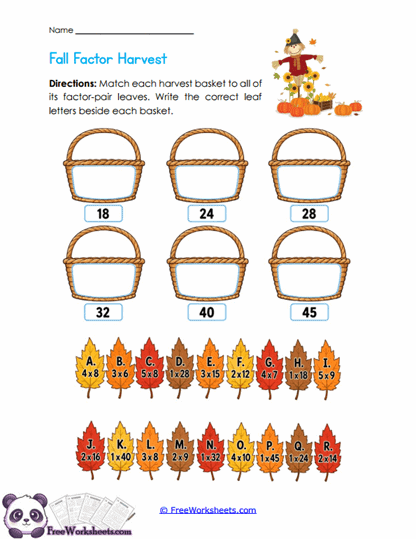
Factor Pair Harvest
What Kids Do: Students match multiplication facts printed on leaves to the harvest baskets labeled with target numbers. For each basket, they find every leaf showing a factor pair with the correct product and write the matching letters beside the number.
Target Skill: Matching several multiplication equations to one target strengthens students’ ability to recognize all factor pairs rather than stopping at the first one. It also reinforces multiplication fluency and makes the connection between products and factors clear.
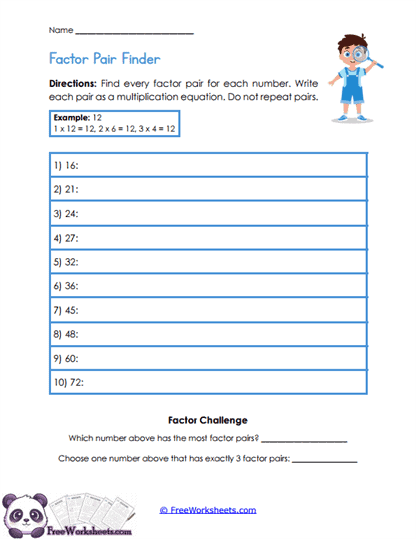
Factor Pair Hunt
What Kids Do: Students find all the whole-number pairs that multiply to each of ten target numbers, including 16, 24, 36, and 72. They record the equations without repeating reversed pairs, then answer two challenge questions about which numbers have the most or exactly three factor pairs.
Target Skill: Systematically searching for factor pairs builds multiplication fluency and accuracy while helping students recognize when they have found every possibility. The challenge questions encourage comparison and prepare students to reason about prime and composite numbers.
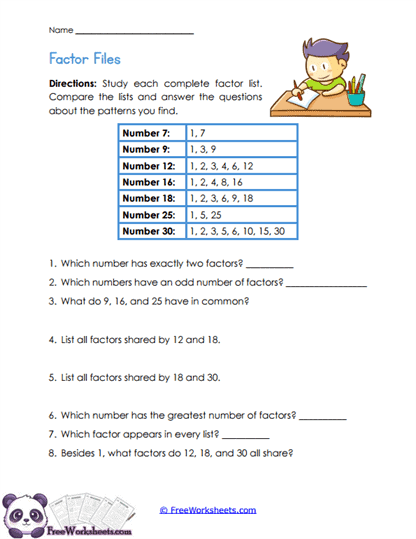
Factor Pattern Files
What Kids Do: Students study a completed table of factors for seven numbers and answer questions comparing the lists. They identify numbers with exactly two factors, find shared factors, and analyze patterns in numbers such as 9, 16, and 25.
Target Skill: Analyzing completed factor lists develops students’ ability to notice and explain number relationships. They practice identifying shared factors, recognizing prime numbers, and connecting perfect squares to an odd number of factors.
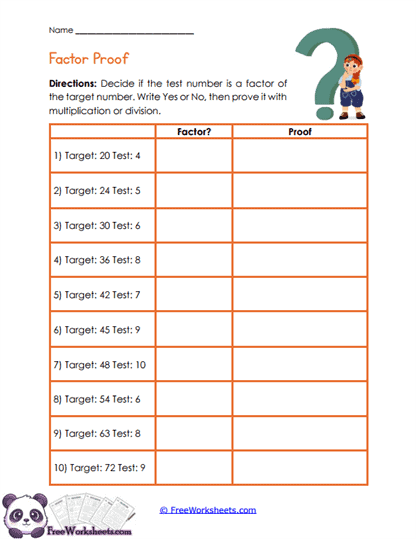
Factor Proof
What Kids Do: Students review ten target-and-test number pairs, decide whether each test number is a factor, and record Yes or No. They then prove each decision with a multiplication or division equation, including examples where division does not result in a whole number.
Target Skill: Requiring evidence helps students understand that a factor must divide a number evenly. Writing multiplication or division proofs strengthens factor knowledge, reinforces operation relationships, and develops clear mathematical explanations.
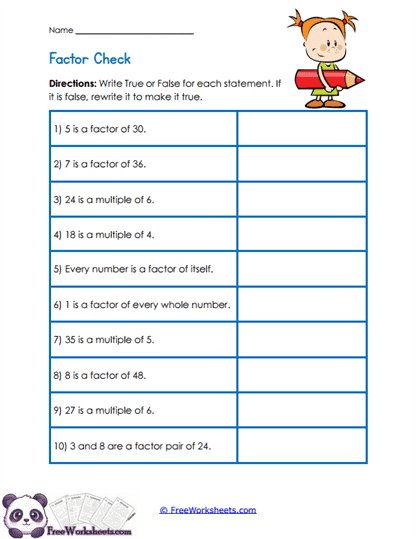
Factor Truth Check
What Kids Do: Students read ten statements about factors and multiples and mark each one True or False. When a statement is false, they rewrite it to make it accurate, checking claims about factor pairs, multiples, and general rules for whole numbers.
Target Skill: Evaluating and correcting statements builds understanding of how factors and multiples are defined. Students practice checking number relationships with multiplication or division and learn to explain why a claim is true or how it needs to change.
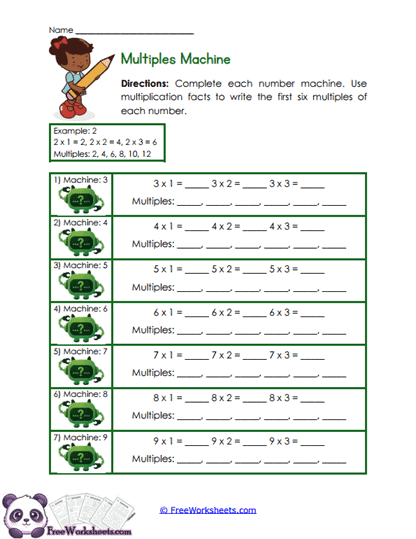
Multiples Machine
What Kids Do: Students complete multiplication facts for the numbers 3 through 9, then use the products to write the first six multiples of each number in order. Each number machine connects a sequence of equations to its matching multiples list.
Target Skill: Building multiples from multiplication facts helps students see that the two are different ways to express the same number pattern. The repeated sequences strengthen multiplication fluency, skip-counting, and readiness for common multiples.
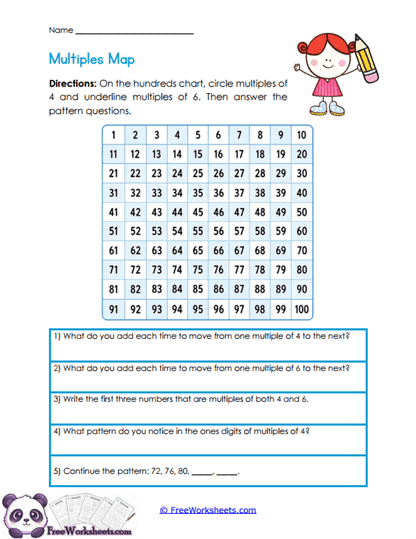
Multiples Pattern Map
What Kids Do: Students use a hundreds chart to circle multiples of 4 and underline multiples of 6. They then answer questions about how the patterns grow, identify numbers that appear in both sets, and describe patterns in the ones digits.
Target Skill: Marking multiples on a chart helps students visualize the spacing and overlap between number sequences. They practice skip-counting, finding common multiples, extending patterns, and explaining what they observe rather than only listing answers.
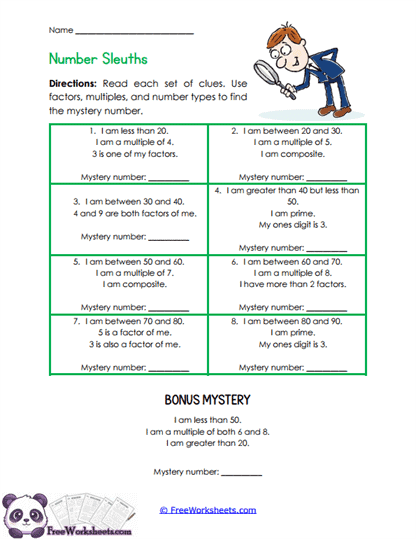
Mystery Number Clues
What Kids Do: Students solve eight number riddles and a bonus challenge by combining clues about ranges, factors, multiples, prime numbers, and digit patterns. They narrow down possible answers, check each clue, and write the number that satisfies them all.
Target Skill: Combining clues develops logical reasoning and encourages students to test possibilities systematically. Students apply knowledge of factors, multiples, primes, and number properties while learning that a valid answer must meet every condition.
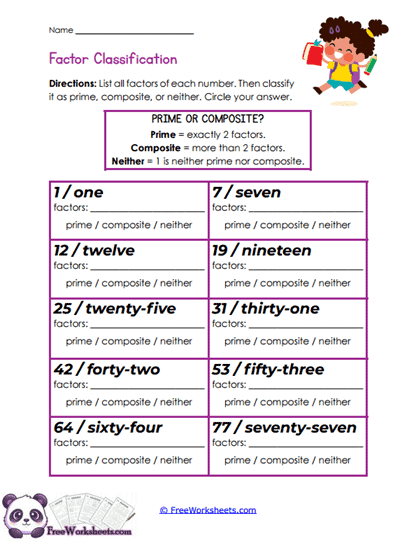
Prime or Composite
What Kids Do: Students list all the factors of ten numbers, then classify each as prime, composite, or neither. The numbers include examples such as 1, 7, 25, 42, and 77, requiring students to use their factor lists to support each choice.
Target Skill: Finding factors before classifying numbers gives students evidence for identifying prime and composite numbers. They learn that primes have exactly two factors, composites have more than two, and 1 is neither, strengthening divisibility and number classification skills.
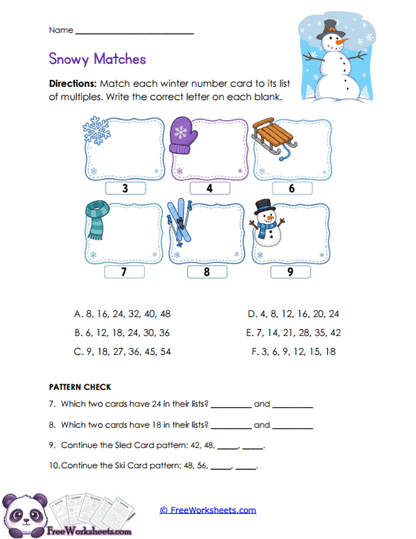
Winter Multiple Match
What Kids Do: Students match six winter-themed number cards to lettered lists of multiples. They then answer pattern questions by finding numbers shared across lists and extending sequences such as 42, 48, __, __.
Target Skill: Matching numbers to their multiples reinforces the connection between multiplication facts and ordered sequences. Follow-up questions develop pattern recognition and help students identify common multiples across different number lists.