
About This Worksheet
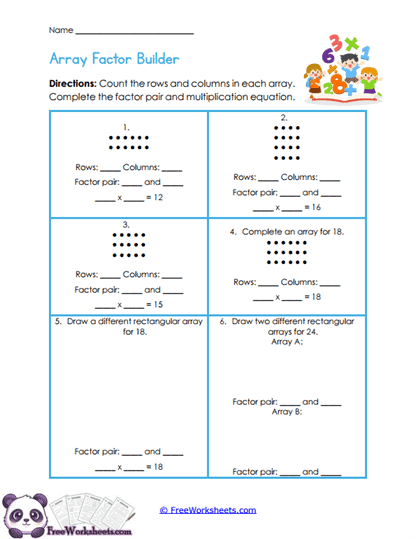
This Grade 4 math worksheet helps children see factors through rectangular arrays. Students count rows and columns in dot arrays, write the matching factor pair, and complete the multiplication equation. Later, they have to draw their own arrays for numbers such as 18 and 24.
This visual approach is especially helpful for children who understand multiplication better when they can see groups arranged in rows and columns. It makes the idea of a factor pair concrete instead of leaving it as just a list of numbers.
Learning Goals
The main goal is to help students connect multiplication, arrays, and factor pairs.
Children practice understanding that if an array has 3 rows and 4 columns, then 3 and 4 are factors of 12 because 3 × 4 = 12.
They also learn that one number can have more than one rectangular arrangement. That helps students see why some numbers have several factor pairs.
What Students Will Do
In the first part, students look at each dot array and count the number of rows and columns.
They record those numbers as a factor pair and then write the multiplication equation that gives the total.
One problem asks students to complete an array for 18, so they need to add the missing dots in a rectangular pattern.
Later, students draw a different rectangular array for 18 and then draw two different arrays for 24. They write the factor pairs that match the arrays they created.
Common Challenges
Some children may reverse rows and columns and worry that the answer is wrong. Explain that 3 × 4 and 4 × 3 both give the same total, so both describe the same factor pair.
Another common issue is drawing an arrangement that is not rectangular. Every row should have the same number of dots.
A parent or teacher can ask, “Are all your rows equal?” and “Does the total number of dots match the target?”
Teaching Suggestions
Before beginning, build a small array with counters or coins. Count the rows, count the columns, and then write the multiplication fact.
Teachers can also have students rotate an array and notice that the total stays the same even though the rows and columns switch.
For a challenge, ask students which numbers on the page have the most possible rectangular arrays and why.
Worksheet Features
The page combines completed arrays, an incomplete array, and open drawing spaces. Students move from reading visual models to creating their own, which makes the practice more meaningful.
This worksheet works well for hands-on factor lessons, multiplication centers, small groups, or visual math practice.