
Comparing Fractional Values Worksheets
4th grade math comparing fractional values worksheets help students judge fraction size using models, benchmarks, equivalence, and comparison strategies. Free, ready-to-print worksheets in PDF format are designed for immediate classroom use, centers, guided practice, homework, or homeschool lessons. Students strengthen fraction magnitude, equivalence, and ordering while developing skills that support curriculum expectations.
About This Collection of Worksheets
Comparing fractional values helps 4th grade students understand how fractions relate to one another in size. Students learn that different fraction pairs may call for different strategies, including comparing numerators, thinking about piece size, using benchmarks, creating equivalent fractions, or finding common denominators. This flexible approach helps children reason about fractions instead of relying on one shortcut for every comparison.
The collection includes shaded models, number lines, same-denominator comparisons, same-numerator comparisons, benchmark sorting, equivalent-fraction matching, common-denominator practice, error analysis, ordering activities, seasonal sorting, and real-world comparisons. Some worksheets provide strong visual support, while others ask students to explain or select the most efficient strategy. These varied formats help connect fraction magnitude with both visual and symbolic reasoning.
Teachers can use these worksheets for whole-class lessons, guided math, centers, homework, intervention, review, or informal assessment. Parents, tutors, and homeschool educators can begin with models and simple like-denominator comparisons before moving toward benchmarks, equivalence, common denominators, and multi-fraction ordering. Because the collection encourages students to choose among several strategies, it supports stronger number sense and more independent fraction reasoning.
Paul’s Teacher Tip
Teach students to look at the structure of the fractions before choosing a comparison strategy. If the denominators match, compare the numerators; if the numerators match, think about which denominator creates larger pieces. Benchmarks such as 1/2 and 1 can often make comparisons quicker than creating common denominators. When students use equivalent fractions, remind them that both the numerator and denominator must change by the same factor. Encourage students to explain why one fraction is greater instead of relying only on the < or > symbol.
Worksheet Collection Skill Spotlights
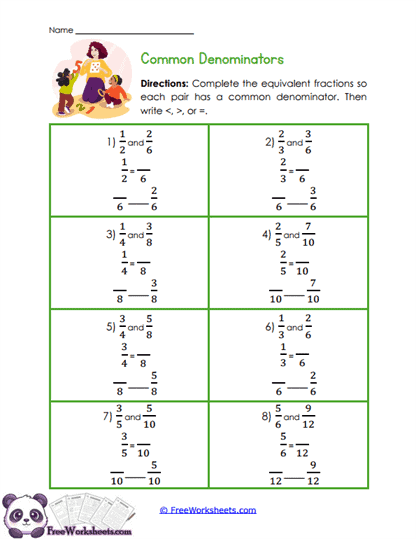
Common Denominator Builder
What Kids Do: Students solve eight fraction comparisons by rewriting unlike-denominator fractions as equivalent fractions with a shared denominator. They show the new forms, compare the resulting numerators, and then write <, >, or = between the original fractional values.
Target Skill: This activity strengthens equivalent-fraction reasoning and common-denominator strategies. 4th grade students practice multiplying numerators and denominators by the same factor and using equivalent forms to make unlike fractions directly comparable.
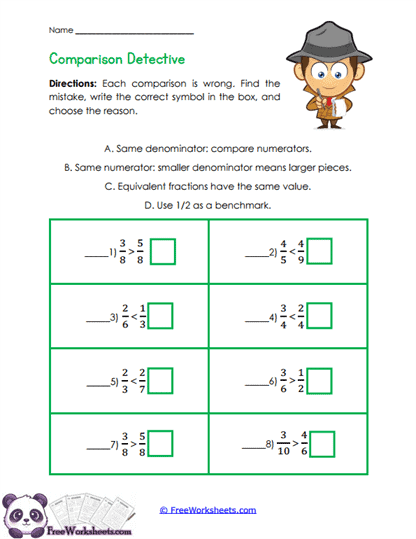
Comparison Repair
What Kids Do: Students inspect eight fraction comparisons that contain an incorrect comparison symbol. They replace the symbol with the correct one and then choose the strategy that best explains the comparison, such as numerator reasoning, piece size, equivalence, or a 1/2 benchmark.
Target Skill: The worksheet develops error analysis and strategic fraction reasoning. 4th grade students learn that different fraction pairs require different comparison methods and practice selecting a strategy based on the relationship between the numerators and denominators.
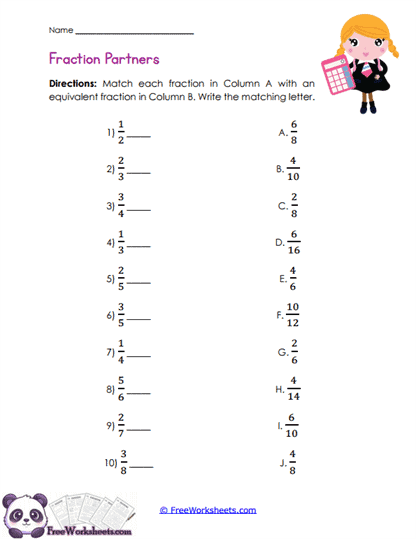
Equivalent Partners
What Kids Do: Students match ten fractions in one column with equivalent values written in another form. They compare numerators and denominators, look for matching multiplication or division relationships, and record the letter connected with each equivalent fraction.
Target Skill: This activity strengthens understanding that fractions can look different while representing the same value. 4th grade students practice multiplicative reasoning, equivalent-fraction recognition, and a key skill needed for comparing fractions with unlike denominators.
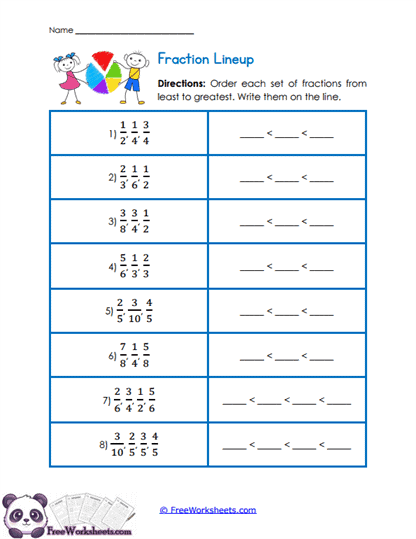
Fraction Order Line
What Kids Do: Students complete eight ordering problems containing groups of three or four fractions. They compare the values, identify the smallest and largest amounts, place the remaining fractions between them, and write each set from least to greatest using comparison symbols.
Target Skill: The worksheet extends fraction comparison beyond pairs of numbers. 4th grade students practice using benchmarks, equivalence, numerator reasoning, and common denominators to organize several fractional values accurately on a single magnitude scale.
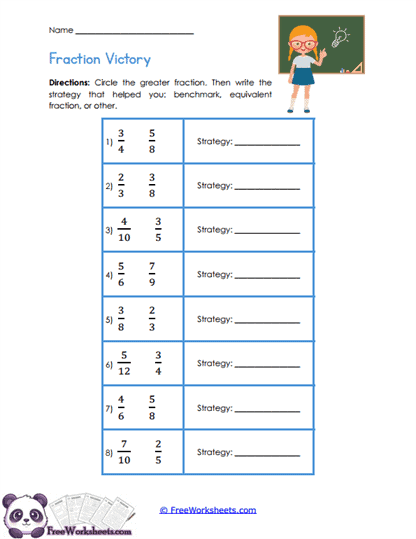
Fraction Strategy Challenge
What Kids Do: Students compare eight varied fraction pairs, circle the greater value, and then write the strategy they used to make the decision. The problems are designed so students may use common denominators, equivalent fractions, benchmarks, or other valid comparison reasoning.
Target Skill: This activity develops flexible strategy selection and mathematical communication. 4th grade students practice choosing an efficient comparison method, explaining their reasoning, and understanding that more than one mathematically sound strategy may sometimes work.
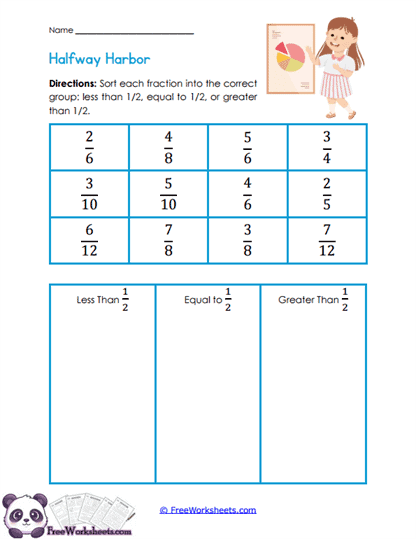
Halfway Sort
What Kids Do: Students sort twelve fractions into three groups based on their relationship to 1/2. They determine whether each fraction is less than one-half, equivalent to one-half, or greater than one-half and place it in the correct category.
Target Skill: The worksheet strengthens benchmark-fraction reasoning. 4th grade students learn to compare the numerator with half of the denominator, recognize common equivalents to 1/2, and use a familiar reference point to judge fraction magnitude efficiently.
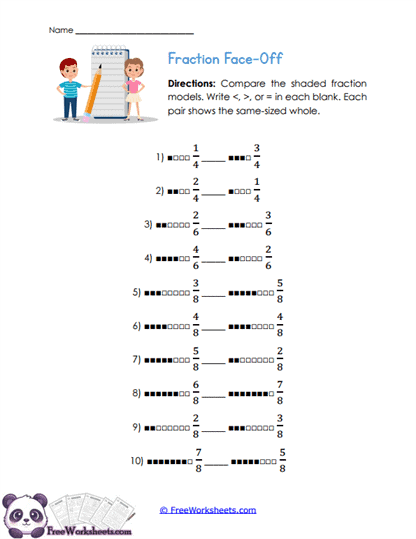
Model Faceoff
What Kids Do: Students compare ten pairs of same-sized shaded fraction bars. They observe how many equal sections are shaded in each model, connect the pictures to the written fractions, and place <, >, or = between the two amounts.
Target Skill: This activity builds a visual foundation for fraction magnitude. 4th grade students strengthen numerator reasoning with like denominators and connect comparison symbols with concrete models showing which fraction represents more, less, or the same amount.
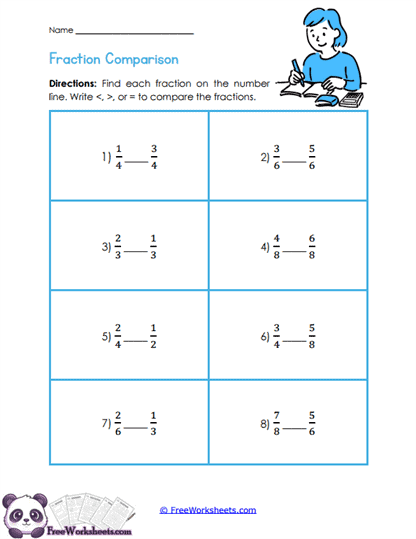
Number Lineup
What Kids Do: Students compare eight fraction pairs by thinking about where each value belongs on a number line between 0 and 1. They consider which fraction lies farther to the right and then write <, >, or = to show the relationship.
Target Skill: The worksheet strengthens fraction magnitude by treating fractions as numbers with specific positions. 4th grade students practice using number lines, benchmarks, equivalence, and relative distance from zero to compare both like and unlike denominators.
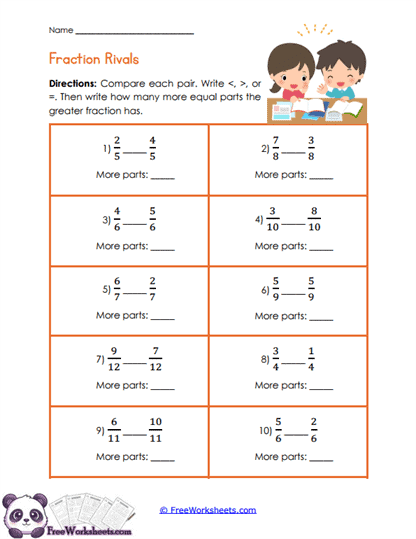
Numerator Rivals
What Kids Do: Students complete ten same-denominator fraction comparisons and then determine how many more equal parts the greater fraction contains. They write the correct comparison symbol and subtract the smaller numerator from the larger one to describe the difference.
Target Skill: This activity strengthens numerator reasoning with equal-sized fractional parts. 4th grade students learn that when denominators match, the larger numerator represents the greater amount and can use the numerator difference to describe how much greater it is.
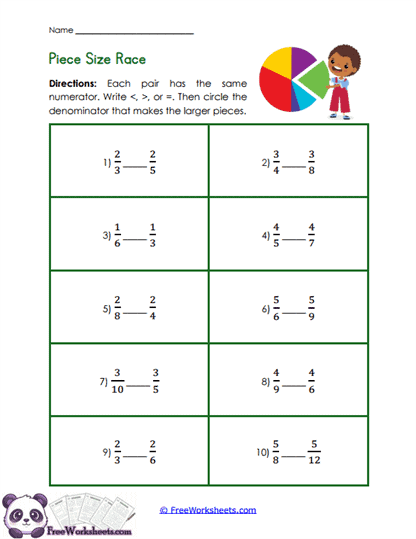
Piece Size Challenge
What Kids Do: Students compare ten fraction pairs that have matching numerators but different denominators. They write <, >, or = and then identify which denominator creates the larger-sized fractional pieces when the wholes are the same size.
Target Skill: The worksheet develops denominator reasoning and fraction magnitude. 4th grade students learn that dividing the same whole into fewer equal parts creates larger pieces, so a smaller denominator produces the larger fraction when numerators match.
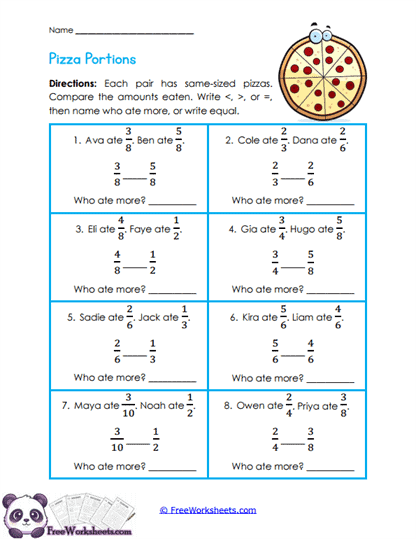
Pizza Portion Challenge
What Kids Do: Students solve eight pizza-themed comparisons involving two people eating fractional portions of equal-sized pizzas. They compare the fractions, write the correct symbol, and identify which person ate more or determine that the amounts are equivalent.
Target Skill: This activity applies fraction comparison to a meaningful context. 4th grade students practice using same-denominator reasoning, same-numerator reasoning, benchmarks, or equivalent fractions while maintaining the important assumption that the wholes being compared are equal in size.
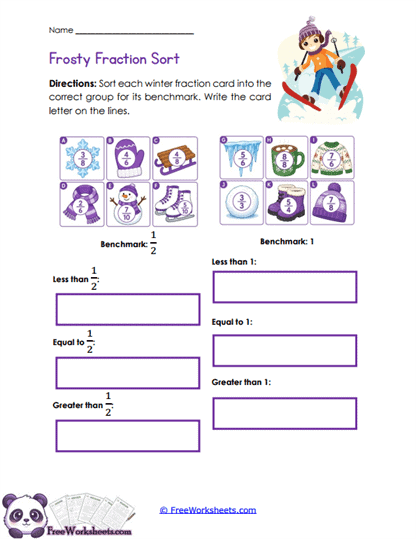
Winter Benchmark Sort
What Kids Do: Students sort winter-themed fraction cards according to two important benchmarks. One group is classified as less than, equal to, or greater than 1/2, while another is classified as less than, equal to, or greater than 1 whole.
Target Skill: The worksheet strengthens benchmark comparison and fraction classification. 4th grade students practice judging magnitude relative to 1/2 and 1, recognizing equivalent benchmark fractions, and distinguishing fractions greater than one-half from those greater than a whole.