
Division Worksheets
4th grade math division worksheets help students solve larger quotients, interpret remainders, estimate answers, and use flexible strategies with multi-digit numbers. Free, ready-to-print worksheets in PDF format are designed for immediate classroom use, centers, guided practice, homework, or homeschool lessons. Students strengthen place-value reasoning, quotient estimation, and problem solving while developing skills that support curriculum expectations.
About This Collection of Worksheets
Division in 4th grade moves students beyond basic fact recall and into larger dividends, one-digit divisors, remainders, estimation, and multiple solving strategies. Students learn to break dividends into easier parts, use area models and partial quotients, connect multiplication with division, and determine whether answers are reasonable. These ideas help children understand why division methods work instead of simply following a memorized procedure.
The collection includes partial-quotient practice, area models, compatible-number estimation, strategy matching, remainder sorting, multiplication checks, error analysis, missing values, seasonal word problems, and mixed reasoning challenges. Some worksheets provide step-by-step support, while others require students to choose a method, analyze completed work, or interpret what a remainder means. This variety helps students build both computation fluency and flexible mathematical thinking.
Teachers can use these worksheets during division lessons, guided math, centers, intervention, homework, review, or assessment preparation. Parents, tutors, and homeschool educators can begin with visual models and structured decomposition before moving toward estimation, remainders, unknown values, and contextual problems. Because the collection combines computation with explanation and checking, it prepares students for long division, fractions, and more advanced multi-step problem solving.

Paul’s Teacher Tip
Encourage students to estimate the quotient before solving a larger division problem so they have a reasonable answer range in mind. When a dividend feels difficult, help them break it into friendly parts that divide evenly by the divisor. Keep connecting division to multiplication by asking students to check whether divisor × quotient + remainder returns the original dividend. When a remainder appears in a word problem, have students explain what the leftover amount represents before writing the final answer. Comparing area models, decomposition, and partial quotients can also help students see that different strategies can represent the same division relationship.
Worksheet Collection Skill Spotlights
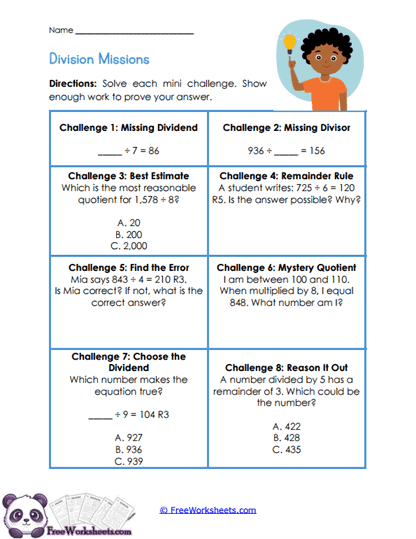
Division Challenge Lab
What Kids Do: Students complete eight varied division challenges involving a missing dividend, missing divisor, quotient estimation, remainder rules, error analysis, a mystery quotient, equation selection, and reasoning about which dividend could produce a given remainder.
Target Skill: This cumulative activity strengthens flexible division reasoning across several 4th grade concepts. Students apply inverse operations, estimation, remainder rules, multiplication connections, and logical thinking instead of relying on one repeated computation procedure.
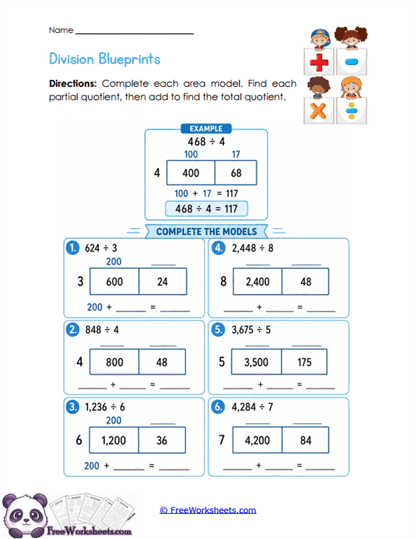
Division Models
What Kids Do: Students complete six area-model division problems with three- and four-digit dividends. They determine the partial quotient represented by each section of a divided rectangle and then add those partial quotients to calculate the complete answer.
Target Skill: The worksheet develops visual understanding of place-value decomposition and partial quotients. 4th grade students connect area models with division, recognize how friendly dividend parts can be divided separately, and combine those results accurately.
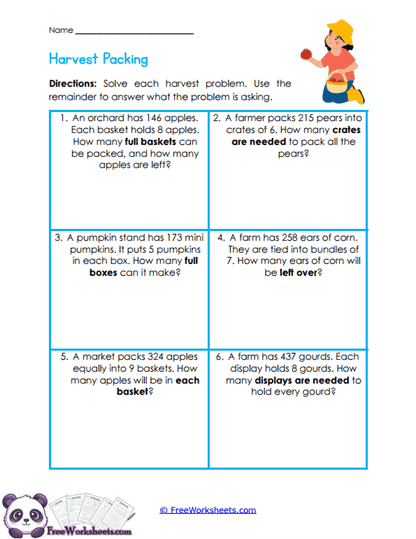
Harvest Division Stories
What Kids Do: Students solve six harvest-themed division stories involving apples, pears, pumpkins, corn, baskets, crates, boxes, and displays. They calculate quotients and remainders and then use the wording of each question to decide what the numerical result means.
Target Skill: This activity strengthens contextual interpretation of division with remainders. 4th grade students learn that a leftover amount may represent unused objects, incomplete groups, or the need for an additional container depending on the real-world situation.
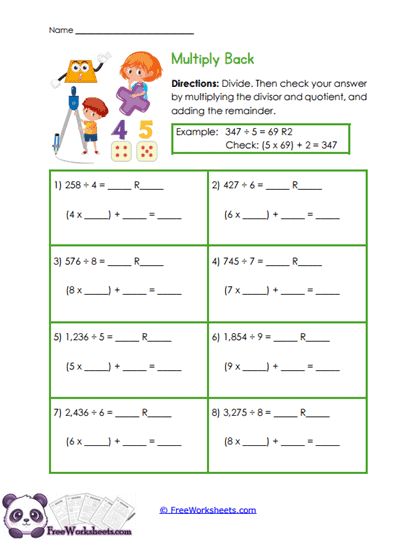
Multiplication Check
What Kids Do: Students solve eight multi-digit division problems, record each quotient and remainder, and then verify the answer. They multiply the divisor by the quotient, add the remainder, and compare the reconstructed value with the original dividend.
Target Skill: The worksheet reinforces the inverse relationship between multiplication and division while building strong self-checking habits. 4th grade students learn a dependable method for verifying quotients and remainders and recognizing when an answer needs correction.
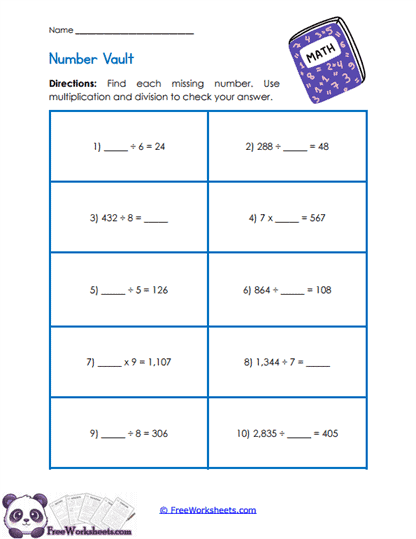
Number Vault
What Kids Do: Students complete ten multiplication and division equations containing missing dividends, divisors, quotients, or factors. They study the position of the unknown, choose the operation that will help them work backward, and check each value with the related inverse operation.
Target Skill: This activity develops equation sense and early algebraic thinking. 4th grade students strengthen their understanding of how dividends, divisors, quotients, factors, and products are related and learn to select multiplication or division strategically.
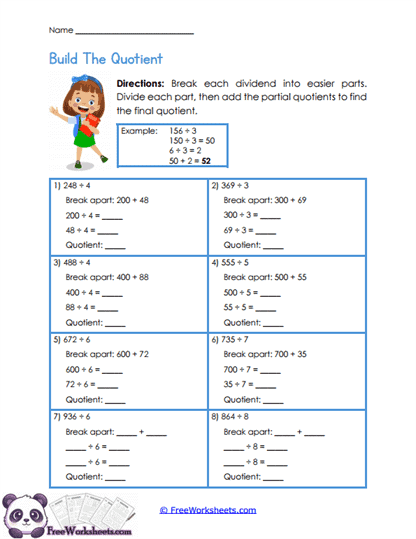
Quotient Builder
What Kids Do: Students solve eight larger division problems by breaking each dividend into easier parts. They divide every friendly part by the same divisor, record the resulting partial quotients, and add those partial answers to determine the final quotient.
Target Skill: The worksheet develops decomposition and partial-quotient reasoning. 4th grade students use place value and known division facts to transform a difficult dividend into manageable pieces while understanding how the separate quotients combine into one complete answer.
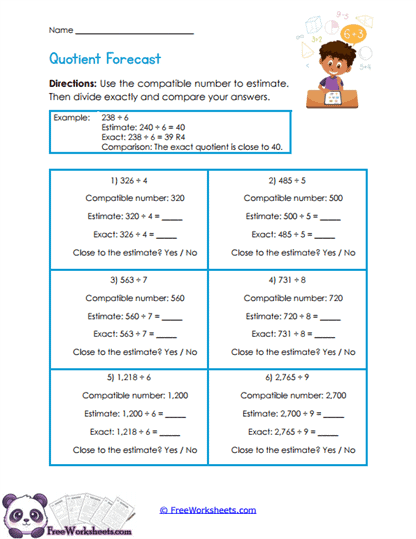
Quotient Estimator
What Kids Do: Students solve six division problems by first using a provided compatible number to estimate the quotient. They then calculate the exact division result, including a remainder when necessary, and decide whether the exact answer is reasonably close to the estimate.
Target Skill: This activity develops quotient estimation and reasonableness checking. 4th grade students practice using nearby numbers that divide evenly, predicting approximate answers, and evaluating whether an exact computation makes sense based on the size of the original numbers.
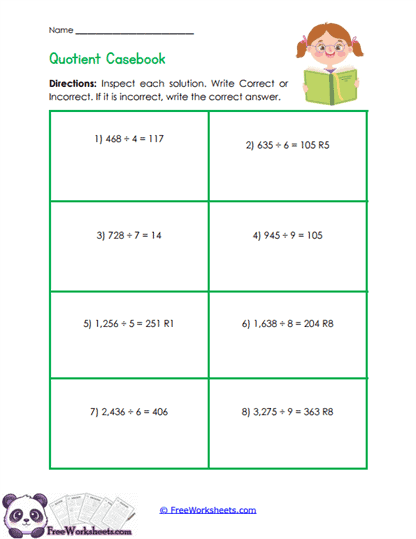
Quotient Inspector
What Kids Do: Students inspect eight completed division equations and decide whether each quotient and remainder is correct. They use multiplication, estimation, or recalculation to verify the work and write a corrected answer whenever the printed solution is inaccurate.
Target Skill: The worksheet strengthens error analysis and mathematical verification. 4th grade students practice checking both quotients and remainders, applying the rule that remainders must be smaller than divisors, and correcting division work with evidence.
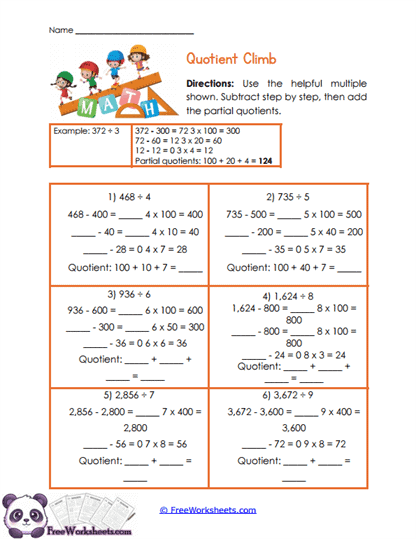
Quotient Steps
What Kids Do: Students solve six larger division problems by subtracting helpful multiples of the divisor from the dividend. They connect each subtraction to a partial quotient, continue until the dividend has been accounted for, and add the partial quotients to find the answer.
Target Skill: This activity strengthens the partial-quotients strategy through multiplication and repeated subtraction. 4th grade students learn to choose useful divisor multiples, track the quotient represented by each removed amount, and combine those pieces accurately.
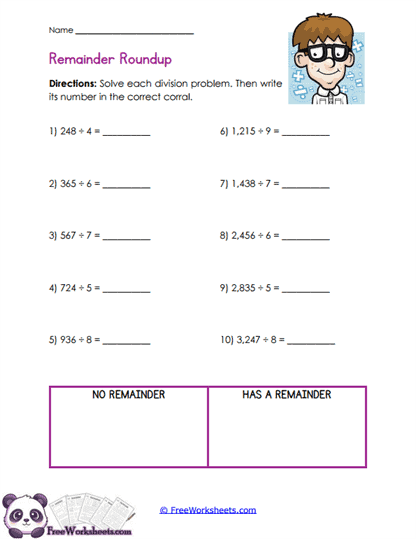
Remainder Sort
What Kids Do: Students solve ten division equations and determine whether each calculation divides evenly or leaves a remainder. After finding the quotient, they place each problem number into either the No Remainder or Has a Remainder category.
Target Skill: The worksheet develops division fluency and remainder recognition. 4th grade students practice identifying exact quotients, determining leftover amounts, and reinforcing the rule that a valid remainder must always be smaller than the divisor.
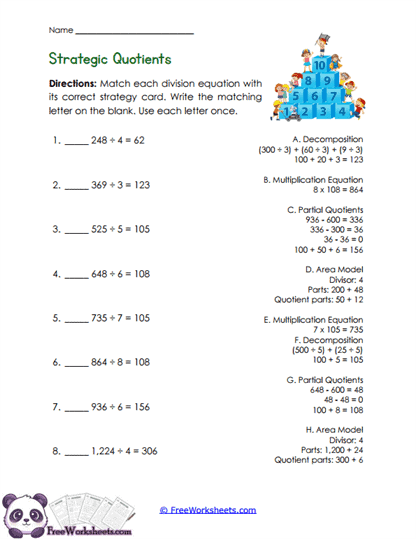
Strategy Matcher
What Kids Do: Students study eight division equations and eight solution cards showing decomposition, related multiplication equations, partial quotients, or area models. They analyze how each strategy represents the calculation and match every division equation with the appropriate method.
Target Skill: This activity develops flexible strategy recognition and mathematical communication. 4th grade students compare different representations of division and understand that area models, decomposition, multiplication relationships, and partial quotients can lead to equivalent results.
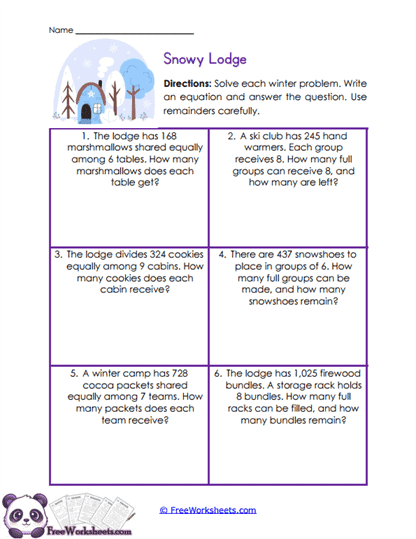
Winter Division Stories
What Kids Do: Students solve six winter-themed division stories involving marshmallows, hand warmers, cookies, snowshoes, cocoa packets, and firewood. They write division equations, calculate quotients and remainders, and interpret each answer according to the situation described.
Target Skill: The worksheet strengthens real-world division and remainder interpretation. 4th grade students practice distinguishing equal-sharing and equal-group situations while deciding how leftover amounts affect answers involving groups, storage, supplies, or distributed items.