
Adding Fractions With Like Denominators Worksheets
4th grade math adding fractions with like denominators worksheets help students combine equal-sized fractional parts and interpret sums in multiple ways. Free, ready-to-print worksheets in PDF format are designed for immediate classroom use, centers, guided practice, homework, or homeschool lessons. Students strengthen fraction sense, numerator reasoning, and problem solving while developing skills that support curriculum expectations.
About This Collection of Worksheets
Adding fractions with like denominators helps 4th grade students understand that the fractional pieces are already the same size, so only the number of pieces being combined changes. Students learn to add the numerators while keeping the denominator unchanged and connect that rule with visual models, number lines, equations, and real-world situations. This conceptual understanding helps prevent common mistakes such as adding the denominators.
The collection includes fraction bars, strips, number-line jumps, visual matching, missing numerators, fraction complements, decomposition, improper fractions, mixed numbers, error analysis, classification, and word problems. Some worksheets provide strong visual support, while others require students to reason symbolically or determine unknown values. These varied formats help students see the same fraction-addition idea from several perspectives.
Teachers can use these worksheets for whole-class lessons, guided math, centers, homework, intervention, or review. Parents, tutors, and homeschool educators can begin with shading and number-line models before moving toward missing values, improper sums, and contextual problems. Because the collection progresses from concrete representations to more independent fraction reasoning, it supports stronger fluency and prepares students for more advanced fraction operations.

Paul’s Teacher Tip
Keep repeating the idea that the denominator names the size of the pieces, while the numerator tells how many pieces are being counted. When students add like fractions, ask whether the size of the pieces changed; if not, the denominator should stay the same. Use fraction bars or strips whenever a student begins adding the denominators because the visual model makes the mistake easy to spot. When sums become greater than one, build the improper fraction first before converting it to a mixed number. Encourage students to compare every final numerator with the denominator so they can quickly tell whether the answer is less than, equal to, or greater than one whole.
Worksheet Collection Skill Spotlights
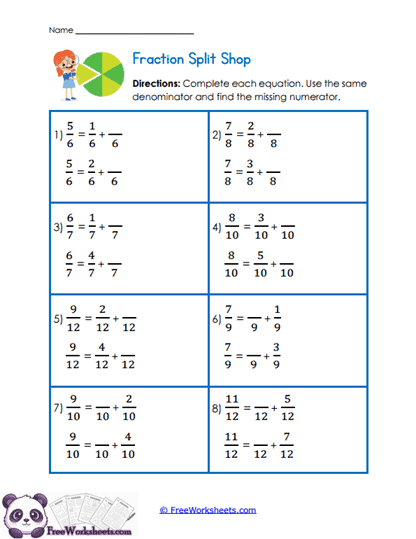
Fraction Decomposer
What Kids Do: Students complete eight fraction equations by breaking a total fraction into two smaller addends with the same denominator. They study the known numerator, determine the missing numerator, and show how two fractional parts can combine to recreate the original amount.
Target Skill: This activity strengthens fraction composition, decomposition, and missing-addend reasoning. 4th grade students learn that the denominator remains fixed while the numerator can be split into different combinations, building flexible understanding of like-denominator addition.
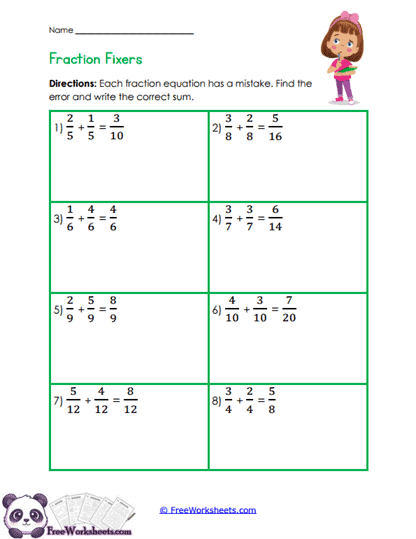
Fraction Error Hunt
What Kids Do: Students inspect eight incorrectly solved fraction-addition equations and determine what went wrong. They recalculate each sum, identify whether the mistake involved the numerator or denominator, and write the correct fraction in the provided space.
Target Skill: The worksheet develops error analysis and conceptual understanding of like-denominator addition. 4th grade students reinforce the rule that equal-sized pieces keep the same denominator while practicing careful checking and correction of common fraction misconceptions.
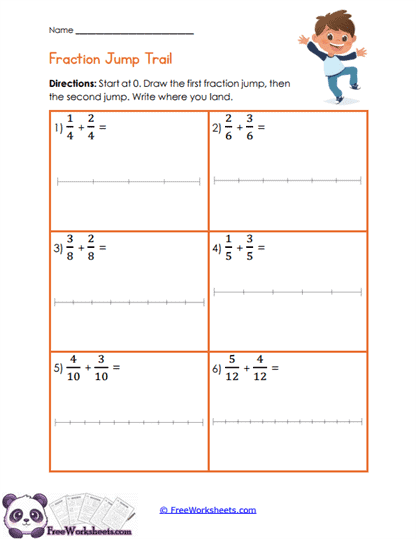
Fraction Jumps
What Kids Do: Students solve six fraction-addition problems by making two successive jumps on number lines divided into equal fractional intervals. They begin at zero, move by the first fraction, continue from that landing point by the second fraction, and record the final position.
Target Skill: This activity strengthens fraction magnitude and number-line reasoning. 4th grade students learn to treat fractions as numbers that can be combined through distance while reinforcing that equal denominators represent equal-sized intervals along the line.
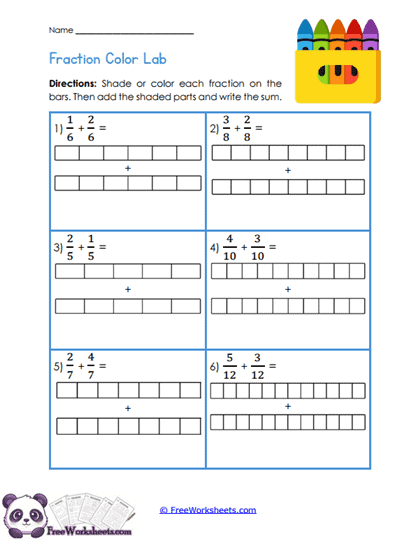
Fraction Shading
What Kids Do: Students complete six problems by shading fraction bars to represent each addend and then combining the shaded parts. They count the total number of shaded sections and write the resulting fraction while working with denominators from 5 through 12.
Target Skill: The worksheet builds a visual foundation for adding like-denominator fractions. 4th grade students connect numerators with counted pieces, denominators with equal part sizes, and the addition process with physically combining fractional portions of the same-sized whole.
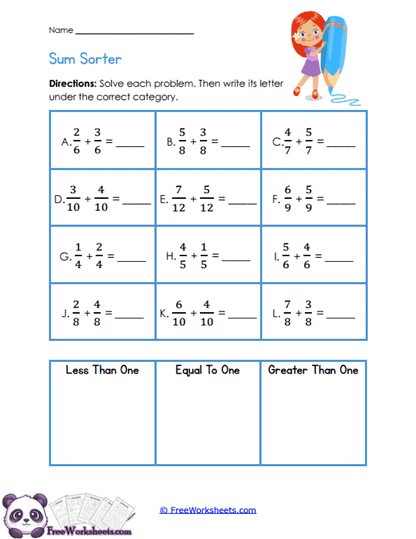
Fraction Sum Sort
What Kids Do: Students solve twelve lettered fraction-addition equations and then classify each result into one of three categories: less than one, equal to one, or greater than one. They compare each sum’s numerator with its denominator before placing the problem letter.
Target Skill: This activity combines fraction computation with magnitude reasoning. 4th grade students practice recognizing proper fractions, wholes, and improper fractions while strengthening their understanding of how numerator size relates to one complete whole.
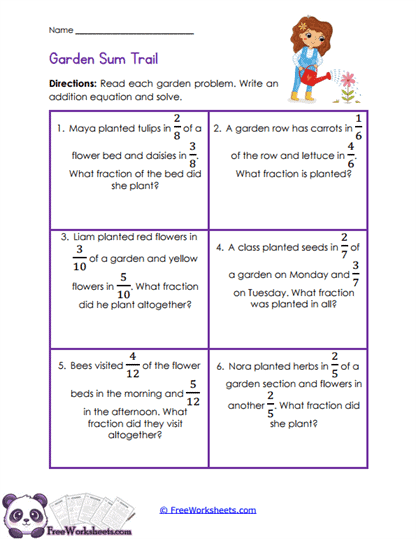
Garden Fraction Stories
What Kids Do: Students read six garden-themed word problems involving flowers, vegetables, seeds, herbs, and visiting bees. They identify two like-denominator fractional amounts, write the matching addition equation, and calculate the total portion described in each story.
Target Skill: The worksheet develops fraction addition in meaningful contexts. 4th grade students practice translating written information into mathematical equations, recognizing common denominators, and applying accurate numerator addition to real-world-style fraction situations.
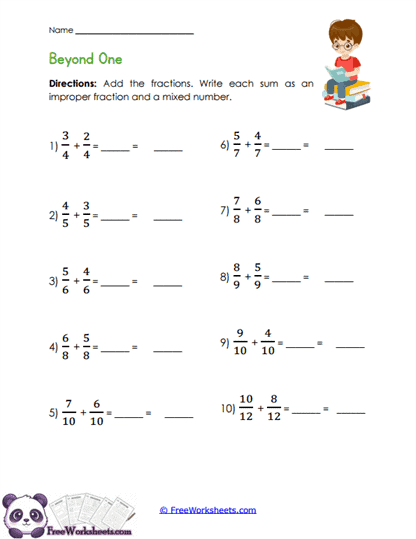
Improper Sum Builder
What Kids Do: Students solve ten like-denominator fraction sums that produce totals greater than one whole. They add the numerators, write each result as an improper fraction, and then convert that value into a mixed number using complete groups of the denominator.
Target Skill: This activity strengthens the connection between improper fractions and mixed numbers. 4th grade students practice recognizing wholes inside a fraction, dividing the numerator into complete denominator-sized groups, and representing the same quantity in two equivalent forms.
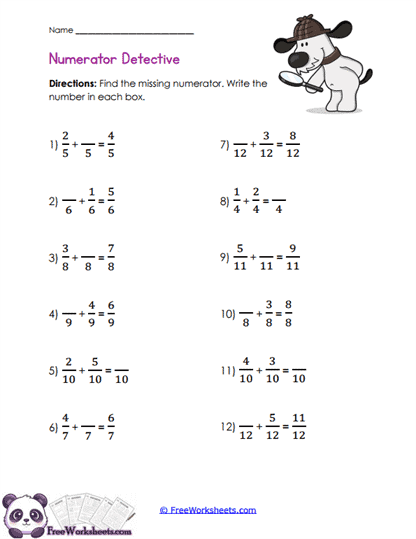
Numerator Hunt
What Kids Do: Students solve twelve fraction equations containing one missing numerator. The blank appears in different positions, so they compare the known numerator and the total numerator and determine what value completes the equation while leaving the denominator unchanged.
Target Skill: The worksheet develops inverse reasoning and early algebraic thinking with fractions. 4th grade students use familiar missing-addend relationships to solve unknown numerators and deepen their understanding that like-denominator addition operates on the number of equal-sized parts.
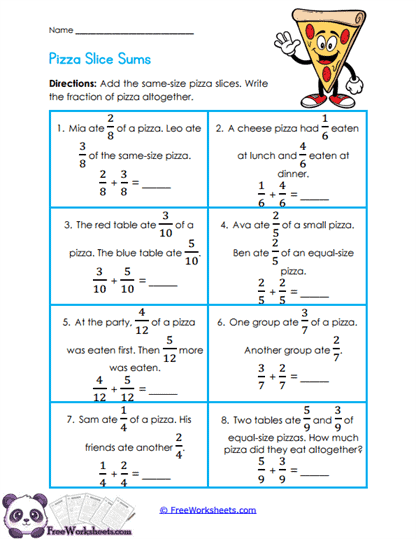
Pizza Fraction Stories
What Kids Do: Students solve eight pizza-themed word problems in which two fractional amounts are eaten, shared, or combined. They identify both like-denominator fractions, write the corresponding addition equation, and calculate how much pizza is represented altogether.
Target Skill: This activity strengthens fraction word-problem comprehension and mathematical modeling. 4th grade students practice recognizing addends within a story, preserving the common denominator, and using numerator addition to determine a meaningful fractional total.
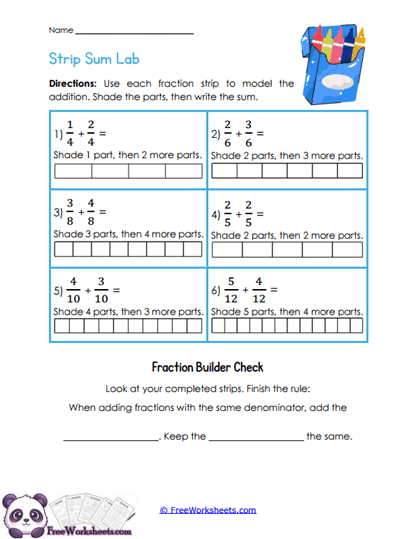
Strip Addition
What Kids Do: Students use six fraction strips to model addition by shading one fractional amount and then shading additional equal-sized parts for the second addend. They determine the combined fraction and complete a rule describing how numerators and denominators behave.
Target Skill: The worksheet connects visual modeling with the general rule for adding like fractions. 4th grade students observe that the number of pieces increases while their size remains unchanged, helping them explain why numerators are added and denominators are preserved.
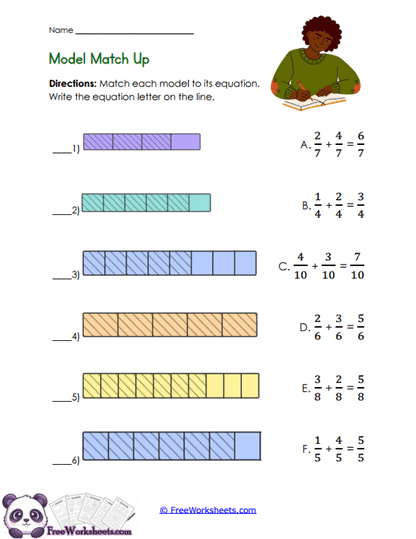
Visual Fraction Match
What Kids Do: Students examine six shaded fraction models and match each one with a lettered addition equation. They identify the denominator from the equal sections, distinguish the two shaded addends, and select the equation whose numerators and final sum match the picture.
Target Skill: This activity strengthens translation between visual and symbolic fraction representations. 4th grade students practice reading models, interpreting numerators and denominators, and recognizing how two like-denominator addends combine into one equivalent fractional amount.
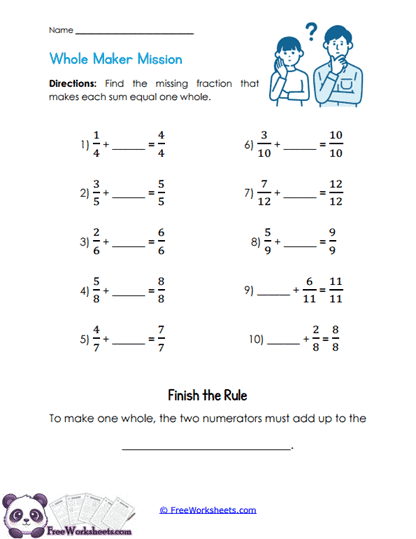
Whole Builder
What Kids Do: Students complete ten missing-fraction equations in which the final sum equals one whole. They determine how many additional equal parts are needed so the two numerators combine to equal the denominator and write the missing fraction.
Target Skill: The worksheet develops fraction complements and understanding of one whole. 4th grade students learn that fractions such as 4/4 or 8/8 represent one complete unit and use missing-addend reasoning to find the fractional amount needed to complete that whole.