
Division Word Problems Worksheets
These worksheets help students solve real-world problems using division strategies, grouping, and remainders accurately. Free, ready-to-print worksheets in PDF format support immediate classroom use, homework practice, math centers, and intervention lessons. Students strengthen division fluency, multi-step reasoning, multiplicative comparison, and interpretation of remainders aligned to class standards.
About This Collection of Worksheets
This collection of Grade 4 division word problem worksheets gives students repeated practice applying division skills in meaningful real-world situations. Learners solve problems involving equal sharing, equal grouping, comparisons, remainders, missing factors, and multi-step operations. The realistic scenarios encourage students to connect mathematical reasoning with everyday contexts while building confidence with division strategies.
Teachers can use these printable worksheets during whole-group lessons, independent practice, small-group intervention, review sessions, or assessment preparation. Each activity supports reading comprehension alongside mathematical reasoning, helping students identify important details, select appropriate operations, and explain their thinking clearly. The structured layouts also make the worksheets easy to assign for homework or homeschool reinforcement.
The worksheets gradually increase in complexity so students can strengthen foundational division concepts before moving into more advanced reasoning tasks. Students practice interpreting remainders, deciding when to round up, comparing quantities multiplicatively, and combining division with additional operations. This variety helps learners develop flexible problem-solving strategies that align with Grade 4 math standards and prepare them for upper-level arithmetic.
Paul’s Teacher Tip
Encourage students to underline important numbers and circle clue words before solving each problem. Many learners understand the division process but struggle deciding whether they should find the number of groups, the size of groups, or how to interpret a remainder. Modeling visual strategies such as arrays, equal-group drawings, and bar models can help students make sense of complex word problems. During partner discussions, ask students to explain why they chose a specific operation and how they know their answer makes sense in the context of the story. When teaching remainder problems, compare situations where leftovers should be ignored, included, or rounded up so students recognize how context changes the solution. Repeated exposure to different problem types builds stronger reasoning skills and greater confidence with real-world math.
Worksheet Collection Skill Spotlights
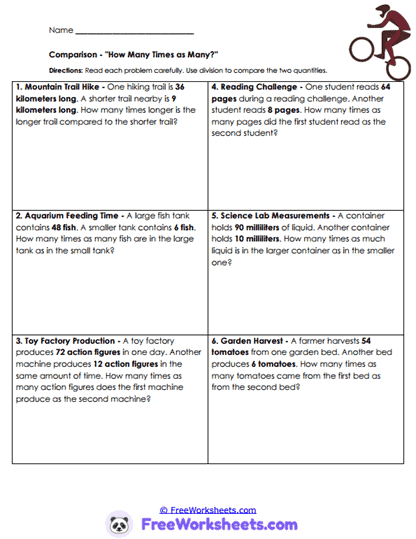
Compare Counts
- What Kids Do:
Students read comparison-based division stories and determine how many times greater one quantity is than another. They solve realistic scenarios involving gardens, trails, factories, and science measurements while practicing careful reading and mathematical interpretation. - Target Skill:
Students strengthen multiplicative comparison skills by using division to compare quantities accurately and explain relationships between numbers. This supports Common Core expectations for interpreting “how many times as many” situations and applying division within real-world contexts.
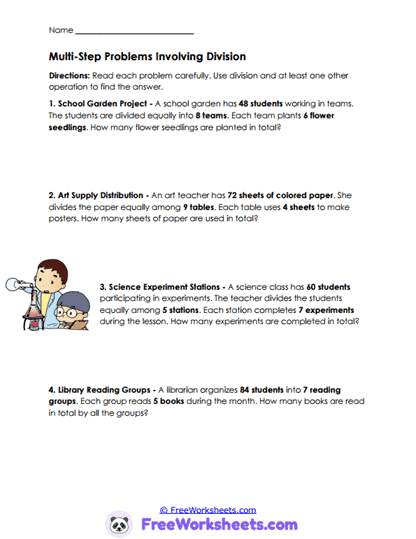
Divide Steps
- What Kids Do:
Students solve multi-step division word problems that require dividing quantities into equal groups before completing additional operations such as multiplication or total calculations. Learners organize information, follow sequential steps, and justify their reasoning clearly. - Target Skill:
Students develop advanced problem-solving strategies by combining division with additional arithmetic operations in meaningful situations. This reinforces Common Core standards focused on multi-step reasoning, mathematical modeling, and interpreting numerical relationships within contextual problems.
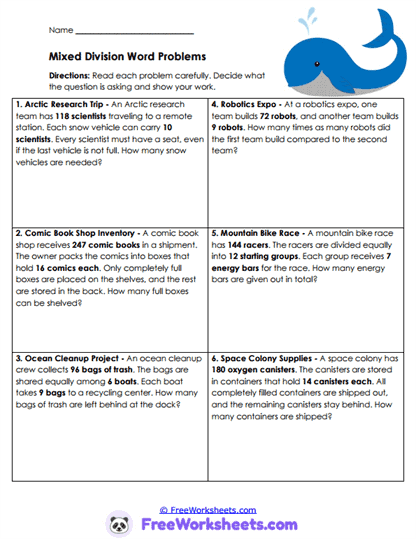
Division Mix
- What Kids Do:
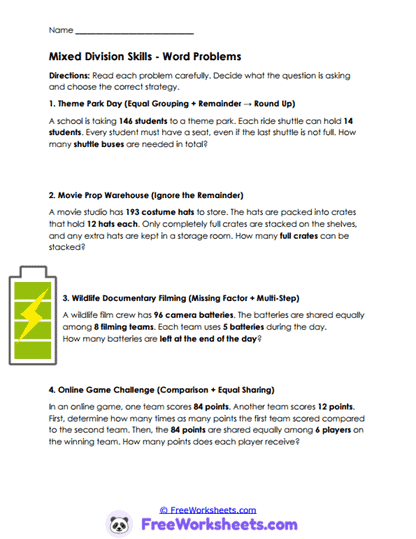
Students work through a variety of division scenarios involving equal groups, comparisons, remainders, and rounding decisions. The mixed structure encourages learners to evaluate each problem carefully and select the most effective strategy independently. - Target Skill:
Students improve mathematical flexibility by identifying appropriate division methods across multiple contexts. The worksheet reinforces Common Core expectations for interpreting remainders, comparing quantities, and applying operations strategically to solve practical problems.
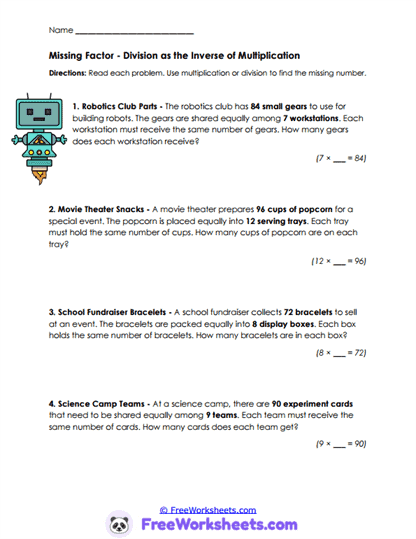
Factor Hunt
- What Kids Do:
Students solve missing-factor problems connected to real-world stories involving robotics, fundraising, and science camps. Learners use multiplication and division relationships to determine unknown quantities and explain how the operations are connected. - Target Skill:
Students strengthen understanding of inverse operations and fact families while developing algebraic reasoning skills. This Common Core-aligned practice supports fluency with multiplication and division relationships and encourages deeper conceptual understanding.
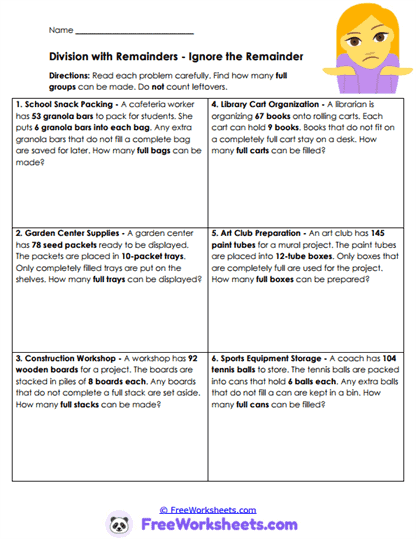
Full Groups
- What Kids Do:
Students solve division word problems where only complete groups count in the final answer. They analyze realistic situations involving storage, equipment, and supplies while deciding why leftover items should be ignored. - Target Skill:
Students build reasoning skills related to interpreting remainders within real-world contexts. This practice supports Common Core expectations for applying division appropriately and understanding when partial groups should not be included in final solutions.
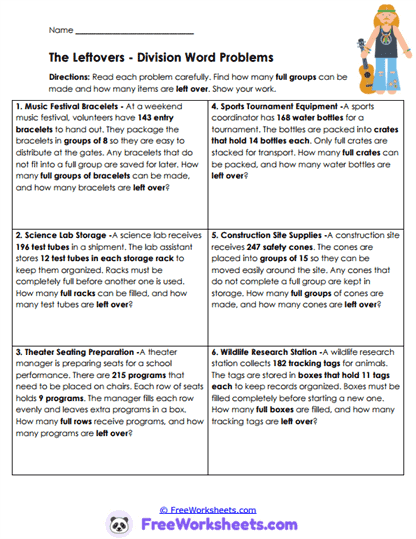
Group Counts
- What Kids Do:
Students divide totals into equal groups and determine both the quotient and the leftover remainder. Realistic scenarios involving programs, crates, and science materials help learners connect division concepts to practical situations. - Target Skill:
Students improve division fluency and remainder interpretation while practicing accurate grouping strategies. This aligns with Common Core standards focused on solving word problems and explaining the meaning of remainders in context.
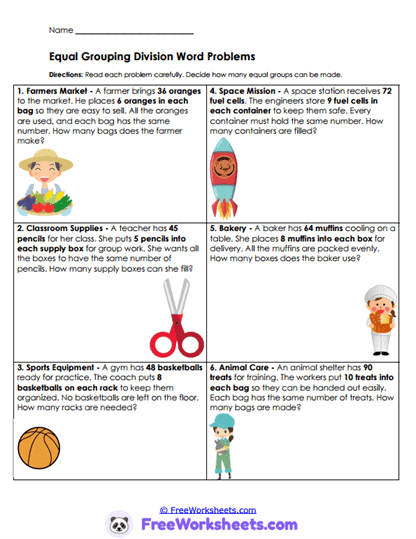
Group Quest
- What Kids Do:
Students solve equal-grouping division problems involving sports equipment, baked goods, and classroom supplies. They identify whether the task requires finding the number of groups or the number of items in each group. - Target Skill:
Students strengthen foundational division reasoning by applying equal-group strategies to practical situations. The worksheet reinforces Common Core skills involving division equations, problem interpretation, and real-world mathematical modeling.
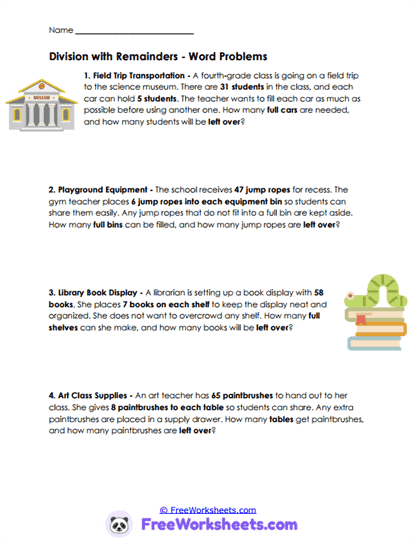
Remainder Routes
- What Kids Do:
Students solve division problems with leftovers and explain what the remainder represents in realistic situations such as field trips, shelving books, and organizing classroom supplies. Learners practice interpreting solutions carefully. - Target Skill:
Students develop confidence solving division problems involving remainders while connecting mathematical answers to story contexts. This Common Core-aligned practice supports reasoning, arithmetic fluency, and contextual interpretation of division results.
Share Stories
- What Kids Do:
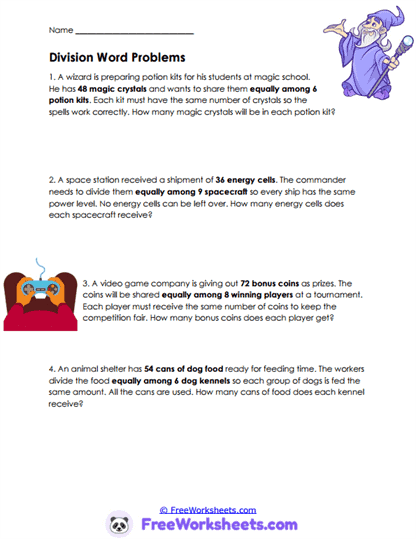
Students read engaging equal-sharing stories and divide totals into fair groups. Scenarios involving coins, food supplies, games, and themed adventures help learners practice dividing quantities evenly and explaining their thinking. - Target Skill:
Students strengthen understanding of division as equal sharing while improving fluency with basic division facts and problem-solving strategies. This supports Common Core expectations for applying operations within practical real-world situations.
Shuttle Math
- What Kids Do:
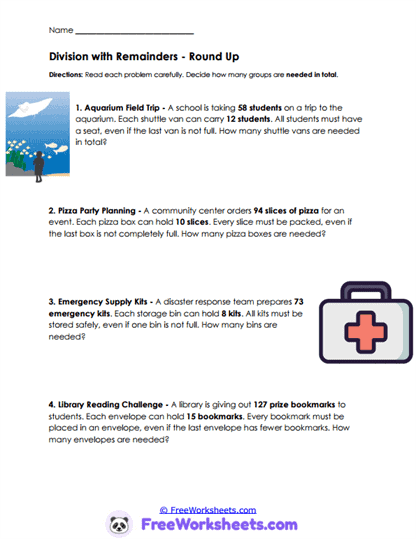
Students solve division problems where leftovers require an additional group, such as determining how many vans, bins, or boxes are needed. Learners analyze each scenario carefully to decide when rounding up is necessary. - Target Skill:
Students build reasoning skills related to interpreting remainders and making contextual decisions about grouping. This Common Core-aligned practice helps learners understand when every person or item must be included in the final answer.
Strategy Mix
- What Kids Do:
Students encounter a wide variety of division word problem types and decide which strategy best fits each situation. Problems include comparisons, grouping, remainders, multi-step reasoning, and rounding decisions in engaging contexts. - Target Skill:
Students improve critical thinking and mathematical flexibility by selecting appropriate operations and strategies independently. The worksheet reinforces Common Core goals related to problem-solving accuracy, contextual reasoning, and strategic application of division.
Team Totals
- What Kids Do:
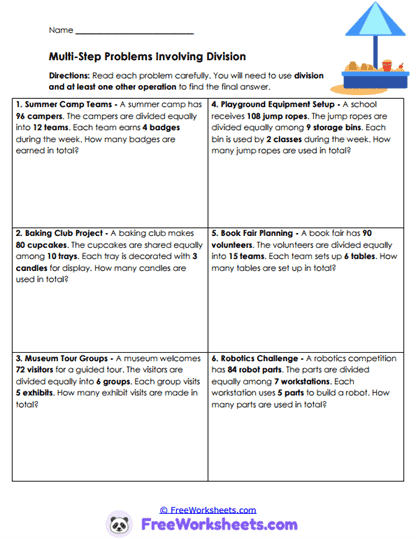
Students solve multi-step word problems that combine division with multiplication in practical situations involving camps, robotics, museums, and volunteer projects. Learners organize information and complete calculations step by step. - Target Skill:
Students strengthen multi-step problem-solving abilities by applying division and multiplication together within real-world scenarios. This Common Core-focused practice supports mathematical reasoning, operational fluency, and clear explanation of solution processes.