
Measuring Area And Perimeter Worksheets
4th grade math measuring area and perimeter worksheets help students calculate boundaries, compare covered space, and analyze measurements across varied shapes. Free, ready-to-print worksheets in PDF format are designed for immediate classroom use, centers, guided practice, homework, or homeschool lessons. Students strengthen perimeter calculation, area reasoning, and geometric measurement while developing skills that support curriculum expectations.
About This Collection of Worksheets
Measuring area and perimeter helps 4th grade students distinguish between two important features of geometric figures. Perimeter describes the total distance around a shape, while area describes how much space the shape covers. Understanding the difference helps students select the correct measurement method instead of confusing side-length addition with interior unit counting.
The collection includes perimeter error analysis, direct perimeter calculations, answer matching, regular and irregular polygons, composite figures, tiled shapes, and visual area comparisons. Students work with rectangles, triangles, trapezoids, pentagons, L-shapes, crosses, and other figures while calculating outside distances or comparing interior units. These varied formats encourage careful observation and make students apply measurement ideas across many types of shapes.
Teachers can use these worksheets during geometry lessons, guided math, centers, intervention, homework, review, or assessment preparation. Parents, tutors, and homeschool educators can begin with direct perimeter problems before progressing to irregular boundaries and visual area comparisons. Because students repeatedly calculate, compare, and check measurements, the collection supports stronger geometric reasoning and prepares learners for formulas, composite figures, and more advanced measurement problems.

Paul’s Teacher Tip
Have students say “around” for perimeter and “inside” for area before they begin each problem. When finding perimeter, encourage them to place a small check mark beside every outside edge as it is added so no side is skipped or counted twice. For irregular figures, tracing the entire boundary in one direction creates a reliable counting routine. When comparing area, have students write the number of equal units beside each figure before deciding which is larger. If students confuse the two measurements, ask whether they are measuring the border of the shape or the space the shape covers.
Worksheet Collection Skill Spotlights
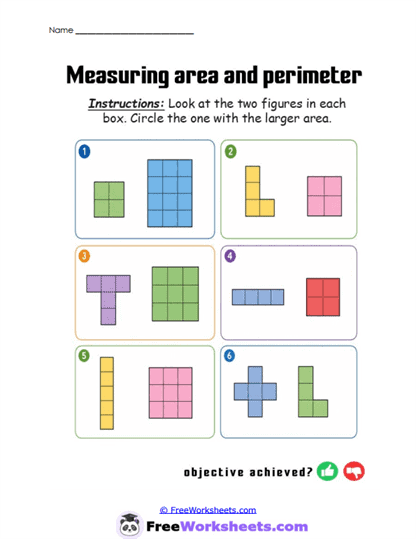
Area Pair Challenge
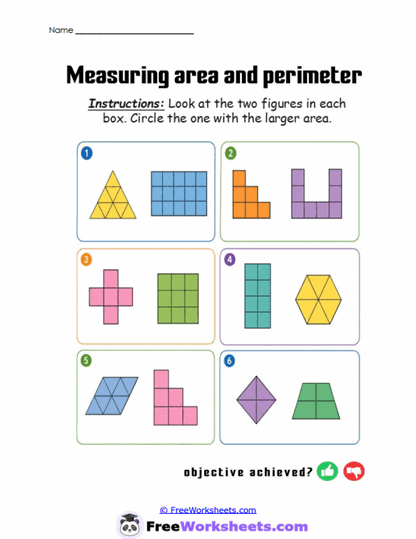
What Kids Do: Students compare six pairs of figures built from equal-sized square units. They count the interior units in each shape, write or mentally track both totals, and circle the figure that covers the greater amount of space in each pair.
Target Skill: This activity develops visual understanding of area as interior coverage rather than boundary length. 4th grade students practice counting unit squares systematically and learn that a taller, wider, or more unusual-looking shape does not automatically have greater area.
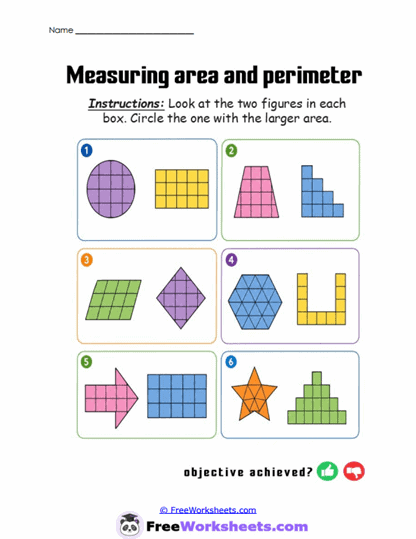
Area Unit Faceoff
What Kids Do: Students examine six pairs of more complex tiled figures, including rectangles, L-shapes, arrows, stars, hexagons, stair-step designs, and other arrangements. They group or count the equal units and identify which figure has the greater total area.
Target Skill: The worksheet strengthens area comparison and spatial reasoning with nonstandard shapes. 4th grade students learn to rely on equal-unit measurement rather than visual appearance while preparing to decompose composite figures into simpler sections for efficient area calculation.
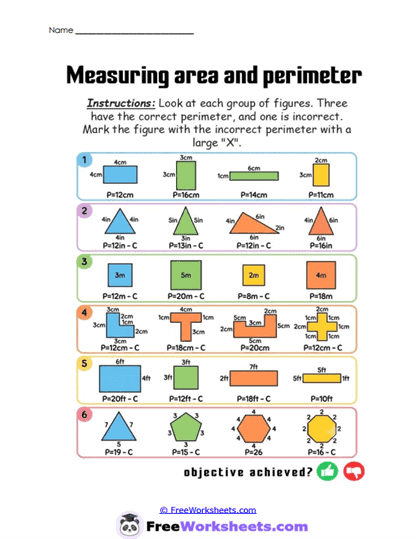
Boundary Check
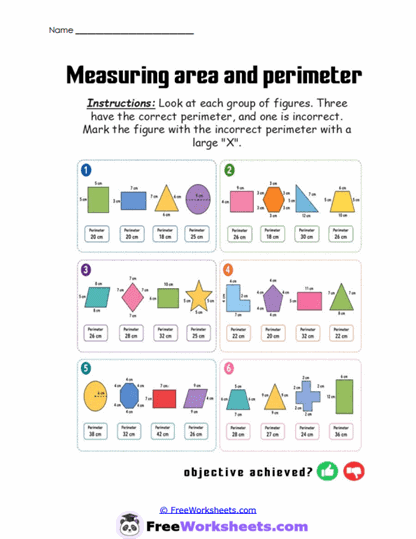
What Kids Do: Students work through four groups of figures that already have perimeter values printed beneath them. They add all labeled exterior side lengths, compare their calculated totals with the stated answers, and mark the one incorrect perimeter in each group.
Target Skill: This activity strengthens perimeter fluency and mathematical verification. 4th grade students practice following irregular boundaries carefully, adding every exterior side exactly once, and evaluating completed work instead of assuming that a printed measurement must be correct.
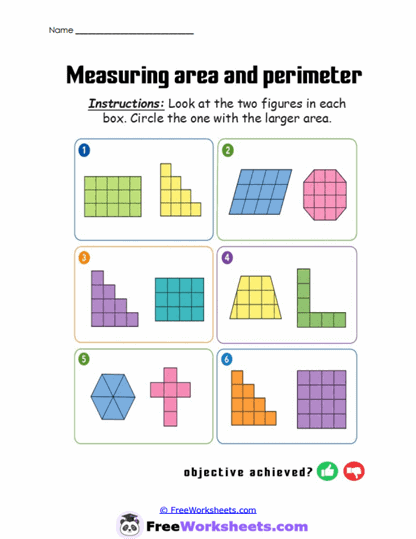
Grid Area Check
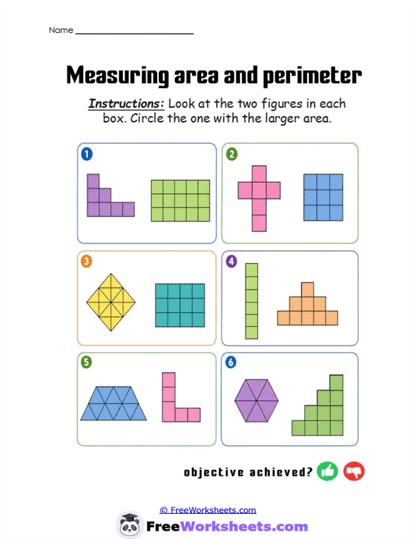
What Kids Do: Students solve six area-comparison problems featuring rectangles, stair-step figures, crosses, and other tiled shapes. They count equal-sized interior units in each figure, compare the two totals, and circle the shape that covers more space.
Target Skill: The worksheet develops area measurement with irregular visual models. 4th grade students practice organized unit counting, distinguish area from perimeter, and recognize that figures with very different outlines can still be compared fairly when their measurement units are equal.
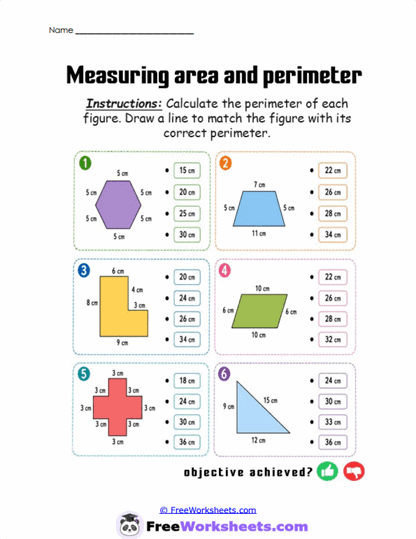
Irregular Perimeters
What Kids Do: Students calculate the perimeter of six multi-sided or composite figures, including a hexagon, trapezoids, an L-shape, a cross-shaped figure, and a triangle. They add every labeled boundary segment and match each total with the correct answer choice.
Target Skill: This activity extends perimeter reasoning beyond simple rectangles and squares. 4th grade students practice tracking many exterior edges, organizing multi-step addition, and applying the same definition of perimeter consistently to irregular and composite figures.
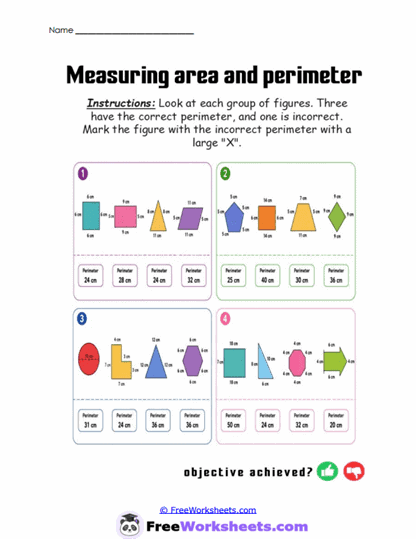
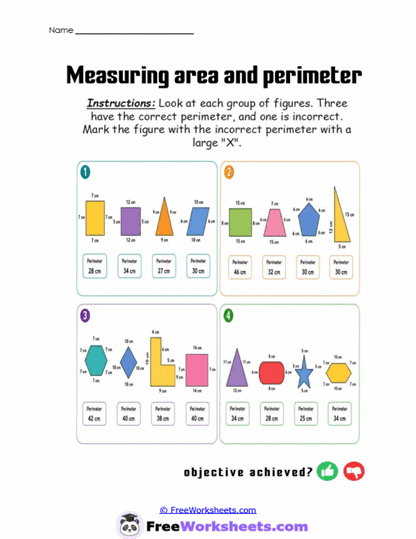
Perimeter Challenge
What Kids Do: Students inspect four groups containing several polygons with labeled side lengths and stated perimeter values. They independently calculate the total distance around each figure, compare it with the printed result, and identify the one incorrect answer in every set.
Target Skill: The worksheet strengthens perimeter calculation and error analysis across several shape types. 4th grade students practice distinguishing boundary length from area, adding numerous side measurements accurately, and recognizing when visual size does not match actual perimeter.
Perimeter Checkup
What Kids Do: Students examine six groups of rectangles, squares, triangles, diamonds, trapezoids, and other polygons. They recalculate the perimeter of each figure using its labeled sides and mark the one shape in each group whose printed perimeter is incorrect.
Target Skill: This activity reinforces perimeter as the sum of all exterior side lengths. 4th grade students develop a systematic checking routine, strengthen addition accuracy, and practice evaluating measurements across familiar and less familiar geometric figures.
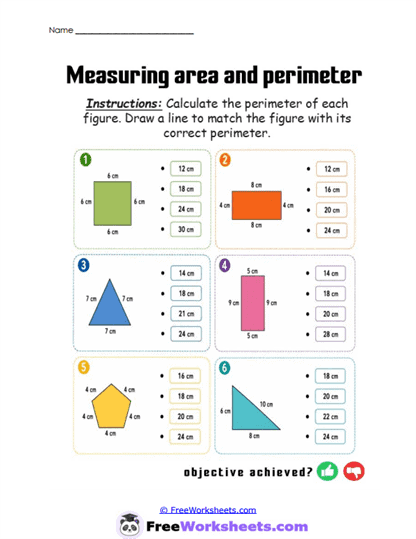
Perimeter Choices
What Kids Do: Students calculate the perimeter of six figures, including a square, rectangle, triangle, diamond, pentagon, and irregular L-shaped figure. They trace or inspect each boundary, add the labeled measurements, and connect the figure to the correct centimeter answer.
Target Skill: The worksheet builds independent perimeter calculation across regular and irregular shapes. 4th grade students practice recognizing every exterior segment, avoiding accidental area calculations, and verifying their totals against multiple possible measurements.
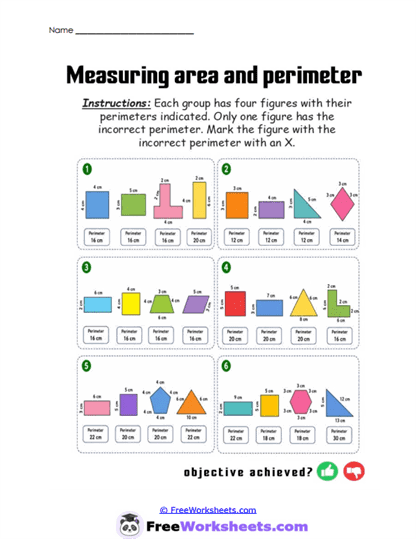
Perimeter Error Hunt
What Kids Do: Students check six groups of four figures that already display side lengths and perimeter answers. They calculate the outside distance for rectangles, triangles, squares, crosses, pentagons, and other polygons and place an X on the incorrect perimeter in each group.
Target Skill: This activity combines measurement practice with mathematical error detection. 4th grade students strengthen side-length addition, boundary recognition, and the habit of verifying completed solutions while learning that perimeter depends on every outside edge of a figure.
Perimeter Match
What Kids Do: Students solve six direct perimeter problems involving a square, rectangles, triangles, and a diamond-shaped quadrilateral. They add all labeled sides for each figure and draw a line from the shape to the correct perimeter measurement among four answer choices.
Target Skill: The worksheet strengthens straightforward perimeter computation and answer matching. 4th grade students practice expressing perimeter in appropriate units, recognizing polygon boundaries, and using addition rather than area formulas to determine total outside distance.
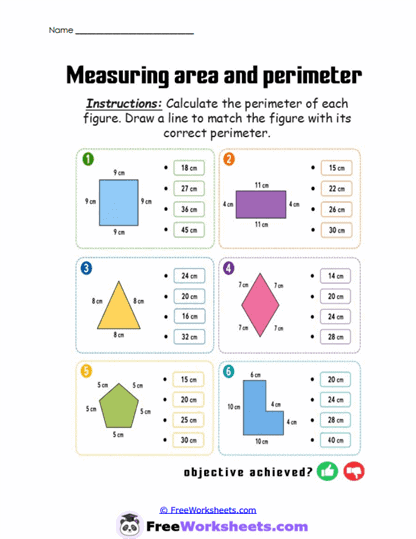
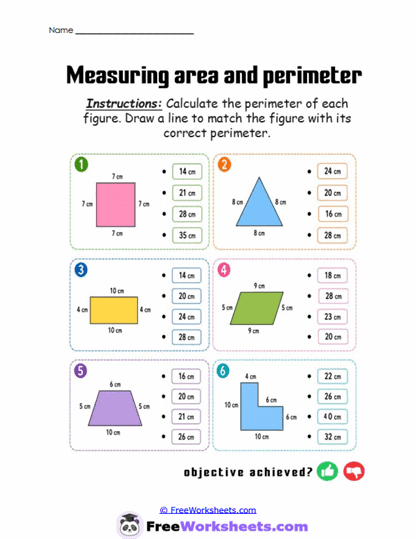
Perimeter Matchup
What Kids Do: Students calculate perimeter for six figures that include a square, triangle, rectangle, parallelogram, trapezoid, and L-shaped composite figure. They add each exterior side length and match the completed calculation with its correct measurement choice.
Target Skill: This activity develops perimeter fluency across increasingly varied shapes. 4th grade students practice adapting the same boundary-measurement concept to common polygons and composite figures while strengthening organized multi-step addition and spatial reasoning.
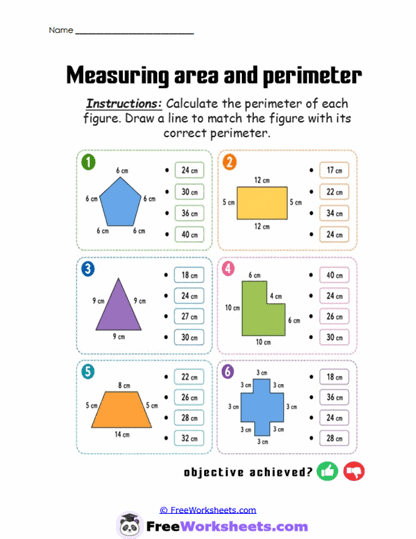
Perimeter Practice
What Kids Do: Students solve six perimeter problems featuring a pentagon, rectangle, triangle, L-shaped figure, trapezoid, and cross-shaped composite figure. They identify every outside side, add the given measurements, and choose the correct perimeter from the available answers.
Target Skill: The worksheet provides mixed practice with both regular and irregular boundaries. 4th grade students reinforce careful side tracking, whole-number addition, polygon analysis, and the understanding that perimeter is determined by exterior length rather than a figure’s overall appearance.
Polygon Perimeter Hunt
What Kids Do: Students inspect six sets of varied geometric figures and verify the stated perimeter of every shape. They trace outside boundaries, add the labeled lengths, compare their totals with the printed measurements, and identify the single incorrect result in each set.
Target Skill: This activity develops perimeter reasoning with a broad range of polygon structures. 4th grade students strengthen visual analysis, multi-step addition, and error checking while learning to ignore interior lines and focus only on the complete exterior boundary.
Shape Area Compare
What Kids Do: Students compare six pairs of differently shaped figures divided into equal area units. They count or combine the units inside triangles, rectangles, L-shapes, crosses, parallelograms, diamonds, and trapezoids and circle the figure with the greater area.
Target Skill: The worksheet strengthens flexible visual area reasoning across different geometric forms. 4th grade students learn to compare interior coverage rather than outlines and develop the systematic unit-counting skills needed before using multiplication and area formulas.
Tiled Shape Compare
What Kids Do: Students examine six pairs of tiled geometric models, including rectangles, crosses, stair-step shapes, diamonds, trapezoids, and other arrangements. They count or group the equal-sized pieces in each figure and circle the one with the larger total area.
Target Skill: This activity reinforces area as a measure of covered space regardless of shape or orientation. 4th grade students practice comparing equal units, separating area from perimeter, and reasoning about nonstandard figures without relying on height, width, or visual impressions alone.