
About This Worksheet
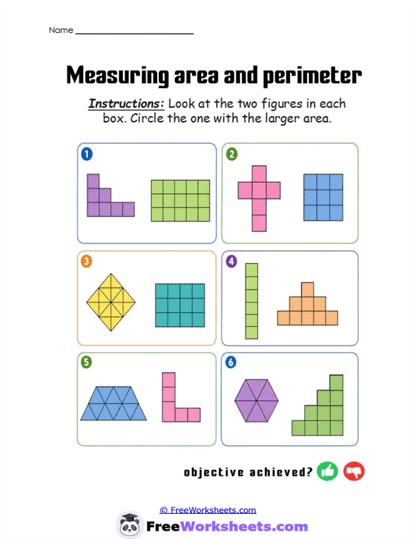
Tiled Shape Compare is a fourth grade area activity that asks students to compare two figures made from equal-sized pieces. The models include rectangles, crosses, stair-step shapes, diamonds, trapezoids, and other tiled arrangements. Students determine which figure contains more area units and circle the larger one. The activity shows that shape and orientation can change while the amount of space covered is still determined by the number of equal units.
Curriculum and Grade Alignment
This worksheet is intended for fourth grade learners who are developing stronger area sense with nonstandard shapes. The main goal is to help students compare area without being distracted by the overall outline of a figure. Before beginning, your child should understand how unit squares or equal sections represent area. The next step is using multiplication or decomposition to calculate area more efficiently. This activity supports area comparison, geometry, and spatial reasoning.
Student Tasks
Students will complete six pairwise area comparisons. They examine the equal-sized pieces inside each figure, count or group them, and circle the figure with the greater total area. The page includes both rectangular and irregular shapes, encouraging students to use the units rather than appearance alone. This builds flexible visual reasoning and careful counting.
Common Challenges and Misconceptions
Some students may think a wider or taller figure must have more area. Others may compare the outside boundary instead of the number of interior units. A child may also have trouble counting triangular or angled pieces when the models are not all made from simple squares. Encourage your child to look for complete unit groups and combine smaller pieces when appropriate. This keeps the focus on covered space.
Implementation Guidance
Teachers can use this worksheet as area-comparison practice after introducing square units and tiled models. It works well in small groups because students can discuss different ways to count the same figure. Parents can ask the child to explain why the larger-looking shape is not always the one with greater area. This helps separate area from visual impression and perimeter.
Details and Features
This worksheet includes six color-coded pairs of geometric models. Each figure is divided into equal area units, and students circle the figure with the larger area. The varied outlines add challenge while keeping the measurement concept consistent. The printable supports unit-area reasoning, shape comparison, visual counting, and geometry.