
Multi-step Word Problems Worksheets
4th grade math multi-step word problems worksheets help students organize information, choose operations, and solve problems requiring several calculations. Free, ready-to-print worksheets in PDF format are designed for immediate classroom use, centers, guided practice, homework, or homeschool lessons. Students strengthen operation sense, mathematical reasoning, and problem solving while developing skills that support curriculum expectations.
About This Collection of Worksheets
Multi-step word problems help 4th grade students learn how to organize information and decide what must happen first, second, and sometimes third. Students combine addition, subtraction, multiplication, and division while interpreting real-world situations and determining which quantities matter. This type of practice develops the planning skills needed to solve longer problems without simply grabbing numbers and calculating.
The collection includes operation planning, equation matching, bar models, first-step identification, error analysis, irrelevant-information problems, estimation, remainder interpretation, seasonal applications, and mixed-up solution steps. Some worksheets provide clear organizational support, while others ask students to select operations or explain the reasoning behind a solution more independently. These varied formats strengthen both computation and problem structure.
Teachers can use these worksheets for whole-class lessons, guided math, centers, intervention, homework, review, or assessment preparation. Parents, tutors, and homeschool educators can encourage students to underline the question, identify relevant information, and explain each planned step before calculating. Because the collection emphasizes sequencing, checking, and interpretation, it helps students build confidence with increasingly complex mathematical situations.

Paul’s Teacher Tip
Before students calculate, have them explain what the first step will find and why that information is needed. Encourage them to underline the final question so they do not stop after an intermediate calculation. When several numbers appear, ask whether each one is actually necessary to answer the problem. For division problems with remainders, have students explain what the leftover amount means in context before giving the final answer. After solving, students should reread the question and check that their answer label matches what was actually asked.
Worksheet Collection Skill Spotlights
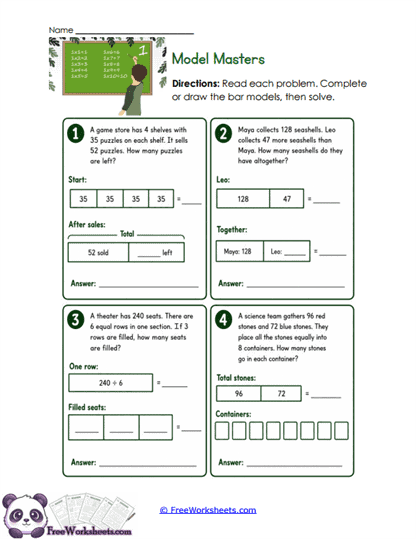
Bar Model Solver
What Kids Do: Students solve four multi-step problems using partially completed bar models to organize the quantities. They identify how the visual sections represent totals, equal groups, removed amounts, or remaining values and then use the model to complete the necessary calculations.
Target Skill: This activity develops mathematical modeling and operation sequencing. 4th grade students learn to translate word-problem relationships into visual structures, identify which quantity must be found first, and connect that result with the operation needed for the next step.
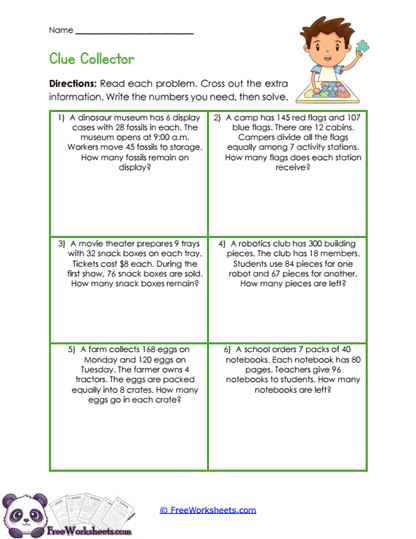
Clue Filter
What Kids Do: Students solve six multi-step word problems that contain extra numerical information. They decide which details are relevant, cross out values that are not needed, organize the remaining information, and then complete the required calculations in the correct order.
Target Skill: The worksheet strengthens problem analysis and reading comprehension. 4th grade students practice distinguishing useful data from distracting details, selecting operations from the meaning of the story, and avoiding the common habit of using every number simply because it appears.
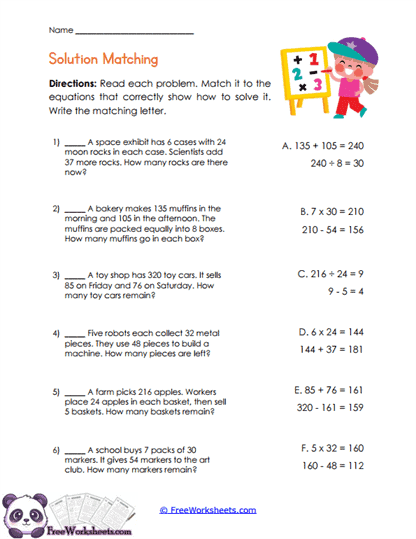
Equation Match
What Kids Do: Students read six multi-step stories and compare them with six lettered pairs of equations. They determine what must happen first and second in each situation, identify the equation pair that accurately represents those steps, and record the matching letter.
Target Skill: This activity strengthens mathematical representation and operation sequencing. 4th grade students practice connecting written situations with numerical equations and recognizing that both the choice of operations and their order must accurately reflect the structure of the problem.
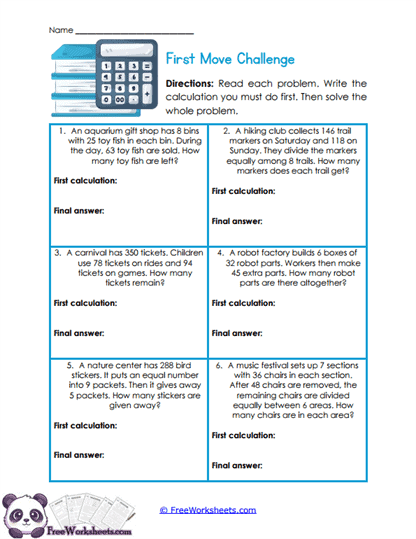
First Step Focus
What Kids Do: Students solve six multi-step word problems by identifying the first calculation before continuing with the complete solution. They determine which information must be found initially, write that calculation, use its result in the next step, and record the final answer.
Target Skill: The worksheet develops planning and sequencing skills for longer problems. 4th grade students learn to identify prerequisite information, choose the correct first operation, and understand how one intermediate result becomes necessary information for the next calculation.
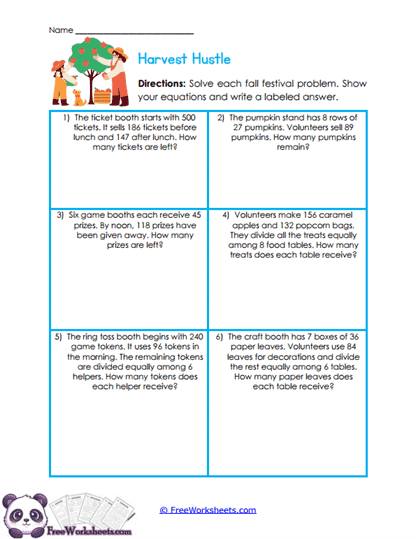
Harvest Problem Solving
What Kids Do: Students solve six fall-themed word problems involving tickets, pumpkins, prizes, treats, game tokens, and craft supplies. They determine the two operations needed, write both equations in order, complete the calculations, and provide a labeled final answer.
Target Skill: This activity strengthens mixed-operation problem solving in contextual situations. 4th grade students practice deciding which operation must come first, carrying an intermediate answer into the next step, and communicating a complete solution with appropriate units or labels.
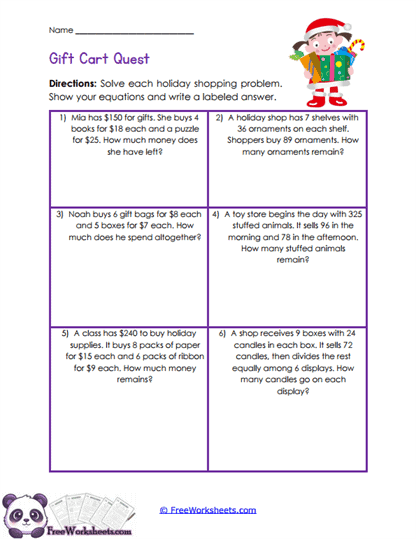
Holiday Shopping
What Kids Do: Students solve six holiday-themed problems involving gifts, ornaments, presents, stuffed animals, supplies, and candle displays. They use two or more operations as needed, show the equations that represent each stage, and write a labeled final response.
Target Skill: The worksheet develops real-world multi-step reasoning with all four operations. 4th grade students practice combining multiplication with addition, subtraction, or division while organizing calculations in a logical sequence and checking that the result fits the shopping situation.
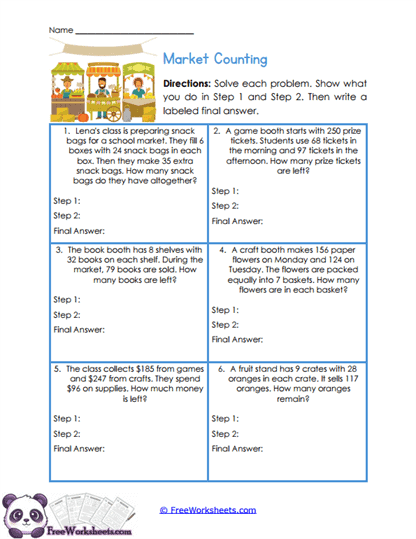
Market Math
What Kids Do: Students complete six market-themed word problems involving snack bags, prize tickets, books, flowers, money, and oranges. Each problem provides separate spaces for Step 1, Step 2, and the Final Answer so students can organize two calculations clearly.
Target Skill: This activity builds foundational multi-step problem-solving habits. 4th grade students practice identifying which quantity must be calculated first, selecting appropriate operations, using the first result correctly in the second step, and recording a complete answer to the original question.
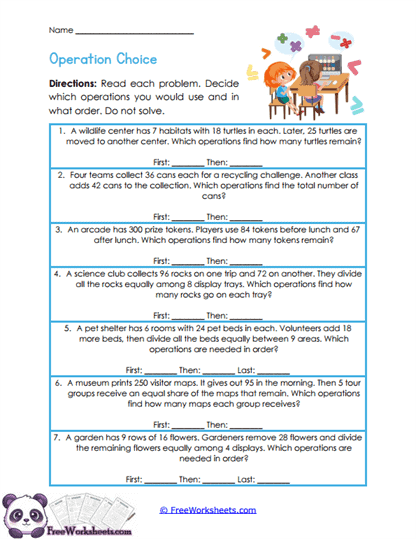
Operation Planner
What Kids Do: Students read seven multi-step situations and identify which operation should be used first, which should come next, and, when needed, which should be completed last. They focus on planning the solution sequence without carrying out all of the arithmetic.
Target Skill: The worksheet isolates operation sense from computation so 4th grade students can focus on problem structure. Learners practice interpreting actions in a story, selecting addition, subtraction, multiplication, or division, and sequencing those operations logically before solving.
Reasonable Answers
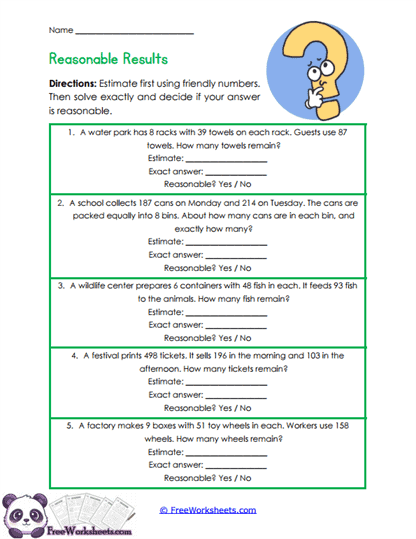
What Kids Do: Students solve five multi-step word problems by first estimating with friendly numbers and then calculating the exact result. After comparing the estimate with the exact answer, they decide whether the completed solution is mathematically reasonable.
Target Skill: This activity strengthens estimation, number sense, and self-checking within multi-step problems. 4th grade students learn to create an expected answer range before calculating and use that prediction to recognize results that may contain an operation or computation error.
Remainder Decisions
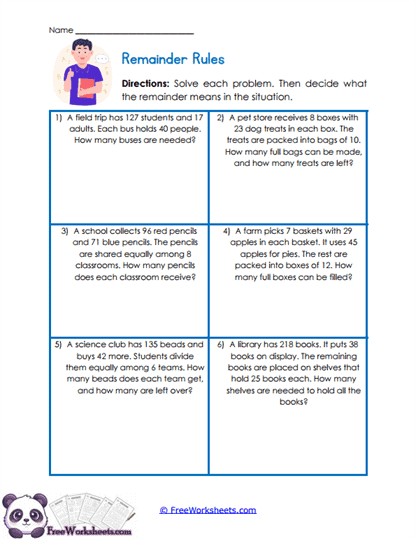
What Kids Do: Students solve six division-based word problems involving buses, boxes, supplies, apples, teams, and shelves. They calculate the quotient and remainder and then decide whether the situation requires reporting leftovers, using the whole-number quotient, or rounding up.
Target Skill: The worksheet develops contextual interpretation of remainders. 4th grade students learn that a remainder is not handled the same way in every problem and must be interpreted according to whether the question asks about leftovers, full groups, or total groups needed.
Solution Repair
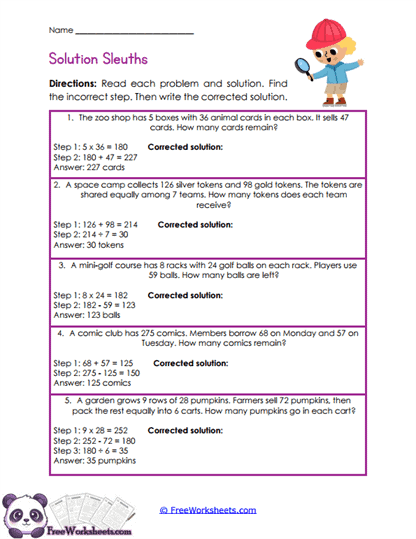
What Kids Do: Students inspect five incorrectly solved multi-step problems involving zoo cards, arcade tokens, golf balls, comic books, and pumpkins. They review each calculation in sequence, locate the error in reasoning or arithmetic, and rewrite the complete solution correctly.
Target Skill: This activity strengthens error analysis and mathematical verification. 4th grade students practice checking operation choice, step order, and computation rather than focusing only on a final answer, helping them develop stronger habits for reviewing their own multi-step work.
Step Order Challenge
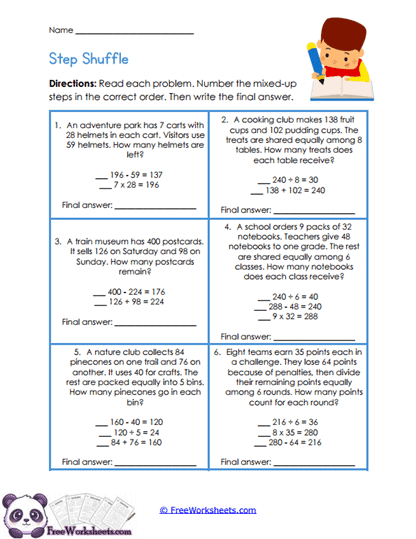
What Kids Do: Students read six word problems accompanied by calculations that have been placed in the wrong order. They determine what each calculation represents, number the steps so the solution follows the story logically, and then use the corrected sequence to find the final answer.
Target Skill: The worksheet develops logical sequencing and understanding of dependency between calculations. 4th grade students practice recognizing that later operations often rely on results from earlier steps and that a valid multi-step solution must follow the mathematical structure of the situation.