
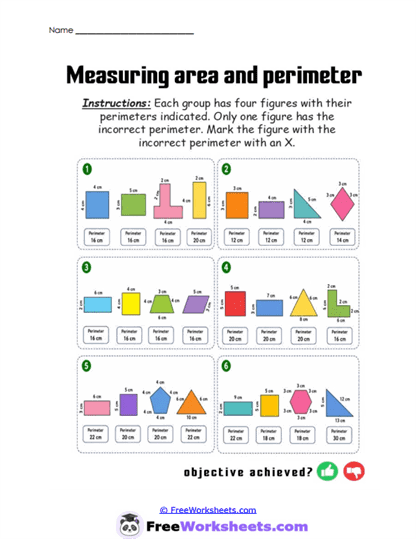
About This Worksheet
Perimeter Checkup is a fourth grade error-analysis activity that asks students to verify perimeter values for several different figures. Each group includes four shapes with side lengths shown and a perimeter written underneath. Students determine which three perimeter calculations are correct and which one is not. By recalculating the distance around each shape, students practice perimeter while learning not to trust a completed answer without checking it.
Curriculum and Grade Alignment
This worksheet is intended for fourth grade learners who are strengthening perimeter skills with multiple polygon types. The main goal is to help students apply the rule of adding all exterior side lengths and use that rule to evaluate completed work. Before beginning, your child should understand what perimeter means and be comfortable adding several side lengths. The next step is solving perimeter problems where some side lengths are missing or must be inferred. This activity supports geometry, measurement, addition, and error analysis.
Student Tasks
Students will examine six groups of four figures. The shapes include rectangles, squares, triangles, diamonds, trapezoids, and other polygons. They add the labeled side lengths for each figure, compare the result with the printed perimeter, and mark the one incorrect answer in each group. The repeated format encourages accuracy and careful visual inspection.
Common Challenges and Misconceptions
Some students may skip equal-looking sides that are not individually labeled, or they may count only the longest dimensions. Others may confuse perimeter with area and multiply length by width. A child may also forget that irregular figures still require every outside side to be counted. Encourage your child to move clockwise around each figure and keep a running total. This creates a consistent checking routine.
Implementation Guidance
Teachers can use this worksheet as a follow-up to direct perimeter instruction. It works especially well in small groups because students can explain why a particular stated perimeter is wrong. Parents can ask the child to write a small addition sentence beside each figure before comparing with the answer. This keeps the reasoning visible and easier to check.
Details and Features
This worksheet includes six boxed perimeter-checking groups with four figures in each. Side lengths and perimeter values are printed directly with the shapes. Students identify one incorrect perimeter in every set. The printable supports perimeter fluency, error checking, polygon recognition, and measurement reasoning.