
About This Worksheet
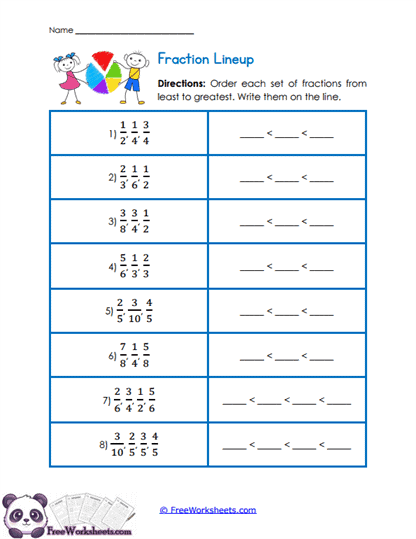
Fraction Order Line is a fourth grade activity that asks students to put groups of fractions in order from least to greatest. Each row gives three or four fractions with different numerators and denominators, so students must compare their values before deciding where each one belongs. For example, a set such as 1/2, 1/4, and 3/4 requires students to recognize which fraction is smallest, which is in the middle, and which is largest. This helps children move beyond comparing only two fractions at a time and begin thinking about several fractional values together.
Curriculum and Grade Alignment
This worksheet is made for fourth grade learners who are strengthening fraction comparison and ordering skills. The main goal is to help students arrange several fractions by size using strategies such as common denominators, equivalent fractions, benchmarks, and numerator or denominator reasoning. Before using this page, your child should be comfortable comparing two fractions. The next step is ordering more complex sets of fractions and explaining which comparison strategy was most useful. This activity supports fraction magnitude, number sense, and ordering.
Student Tasks
Students will complete eight ordering problems. Most sets contain three fractions, while some include four. Students compare all of the values and write them from least to greatest using < symbols between the answers. The problems include a mixture of like denominators, unlike denominators, familiar benchmark fractions, and equivalent values. This builds careful comparison and the ability to consider several fractions at once.
Common Challenges and Misconceptions
Some students may correctly find the smallest fraction but struggle to place the remaining values in order. Others may compare only the numerators or denominators when the fractions are not directly comparable that way. A child may also overlook equivalent fractions and accidentally place equal values in different positions. Encourage your child to compare each fraction to familiar benchmarks such as 1/2 and 1 before ordering the full set. This often makes the sequence easier to see.
Implementation Guidance
Teachers can use this worksheet after students have practiced several fraction comparison strategies. It works well as an independent review because students must choose the strategy that fits each set. Parents can have the child write a quick decimal-like estimate or draw a number line if a group feels difficult. Another helpful approach is to identify the smallest and largest fractions first, then place the remaining value or values between them. This keeps the ordering process organized.
Details and Features
This worksheet includes eight fraction-ordering problems in a blue table. Students arrange sets of three or four fractions from least to greatest and write them using comparison symbols. The variety of denominators encourages flexible strategy use. The printable supports fraction comparison, ordering, benchmarks, equivalence, and number sense.