
Identifying Factors And Multiples Worksheets
Finding every factor of a number requires more careful reasoning than recognizing a familiar multiplication fact. These grade 4 identifying factors and multiples worksheets focus on factor recognition through coloring valid factors around numbers in stars and circles, crossing out incorrect entries in factor lists, and connecting numbers to shared factors. The free printable PDFs suit learners strengthening their multiplication and division knowledge. Encourage children to test each possible factor rather than guessing, using division or a multiplication equation to confirm that it divides evenly.
-
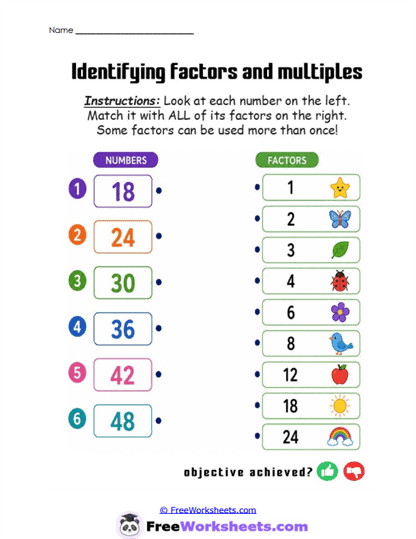
Complete Factor Match
-
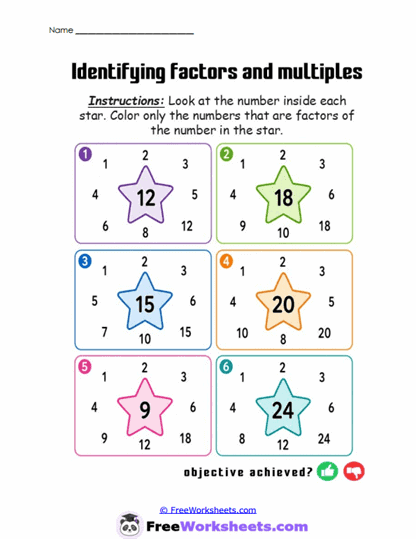
Factor Circle Challenge
-
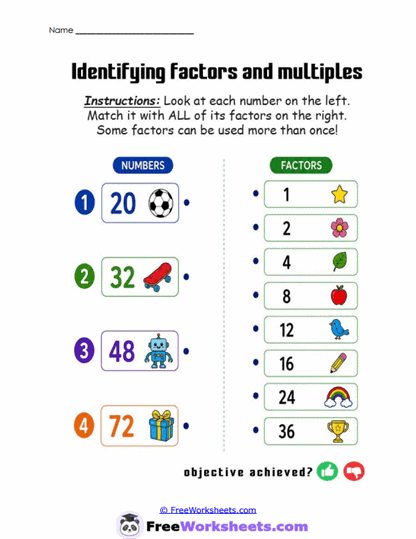
Factor Connection Challenge
-
-
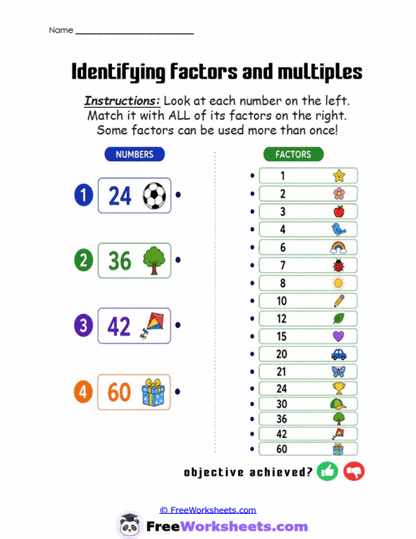
Factor Connection Web
-
Factor Field Check
-
Factor Intruder Hunt
-
Factor List Detective
-
Factor List Repair
-
Factor Match Network
-
Factor Mistake Hunt
-
Factor Shape Search
-
Factor Star Search
-
Odd Factor Out
-
Shape Factor Hunt
-
Shared Factor Links
About This Collection of Worksheets
Identifying factors helps students understand how whole numbers are built through multiplication. A factor divides a target number evenly, with no remainder, and can be confirmed with a multiplication equation. This understanding supports later work with prime and composite numbers, common factors, and fraction simplification.
The collection offers several visual and reasoning-based ways to practice. Students color factors around target numbers in stars, circles, and other shapes; mark the number that does not belong in a factor list; and connect multiple targets to shared factor banks. The activities progress from checking individual choices to comparing complete factor sets.
Teachers can use these worksheets for guided lessons, math centers, partner work, independent practice, homework, or review. Parents, tutors, and homeschool educators can ask students to prove a choice with multiplication or division before coloring, crossing out, or drawing a connection. For extra support, counters can help students model equal groups; students ready for a challenge can compare which targets share the most factors.
Paul’s Teacher Tip
Begin by modeling a target number with a multiplication pair, then show how division confirms that each number divides evenly. Have students test one choice at a time and explain the evidence for including or excluding it. Watch for the misconception that every number smaller than an even target is a factor; even numbers still need to divide with no remainder. When students mark an intruder, ask them to replace it with a number that really is a factor. For an extension, invite them to find all factor pairs for one target and compare its factor list with another.
Worksheet Collection Skill Spotlights
Complete Factor Match
What Kids Do: Students connect each of six target numbers, including 18, 24, 30, 36, 42, and 48, to every matching factor in a shared number list. They draw multiple lines when the same factor belongs with more than one target.
Target Skill: The activity develops accuracy identifying complete factor sets and introduces common factors through repeated connections. Students check whether each number divides a target evenly, reinforcing the relationship between multiplication facts, division, and factor relationships.
Factor Circle Challenge
What Kids Do: Students work through six numbered sections, each with a target number in the center and possible factors arranged around it. They test each choice and color only the numbers that divide the target evenly, leaving the other choices uncolored.
Target Skill: Repeatedly evaluating possible factors builds confidence using multiplication and division to check divisibility. Students also compare how many factors different targets have, supporting number sense and preparing them to classify prime and composite numbers.
Factor Connection Challenge
What Kids Do: Students examine a factor bank and connect each of four larger targets-20, 32, 48, and 72-to every factor that belongs. They can reuse a factor when it divides more than one target, creating a complete network of correct relationships.
Target Skill: This challenge strengthens students’ ability to identify factors of larger numbers and compare factor sets. Checking each possible connection helps students recognize shared factors and builds understanding that an even target does not automatically make every even number a factor.
Factor Connection Web
What Kids Do: Students start with four target numbers-24, 36, 42, and 60-and draw lines to every matching number in a broad factor bank. They check the list systematically for each target, creating a web that shows all the correct factor relationships.
Target Skill: Working with a larger bank develops careful divisibility checking and helps students identify complete factor sets. Comparing the overlapping connections builds understanding of common factors and supports later work with greatest common factors and fraction simplification.
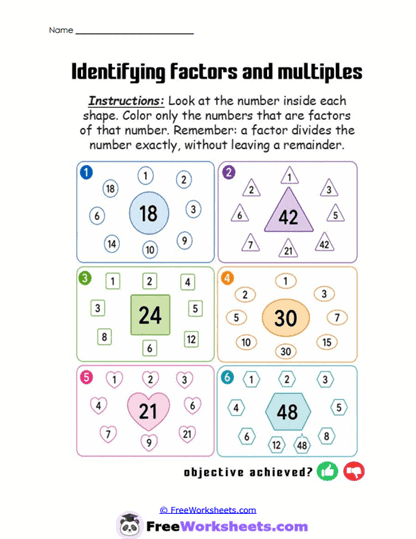
Factor Field Check
What Kids Do: Students review six target numbers, including 18, 21, 30, 42, and 48, and examine the choices around each one. They color every true factor and leave the nonfactors uncolored, checking the choices with multiplication or division as needed.
Target Skill: This activity helps students identify factors efficiently while reinforcing that a factor must divide the target exactly. The range of target numbers encourages them to use different multiplication facts and recognize that numbers can have different numbers of factors.
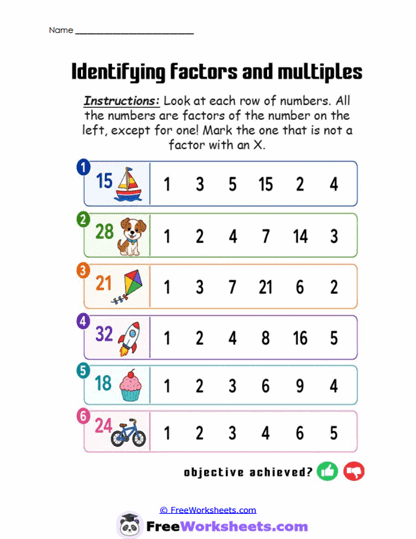
Factor Intruder Hunt
What Kids Do: Students read six target numbers, each followed by a short list of possible factors. They test every number in a row, then place an X on the single choice that does not divide the target evenly.
Target Skill: Students practice verifying factor relationships instead of selecting answers by appearance or familiarity. Identifying and explaining the intruder strengthens multiplication and division reasoning while preparing students to work with primes, composites, and common factors.
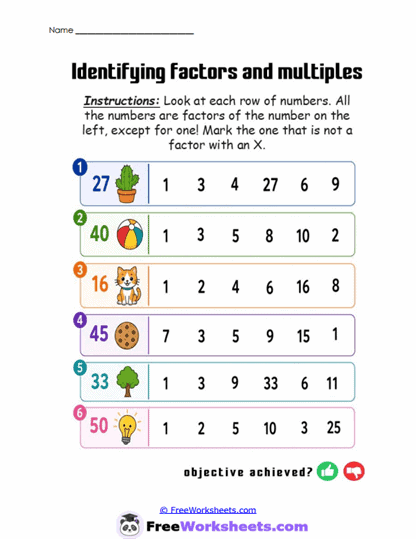
Factor List Detective
What Kids Do: Students inspect possible factor lists for targets such as 27, 40, 16, 45, 33, and 50. They check each number in a row, find the one choice that is not a true factor, and mark it with an X.
Target Skill: The detective format develops precision when working with factor lists, including lists where incorrect choices may look plausible. Students use multiplication or division to confirm whether each number divides the target evenly and can extend the practice by listing all its factors.
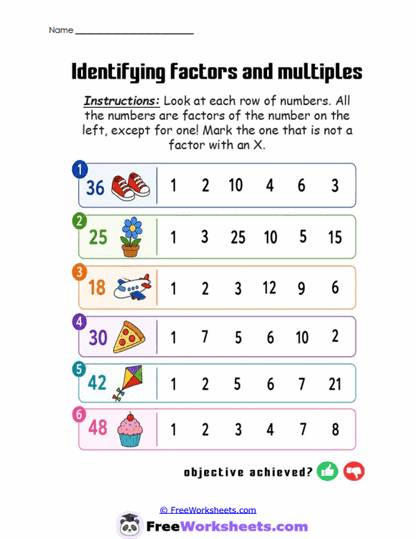
Factor List Repair
What Kids Do: Students examine six target numbers, including 36, 25, 18, 30, 42, and 48, alongside lists that each contain one incorrect choice. They test the numbers, mark the one that does not belong, and can rewrite the row as a correct factor list.
Target Skill: Finding and correcting an error reinforces how to verify factor lists with multiplication and division. Students build accuracy with factor pairs and learn to check every choice rather than relying on visual clues or assumptions about the largest number.
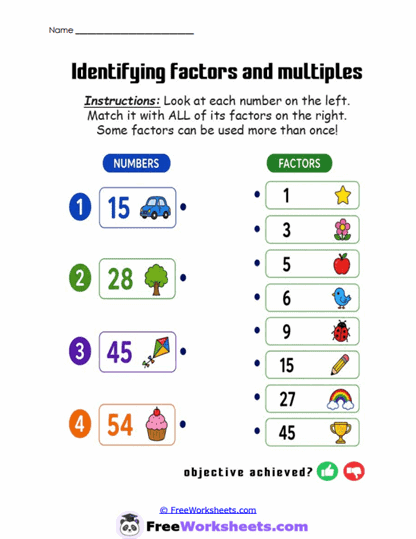
Factor Match Network
What Kids Do: Students connect each of four targets-15, 28, 45, and 54-to all of its factors in a shared bank. They work through the bank for each target, drawing every correct line and reusing factors when they apply to multiple numbers.
Target Skill: The network format helps students compare factor relationships across different targets, including odd and even numbers. They strengthen divisibility reasoning and multiplication recall while seeing that one factor may belong to several numbers.
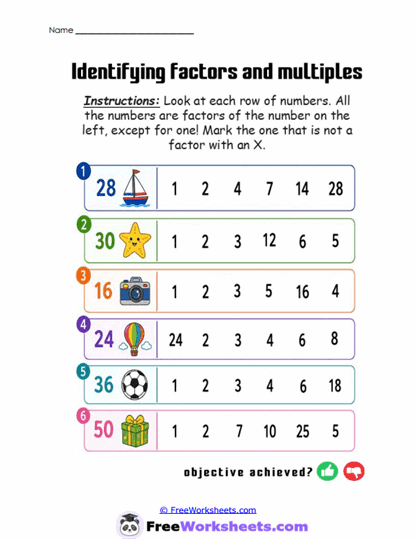
Factor Mistake Hunt
What Kids Do: Students inspect six nearly correct factor lists for target numbers such as 28, 30, 16, 24, 36, and 50. They test each listed number and mark the one choice in every row that is not actually a factor.
Target Skill: This activity builds the habit of checking each factor with mathematical evidence. Students practice using multiplication facts and division to find errors, reinforcing that a number must divide the target exactly and preparing them for later divisibility and fraction work.
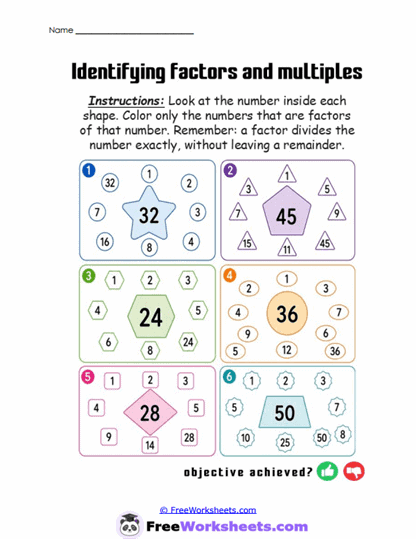
Factor Shape Search
What Kids Do: Students look at six target numbers shown inside colorful shapes, including 32, 45, 24, 36, 28, and 50. They test the surrounding choices and color only the numbers that divide each target evenly.
Target Skill: Applying the same factor rule across different visual layouts keeps students focused on number relationships rather than a single format. Thinking in factor pairs supports accuracy with larger targets and helps students recognize how factor counts vary from number to number.
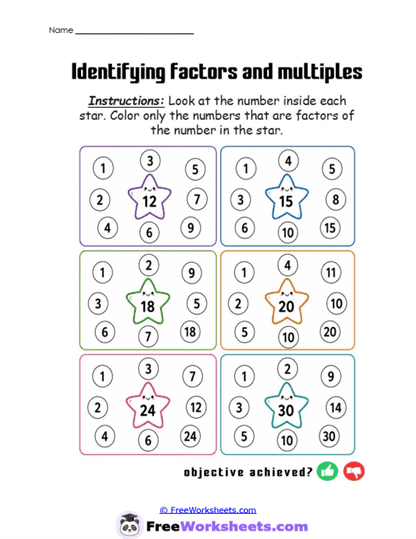
Factor Star Search
What Kids Do: Students examine six star diagrams with target numbers in the center and possible factors around them. They check each surrounding number and color the choices that divide the target evenly, repeating the process for targets such as 12, 15, 18, 20, 24, and 30.
Target Skill: The visual search builds understanding that factors divide a whole number with no remainder. Connecting each correct choice to a multiplication fact reinforces the link between multiplication and division and provides practice that supports prime and composite classification.
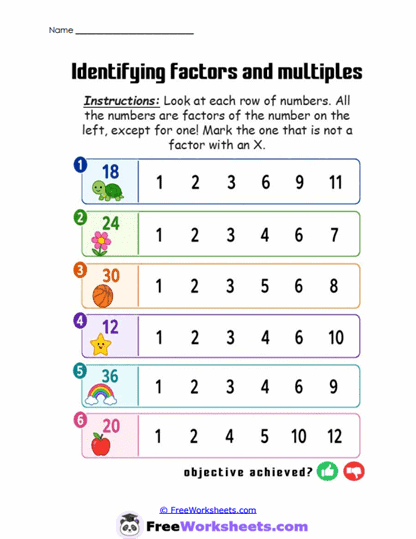
Odd Factor Out
What Kids Do: Students read a target number at the start of each row, then test the short list of possible factors beside it. All but one choice divide the target evenly; students check the list and mark the single number that does not belong.
Target Skill: Finding the exception strengthens careful checking and helps students distinguish true factors from numbers that only seem related. Verifying each choice with multiplication or division reinforces the meaning of a factor and develops mathematical accuracy.
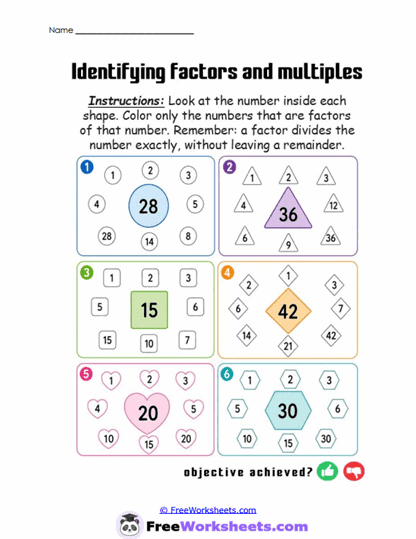
Shape Factor Hunt
What Kids Do: Students work with six target numbers displayed in different shapes, such as 28, 36, 15, 42, 20, and 30. For each shape, they test the numbers around the target and color all choices that divide it evenly.
Target Skill: Changing the visual shape while keeping the math consistent encourages students to focus on factor relationships. They practice finding all factors, using multiplication or division as proof, and noticing how different target numbers have different factor sets.
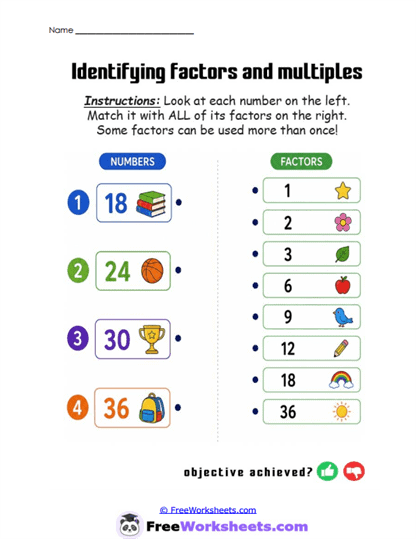
Shared Factor Links
What Kids Do: Students connect four target numbers-18, 24, 30, and 36-to all the factors that divide them evenly. A shared factor bank can be used more than once, so they draw every correct line and compare which factors connect to multiple targets.
Target Skill: Identifying complete factor sets helps students see how different numbers can share factors. The task reinforces division and multiplication as ways to verify a connection and prepares students to work with common factors and simplify fractions.