
About This Worksheet
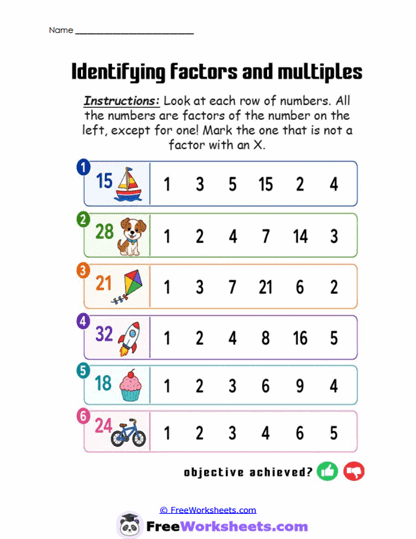
This Grade 4 math worksheet helps children practice spotting the one number that is not a factor in each row. Students work with target numbers such as 15, 28, 21, 32, 18, and 24. Beside each target is a short list of possible factors. Most of the numbers belong, but one does not.
This is a useful activity because it makes students check every choice instead of simply naming a few factors they already know. It also gives teachers and parents a quick way to see whether a child can tell the difference between a true factor and a number that only looks related.
Learning Goals
The main goal is to help students verify factor relationships accurately.
Children practice using multiplication facts and division to decide whether a number divides the target evenly. They also strengthen their understanding that a factor must go into a number with no remainder.
This builds number sense and supports later work with prime numbers, composite numbers, common factors, and fraction simplification.
What Students Will Do
Students begin with the first target number and read all the numbers in that row.
They test each choice to see whether it is a factor. If a number divides the target evenly, it belongs. If it does not, that is the one students mark with an X.
For example, with a target of 15, students may see numbers such as 1, 3, 5, 15, 2, and 4. They must decide which one does not belong with the true factor list.
They repeat the same process for all six rows.
Common Challenges
Some children may assume every small number is a factor. Others may confuse multiples with factors and choose a number simply because it appears in the same multiplication family.
A parent or teacher can ask, “Can this number multiply by a whole number to make the target exactly?” If not, it is not a factor.
Students should also be reminded to check every number before marking the answer.
Teaching Suggestions
Teachers can have students quietly write a multiplication fact beside any choice they are unsure about.
Parents can make the activity more conversational by asking, “Which number is sneaking into this factor list even though it does not belong?”
For stronger students, ask them to replace the incorrect number with a different number that really is a factor of the target.
Worksheet Features
The page includes six target numbers with short factor lists and one incorrect choice in every row. The layout makes the task quick to understand while still requiring careful checking.
This worksheet works well for independent practice, homework, math centers, or a quick factor review.