
About This Worksheet
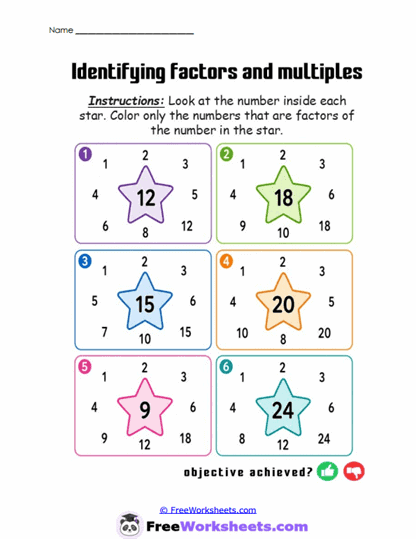
This Grade 4 math worksheet gives children more practice finding factors, but the layout encourages them to scan a larger set of possible answers around each target number. Students work with 12, 18, 15, 20, 9, and 24 and color only the numbers that divide evenly into the number in the center.
This activity is useful because students must decide about every number individually. They cannot rely on one pattern or simply copy a factor list. They have to use multiplication or division knowledge to prove which choices belong.
Learning Goals
The main goal is to help students become more automatic at recognizing factor relationships.
Children practice understanding that if a target number can be divided by another number with no remainder, that number is a factor. They also see that some target numbers have many factors, while others have only a few.
This helps build number sense and prepares students for identifying prime and composite numbers later.
What Students Will Do
Students look at one numbered section at a time. The large center number is the target.
Several smaller numbers are placed around it. Students test each one and color only the numbers that are factors.
For example, with 18, a student may test 1, 2, 3, 4, 6, 9, 10, and 18. They should color the numbers that divide 18 evenly and leave the others uncolored.
The same thinking is repeated for all six target numbers.
Common Challenges
Some children may confuse factors with multiples and choose numbers that are larger than the target simply because they are related by multiplication.
A parent or teacher can keep the rule very simple: “A factor fits into the target with no remainder.”
Another common mistake is missing a factor pair. Encourage children to think in multiplication pairs, such as 2 × 9 = 18 or 3 × 6 = 18.
Teaching Suggestions
Teachers can have students write a small multiplication fact beside any number they are unsure about. That gives them proof before they color.
Parents can ask the child to explain one correct choice and one incorrect choice. This helps show whether the child understands the rule or is guessing.
For stronger students, ask them to count how many factors each target number has and compare which number has the most.
Worksheet Features
The page includes six target numbers surrounded by possible factors in a clean, easy-to-read layout. Students get repeated practice with both smaller and larger target values.
This worksheet works well for math centers, independent review, homework, or small-group support.