
About This Worksheet
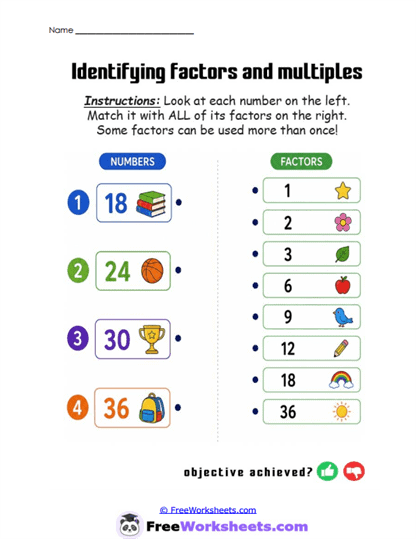
This Grade 4 math worksheet helps children match each target number with all of its correct factors. Students work with 18, 24, 30, and 36. On the right side is a factor bank containing numbers such as 1, 2, 3, 6, 9, 12, 18, and 36.
The important part is that one factor can belong to more than one target number. Children are not making one simple match and moving on. They have to check every possible factor for each target and connect all of the ones that divide evenly.
This helps students see that different numbers can share factors, which is an important idea for later work with common factors and fraction simplification.
Learning Goals
The main goal is to help students identify complete factor sets and notice which factors are shared across several numbers.
Children practice using multiplication and division to prove whether a factor belongs. For example, if 3 × 6 = 18, then 3 and 6 are both factors of 18. If 3 × 8 = 24, then 3 also belongs with 24.
Students begin to see that some factors, such as 1, appear again and again, while others only work with certain targets.
What Students Will Do
Students start with the first target number, 18, and look through the factor list on the right.
They draw a line from 18 to every factor that divides it evenly. Then they repeat the process for 24, 30, and 36.
The directions remind students that factors can be used more than once. That means a number such as 2 or 3 may connect to several different targets.
The goal is to finish with every target connected to its full set of correct factors.
Common Challenges
Some children may think each factor can only be used once because many matching activities work that way. Here, that is not true.
Others may stop after finding the easiest factors and forget to check the rest of the list.
A parent or teacher can say, “Test every number on the right. Does it divide the target with no remainder?”
Teaching Suggestions
Have students work with one target at a time. That keeps the page from feeling crowded.
Teachers can also ask students to say a multiplication fact for each line they draw. For example, “6 × 5 = 30, so 6 is a factor of 30.”
Parents can ask, “Which factors do 18 and 36 share?” That adds a simple common-factor discussion after the main activity is finished.
Worksheet Features
The page includes four target numbers and a shared factor bank with several reusable choices. The layout encourages children to compare factor sets instead of treating each number by itself.
This worksheet works well for factor review, guided math, homework, or preparation for common-factor lessons.