
About This Worksheet
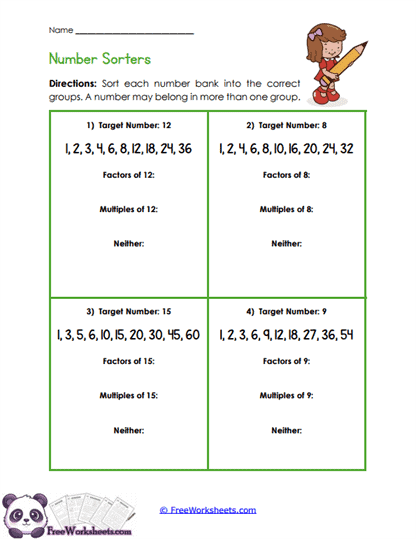
This Grade 4 math worksheet helps children practice telling the difference between factors, multiples, and numbers that are neither. Students work with four target numbers: 12, 8, 15, and 9. For each target, they look through a number bank and decide where every number belongs.
This is useful because factors and multiples can be easy to mix up. A factor is a number that divides evenly into the target, while a multiple is a number you get by multiplying the target by a whole number. This activity gives students repeated practice sorting those ideas correctly.
Learning Goals
The main goal is to help students compare factors and multiples side by side.
Children practice asking two important questions: “Does this number divide into the target evenly?” and “Can I get this number by multiplying the target by a whole number?”
They also learn that some numbers may belong in more than one group, while others may fit neither category.
What Students Will Do
Students begin with the first target number and read through its number bank.
They sort each number into one of three groups: Factors of the target number, Multiples of the target number, or Neither.
For example, with a target of 12, a number like 3 is a factor because 12 ÷ 3 = 4, while 24 is a multiple because 12 × 2 = 24.
Students repeat the same thinking with the remaining target numbers.
Common Challenges
Some children may think every smaller number is a factor or every larger number is a multiple. That is not always true.
A parent or teacher can remind them to prove each choice with multiplication or division. If a number divides evenly, it is a factor. If the target can be multiplied to make it, it is a multiple.
Teaching Suggestions
Before starting, model one number from each category. Show one factor, one multiple, and one number that is neither.
Teachers can also have students write a tiny multiplication or division fact beside any choice they are unsure about.
For stronger students, ask whether any number in the bank belongs in both the factor and multiple groups and why.
Worksheet Features
The page includes four target numbers, four number banks, and three sorting categories for each one. The repeated structure gives students enough practice to really separate the two ideas.
This worksheet works well for guided math, partner work, homework, or review before a factors-and-multiples assessment.