
About This Worksheet
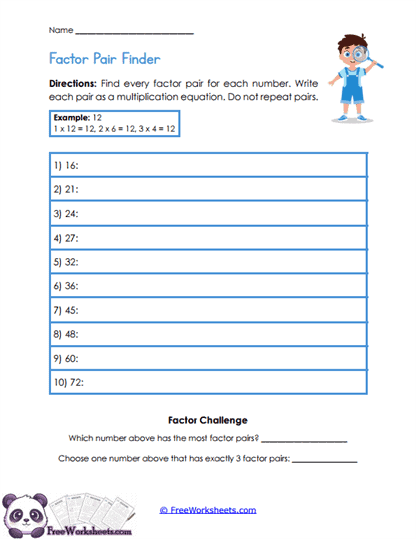
This Grade 4 math worksheet helps children understand that factors come in pairs. Students work with numbers such as 16, 21, 24, 27, 32, 36, 45, 48, 60, and 72. For each number, they find every pair of whole numbers that can be multiplied together to make that target number.
This is a very useful way to build factor sense because children are not just listing random numbers. They are seeing exactly why each number is a factor. For example, if 4 × 6 = 24, then 4 and 6 are a factor pair of 24. That connection between factors and multiplication makes the idea much easier to understand.
Learning Goals
The main goal is to help students find all factor pairs of a whole number without repeating the same pair in reverse order.
Children practice using multiplication facts, checking whether one number divides evenly into another, and organizing factor pairs in a clear way.
This also prepares students for later work with prime and composite numbers, common factors, equivalent fractions, and divisibility.
What Students Will Do
Students begin with the first target number and think of multiplication equations that equal it.
For 16, for example, they might write 1 × 16, 2 × 8, and 4 × 4. They should not repeat 16 × 1 because that is the same factor pair in reverse.
They continue this process for all 10 numbers on the page.
At the bottom, students complete two challenge questions. One asks which number has the most factor pairs. The other asks them to choose a number with exactly three factor pairs.
Common Challenges
Some children may stop after finding the easiest pair, such as 1 and the number itself. Others may accidentally repeat pairs in reverse order.
A parent or teacher can ask, “Can any other whole number divide into this evenly?” Another helpful strategy is to test numbers in order: 1, 2, 3, 4, and so on.
Students may also miss square-number pairs such as 4 × 4. Remind them that a number can be paired with itself.
Teaching Suggestions
Teachers can model one number by creating a simple list of multiplication facts until the factors begin repeating. This shows students when they know they have found all the pairs.
Parents can turn the activity into a multiplication search by asking, “What times what gives us this number?”
For extra support, let students use counters or draw arrays. For stronger students, ask them to list all individual factors after finding the pairs.
Worksheet Features
The page includes 10 target numbers, plenty of writing space for multiplication equations, and two factor challenges at the bottom. The range of numbers gives students practice with both numbers that have few factors and numbers that have many.
This worksheet works well for factor lessons, multiplication review, math centers, homework, or independent practice.