
About This Worksheet
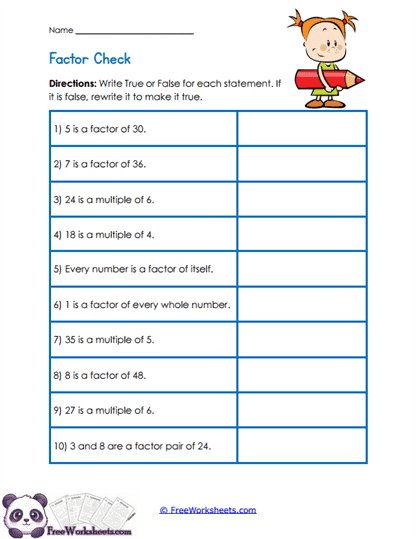
This Grade 4 math worksheet helps children decide whether statements about factors and multiples are true or false. Students read 10 different statements, including ideas such as “5 is a factor of 30,” “24 is a multiple of 6,” and “Every number is a factor of itself.” If a statement is false, they do not stop there-they rewrite it so it becomes true.
This is useful because it asks children to think about the meaning of factors and multiples instead of simply listing them. Students have to decide whether each statement makes sense and then explain the correction when it does not.
Learning Goals
The main goal is to help students check number relationships carefully.
Children practice recognizing factors, recognizing multiples, and using multiplication or division facts to prove whether a statement is correct. They also review important general rules, such as the fact that 1 is a factor of every whole number and every whole number is a factor of itself.
This strengthens number sense, multiplication fluency, and mathematical reasoning.
What Students Will Do
Students read each of the 10 statements one at a time.
If the statement is correct, they write True. If it is not correct, they write False and then rewrite the statement so it becomes accurate.
For example, if a statement says that 18 is a multiple of 4, students should recognize that 4 does not multiply by a whole number to make 18. They would mark it false and correct the idea.
The page also includes statements about factor pairs, so students must think about how two factors multiply to make a target number.
Common Challenges
Some children may mix up the direction of the relationship. For example, they may know that 6 and 24 are connected but not remember whether 6 is a factor of 24 or 24 is a multiple of 6.
A parent or teacher can remind them: “A factor goes into a number evenly. A multiple comes from multiplying the number.”
Students may also rush through the true-or-false part without proving the answer. Encourage them to quietly check with a multiplication or division fact first.
Teaching Suggestions
Teachers can ask students to show one proof beside each answer, even if the page does not require it. That can be as simple as writing 5 × 6 = 30 next to the statement about 5 being a factor of 30.
Parents can turn false statements into a quick discussion: “What would have to change to make this true?”
For stronger students, ask them to write one new true statement and one new false statement about factors or multiples.
Worksheet Features
The page includes 10 statements that mix true facts, false facts, and general factor rules. The correction step gives students more reasoning practice than a basic true-or-false activity.
This worksheet works well for review, homework, math centers, or a quick check before a factors-and-multiples test.