
About This Worksheet
This worksheet focuses on identifying character traits and supporting those traits with evidence from a story. Character traits are qualities that describe how a character thinks, acts, or feels throughout a narrative. Third-grade students strengthen reading comprehension when they learn to support their ideas with details from the text instead of guesses. For example, a character who creates a clever plan to solve a problem may be described as intelligent or quick-thinking. This activity helps students analyze characters more deeply and use textual evidence effectively.
Curriculum and Grade Alignment
This worksheet is designed for Grade 3 students studying character analysis and literary comprehension. The primary learning goal is identifying character traits and finding evidence that supports those conclusions. Students should already be able to describe characters and recount important events in a story. The next progression involves analyzing how character traits influence decisions and story outcomes. This activity aligns with CCSS RL.3.3 and supports TEKS 3.8A by helping students describe characters using evidence from literary texts.
Student Tasks
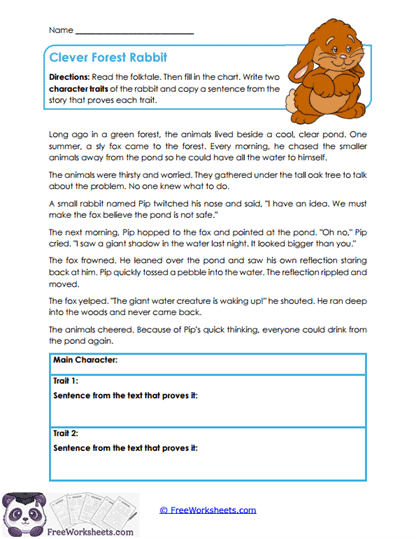
On this worksheet, students will read a folktale about a clever rabbit solving a problem faced by the other animals. They will identify the main character and determine two character traits that describe him. Learners must locate and copy sentences from the story that prove each trait. Students connect actions and dialogue to personality characteristics. The activity encourages evidence-based thinking and close reading.
Common Challenges and Misconceptions
Many students choose traits they like instead of traits supported by the text. Some learners identify a character trait correctly but struggle to find evidence that proves it. Others may confuse emotions with long-term personality traits. Readers sometimes copy sentences without explaining how they support the selected trait. Teachers should encourage students to ask what the character repeatedly does and why those actions matter.
Implementation Guidance
Teachers can use this worksheet during lessons on character analysis and textual evidence. It works well as guided practice before students analyze more complex literary characters. Parents may discuss the character’s actions and ask what those actions reveal about personality. Homeschool educators can extend learning by having students identify additional traits and supporting evidence. The worksheet helps students build stronger analytical reading skills.
Details and Features
The worksheet includes a folktale with a clear central character and a meaningful problem-solving situation. Students complete a structured organizer that connects traits with supporting evidence. Dedicated response spaces help learners organize their thinking. The printable format is suitable for classroom instruction, homework assignments, intervention groups, and homeschool learning. Its focused design supports both comprehension and literary analysis.