
About This Worksheet
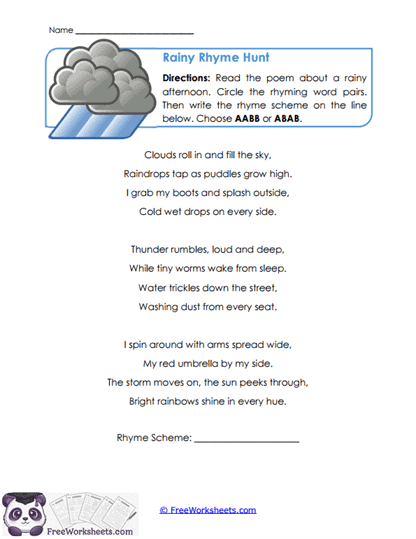
This worksheet focuses on identifying rhyme schemes in poetry. A rhyme scheme is the pattern of rhyming words that appears at the ends of lines in a poem. Third-grade students strengthen poetry comprehension when they learn how poets organize sounds to create rhythm and structure. For example, if the first and third lines rhyme while the second and fourth lines rhyme, the pattern is ABAB. This activity helps students recognize patterns in poetry and understand how rhyme contributes to a poem’s flow.
Curriculum and Grade Alignment
This worksheet is designed for Grade 3 students studying poetry elements and reading comprehension. The primary learning goal is identifying rhyming words and determining the rhyme scheme of a poem. Students should already be able to recognize basic rhyming pairs. The next progression involves comparing rhyme patterns across different poems and analyzing their effects. This activity aligns with CCSS RL.3.5 and supports TEKS 3.9C by helping students understand poetic structure.
Student Tasks
On this worksheet, students will read a poem about a rainy afternoon. They will identify words that rhyme at the ends of lines and examine how those rhymes are organized. Learners must determine the poem’s rhyme scheme and write the correct pattern. Students use careful observation and pattern recognition to complete the activity. The lesson encourages close reading and attention to sound in poetry.
Common Challenges and Misconceptions
Many students recognize rhyming words but struggle to assign the correct letter pattern. Some learners focus on spelling rather than listening for matching ending sounds. Others may accidentally include words that sound similar but do not truly rhyme. Readers sometimes lose track of the pattern when examining multiple stanzas. Teachers should encourage students to underline rhyming pairs before identifying the rhyme scheme.
Implementation Guidance
Teachers can use this worksheet during poetry units or lessons focused on rhyme and rhythm. It works well as guided practice before students analyze more complex poems. Parents may read the poem aloud and help children listen for matching sounds. Homeschool educators can extend the lesson by having students create their own short poems using a specific rhyme scheme. The worksheet supports foundational poetry analysis skills.
Details and Features
The worksheet includes a seasonal poem with clear rhyming patterns appropriate for Grade 3 readers. Students practice identifying both rhyming words and overall rhyme structure. The layout provides space for students to record the rhyme scheme clearly. The printable format is suitable for classroom instruction, homework, literacy centers, and homeschool learning. Its focused design helps students build confidence with poetry elements.