
About This Worksheet
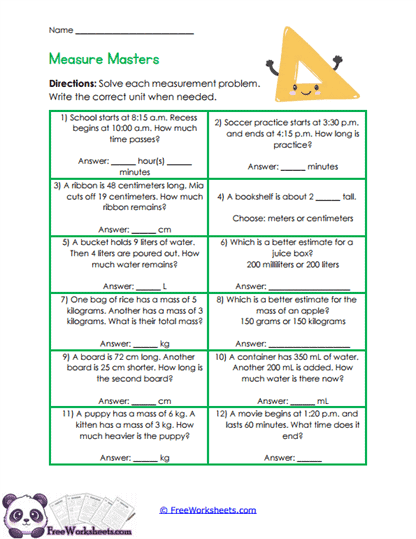
Measurement Mix is a third grade review activity that gives students practice with several different kinds of measurement in one worksheet. Students solve problems involving elapsed time, length, liquid volume, mass, capacity estimates, and time intervals. For example, they may determine how long school lasts, subtract centimeters from a ribbon length, decide whether a juice box is better measured in milliliters or liters, or find the combined mass of two bags. This variety helps children recognize which measurement unit and operation belong with each situation. It also gives them practice using measurement vocabulary in everyday contexts.
Curriculum and Grade Alignment
This worksheet is made for third grade learners who are reviewing standard measurement concepts and units. The main goal is to help students solve problems involving time, length, liquid volume, and mass while selecting reasonable units when needed. Before using this page, your child should have experience with centimeters, meters, milliliters, liters, grams, kilograms, and telling time. The next step is solving multi-step measurement problems and converting among related units where appropriate. This activity supports measurement sense, subtraction, addition, estimation, and elapsed-time reasoning.
Student Tasks
Students will complete twelve measurement problems. They find elapsed time between 10:00 a.m. and 1:15 p.m., determine how long soccer practice lasts, subtract lengths in centimeters, choose sensible capacity units, combine masses, compare kilograms, find missing length differences, subtract milliliters, compare animal masses, and determine an ending time after 60 minutes. Some questions require computation, while others require choosing between two possible units. This builds both numerical fluency and practical measurement judgment.
Common Challenges and Misconceptions
Some students may confuse units that measure different things, such as grams and milliliters. Others may choose the larger-sounding unit without thinking about what is reasonable for the object. Elapsed-time questions can also cause trouble if students try to subtract clock times as ordinary numbers. Encourage your child to identify what is being measured first: time, length, liquid, or mass. Then choose or use a unit that makes sense for that type of quantity.
Implementation Guidance
Teachers can use this worksheet as a mixed measurement review after students have studied the individual units separately. It works well as an informal assessment because the changing question types reveal whether students understand both calculations and unit choice. Parents can ask the child to estimate first, such as whether a juice box should hold hundreds of milliliters or hundreds of liters. For elapsed time, draw a simple timeline and count forward in chunks. This keeps the reasoning concrete and manageable.
Details and Features
This worksheet includes twelve measurement questions in a green two-column grid. Skills include elapsed time, centimeters, meters, milliliters, liters, grams, kilograms, mass comparisons, and reasonable-unit selection. Problems combine direct computation with estimation and unit-choice questions. The printable supports measurement fluency, mathematical reasoning, elapsed time, and real-world problem solving.