
About This Worksheet
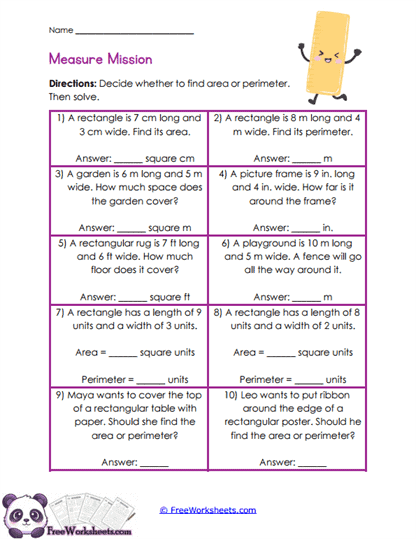
Area Perimeter Quest is a third grade measurement and geometry activity that helps students decide whether a problem is asking for area or perimeter. Each story describes a rectangle or real-world object and gives its length and width. Students determine whether they need to find the space inside the shape or the distance around it, then solve. For example, covering a garden means finding area, while putting a fence around a playground means finding perimeter. This helps children connect formulas with the meaning of the problem instead of applying them automatically.
Curriculum and Grade Alignment
This worksheet is made for third grade learners who are developing an understanding of area and perimeter. The main goal is to help students distinguish between measuring the inside of a rectangle and measuring the distance around it. Before using this page, your child should understand rectangular dimensions and basic multiplication. The next step is solving more complex area and perimeter problems with missing side lengths or larger dimensions. This activity supports measurement, geometry, multiplication, and real-world problem solving.
Student Tasks
Students will complete ten area-and-perimeter problems. They calculate the area of rectangles such as 7 by 3, determine perimeter for shapes such as 8 by 4, and solve real-world situations involving gardens, picture frames, rugs, playgrounds, and posters. Some items ask students to calculate, while others ask whether area or perimeter is the appropriate measure. This builds formula understanding, operation choice, and measurement reasoning.
Common Challenges and Misconceptions
Some students may confuse area and perimeter because both use the same length and width values. Others may add the side lengths when they should multiply for area, or multiply when they should add around the outside. A child may also forget the correct unit, such as square units for area. Encourage your child to ask, “Am I covering the inside or going around the edge?” before calculating. This makes the correct measurement easier to identify.
Implementation Guidance
Teachers can use this worksheet after students have learned area and perimeter separately. It works well as mixed practice because students must decide which concept applies before solving. Parents can draw a rectangle and shade the inside for area, then trace the border for perimeter. This simple visual can help clarify the difference. Ask the child to include the correct measurement unit with every answer.
Details and Features
This worksheet includes ten purple-bordered area and perimeter problems arranged in two columns. The questions use rectangles and real-world contexts such as gardens, frames, rugs, playgrounds, tables, and posters. Some problems ask for calculations while others focus on choosing the correct measurement concept. The printable supports area, perimeter, multiplication, geometry, and problem solving.