
About This Worksheet
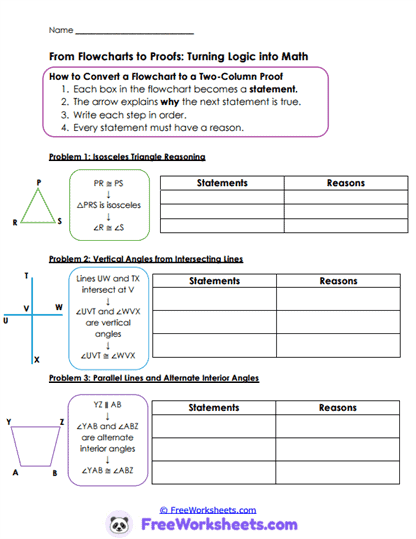
A flowchart proof shows geometry reasoning in connected boxes before it is written as a formal two-column proof. This worksheet helps students translate flowchart ideas into organized proof statements and reasons. Students study triangle relationships, vertical angles, and alternate interior angles while following logical proof steps. For example, if two angles are vertical angles, students can conclude they are congruent. The activity helps students understand how geometry logic moves from one step to the next.
Curriculum and Grade Alignment
This worksheet supports geometry standards involving proof writing and logical reasoning. The main learning goal is to convert visual proof structures into formal two-column proofs. Students should already understand basic geometry vocabulary and common congruence relationships before beginning. The next learning step is creating longer proofs without guided flowcharts. This aligns with HSG-CO.C.10 because students build logical geometric arguments using theorems and definitions.
Student Tasks
On this worksheet, students will read flowchart proofs and rewrite them into statement-and-reason form. They will identify congruent angles, isosceles triangles, and alternate interior angle relationships from diagrams. Students also organize proof steps in the correct order while matching each statement with a reason. Several problems ask learners to explain how one geometry fact leads to another.
Common Challenges and Misconceptions
Some students may place proof steps in the wrong order while rewriting the flowchart. Others may confuse definitions with theorems when choosing reasons. A common mistake is skipping a step because it seems obvious from the picture. Teachers can help by reminding students that every proof statement must connect clearly to the step before it.
Implementation Guidance
This worksheet works well during the transition from visual proof models to formal proof writing. Teachers can model one flowchart conversion together before students complete the remaining proofs independently. Parents helping at home can ask students to explain why each box in the flowchart connects to the next one. Those conversations often make the proof structure easier to understand.
Details and Features
The worksheet includes flowchart diagrams, proof tables, and geometry sketches involving triangles and parallel lines. Students practice converting visual logic into written proof form. The printable layout provides organized proof columns and clear answer spaces for reasoning. The guided format helps students develop confidence with proof organization and sequencing.