
About This Worksheet
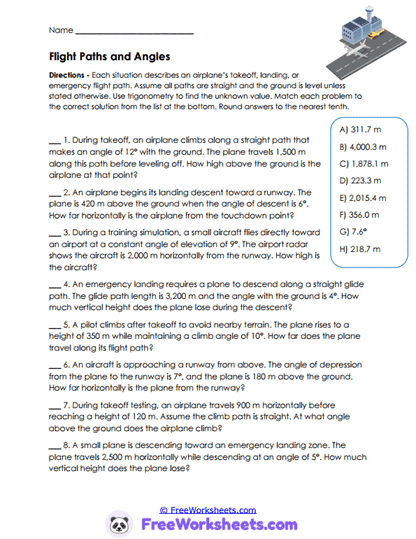
Trigonometry helps pilots and engineers measure heights, distances, and flight paths during air travel. This worksheet gives students practice solving right triangle problems connected to airplanes, glides, descents, and runway approaches. Students use trigonometric ratios to determine unknown heights, horizontal distances, and angles of elevation or depression. For example, an airplane climbing at an angle forms a right triangle with the ground. The activity helps students see how trigonometry supports navigation and aviation planning.
Curriculum and Grade Alignment
This worksheet supports trigonometry standards involving right triangle ratios and applied problem solving. The main learning goal is to apply sine, cosine, and tangent within aviation-themed situations. Students should already understand right triangle vocabulary and angle measurement before beginning. The next learning step is solving more advanced navigation and modeling problems using trigonometric equations. This aligns with HSG-SRT.C.6 because students use right triangle ratios to solve measurement problems.
Student Tasks
On this worksheet, students will solve airplane and flight-path problems involving heights, angles, and distances. They will determine which trigonometric ratio fits each situation and calculate the unknown value. Students also round answers to the nearest tenth and match some problems to multiple-choice answers. Several questions ask learners to interpret the meaning of angles of elevation and depression.
Common Challenges and Misconceptions
Some students may mix up the horizontal distance with the flight path length when setting up the triangle. Others may confuse angles of depression with angles of elevation. A common mistake is choosing the wrong ratio because the triangle sides are not labeled directly. Teachers can help by encouraging students to draw or mark the triangle before solving.
Implementation Guidance
This worksheet works well during trigonometry applications or review lessons focused on navigation and measurement. Teachers can use the aviation theme to show how trigonometry supports real transportation systems. Parents helping at home can ask students to explain what each side of the triangle represents in the flight situation. Those explanations often help students understand the setup more clearly.
Details and Features
The worksheet includes aviation-themed word problems, diagrams, and multiple-choice matching sections. Students practice solving for heights, distances, and angles using trigonometric ratios. The printable format provides room for calculations and organized problem solving. The realistic flight scenarios help make trigonometry more engaging and practical.