
About This Worksheet
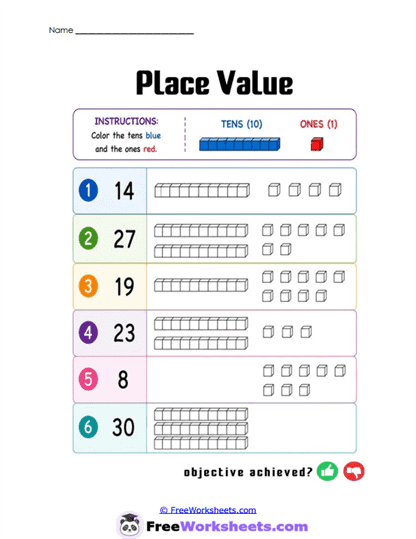
This worksheet helps first graders understand place value by matching written numbers with groups of tens and ones. Students color every tens rod blue and every ones cube red to build each number correctly. As they work, they learn that the digit on the left tells how many groups of ten there are, while the digit on the right shows how many extra ones are needed. Seeing numbers represented with base-ten blocks helps children understand what two-digit numbers really mean instead of simply memorizing them. This hands-on activity builds a strong foundation for future math learning.
Curriculum and Grade Alignment
This worksheet is designed for Grade 1 students who are learning to model two-digit numbers using place value. Students should already recognize numbers through at least 30 before beginning. Building numbers with base-ten blocks develops number sense and prepares students for addition, subtraction, regrouping, and mental math. This activity aligns with CCSS.MATH.CONTENT.1.NBT.B.2 by representing two-digit numbers as groups of tens and ones. It also supports TEKS 1.2.A through using concrete and pictorial models to represent numbers.
Student Tasks
Students read each number shown on the worksheet. They color the tens rods blue and the ones cubes red so the blocks match the number provided. Students repeat the process for every row while checking that the correct number of tens and ones has been colored. When finished, they can explain how many tens and ones each number contains.
Common Challenges and Misconceptions
Some students may reverse the digits and color too many tens or too many ones. Others may forget that each rod already represents ten. A few children may count every small cube instead of recognizing the grouped tens. Encourage students to identify the tens digit first before coloring the remaining ones.
Implementation Guidance
Teachers can pair this worksheet with real base-ten manipulatives before moving to the printed version. It works well during whole-group lessons, math centers, or independent review. Parents can practice the same concept at home by bundling ten craft sticks together and using loose sticks as ones. Having children explain each number aloud reinforces understanding.
Details and Features
The worksheet includes clearly labeled two-digit numbers with matching base-ten block models ready to be colored. The organized layout allows students to focus on one number at a time without becoming overwhelmed. It is suitable for classroom instruction, tutoring, homework, or homeschool practice.