
About This Worksheet
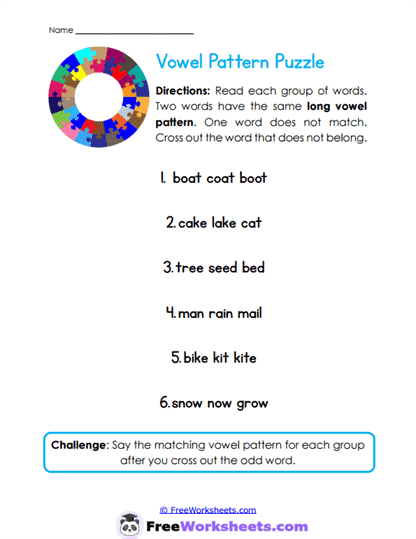
This worksheet is a phonics sorting and reasoning activity that focuses on identifying long vowel patterns. It is designed for first grade students who are learning how vowel teams and silent e patterns work in words. Students compare groups of words to determine which one does not match the shared vowel pattern. Long vowel patterns help vowels say their name and are key for decoding. For example, in boat, coat, boot, the word boot does not belong because it uses a different vowel pattern.
Curriculum and Grade Alignment
This worksheet supports Grade 1 phonics and word analysis skills. The main goal is to help students recognize and compare long vowel spelling patterns. Students should already understand basic vowel sounds and simple word reading. It aligns with Common Core Standard RF.1.3, which emphasizes phonics and pattern recognition. In TEKS, it connects with 1.2(B)(iii) for decoding and identifying vowel patterns.
Student Tasks
On this worksheet, students will read groups of three words carefully. They identify which two words share the same long vowel pattern. Students then cross out the word that does not match the pattern. Afterward, they say the matching pattern aloud to reinforce understanding. This activity builds both phonics recognition and critical thinking skills.
Common Challenges and Misconceptions
Students may focus on meaning instead of vowel patterns when choosing the odd word. Some learners might confuse similar patterns, such as oa and ow. Others may struggle to explain why a word does not belong. There can also be difficulty hearing the difference between vowel sounds. Teachers can support students by modeling how to compare patterns and say the words aloud.
Implementation Guidance
This worksheet works well as a small group or independent phonics activity. Teachers can demonstrate one example before students begin working on their own. It is also useful as a review activity to reinforce pattern recognition. Parents can use it at home by discussing each group of words together. This activity encourages careful thinking while strengthening phonics skills.
Details and Features
The worksheet includes clearly grouped word sets for easy comparison. It provides a challenge section to extend student thinking. The layout is simple and easy for young learners to follow. It combines reading and reasoning skills in one activity. It is designed for easy printing and classroom use.