
About This Worksheet
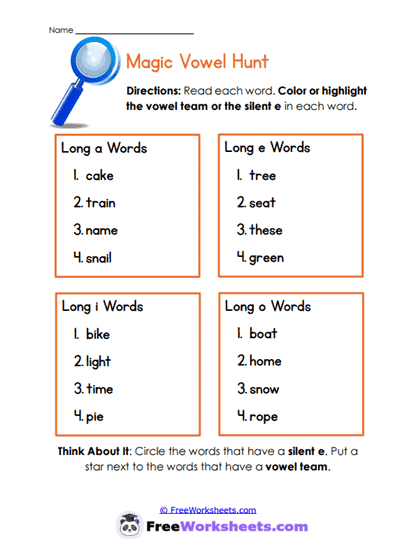
This worksheet is a phonics identification activity that focuses on recognizing long vowel patterns and silent e. It is designed for first grade students who are learning how vowels work in different spelling patterns. Long vowels occur when the vowel says its name, often with the help of a vowel team or silent e. Students practice identifying these patterns within grouped word lists. For example, cake shows a long a sound because the silent e changes the vowel sound.
Curriculum and Grade Alignment
This worksheet supports Grade 1 phonics instruction with a focus on long vowel recognition. The main goal is to help students distinguish between vowel teams and silent e patterns. Students should already be familiar with short vowels and basic decoding skills. It aligns with Common Core Standard RF.1.3, which emphasizes phonics and word analysis. In TEKS, it connects with 1.2(B)(iii), focusing on decoding vowel patterns.
Student Tasks
On this worksheet, students will read lists of words grouped by long vowel sounds. They identify and highlight the vowel team or silent e in each word. Students then compare patterns across different groups to build understanding. In the final section, they circle words with silent e and mark those with vowel teams. This encourages deeper thinking about how vowels function in words.
Common Challenges and Misconceptions
Students may confuse vowel teams with silent e patterns, especially when both create long vowel sounds. Some learners might highlight the wrong letters if they are unsure of the pattern. Others may struggle to understand why different spellings produce the same sound. There can also be difficulty recognizing patterns in less familiar words. Teachers can support students by modeling examples and reviewing each pattern before independent work.
Implementation Guidance
This worksheet works well as a follow-up activity after introducing long vowel patterns. Teachers can guide students through one section before assigning the rest independently. It is also useful in small groups for targeted phonics instruction. Parents can use it at home by reviewing each word and discussing the vowel pattern together. This activity helps build strong foundational decoding skills.
Details and Features
The worksheet includes clearly labeled sections for different long vowel sounds. It provides structured word lists that make pattern recognition easier. The highlight and marking tasks encourage active engagement. The layout is simple and easy for young learners to navigate. It is designed for easy printing and repeated classroom use.