
About This Worksheet
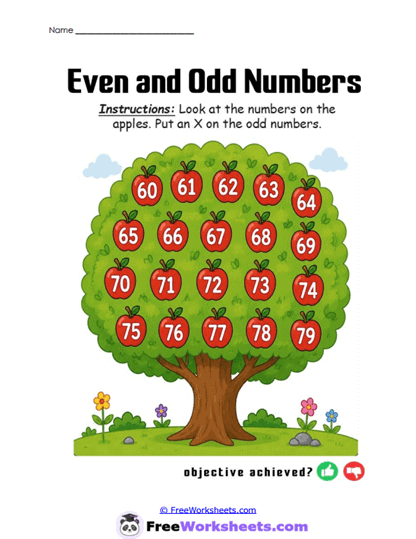
This worksheet gives first graders additional practice finding odd numbers by marking apples on a tree. Students identify odd numbers between 60 and 79 while reinforcing the same rule they learned with smaller numbers. An odd number always leaves one extra when divided into two equal groups. For example, 67 becomes an odd number because one remains after making equal pairs, while 68 is even because it divides evenly. The higher number range helps children see that the even-and-odd pattern never changes.
Curriculum and Grade Alignment
This activity is designed for Grade 1 students who are comfortable recognizing numbers beyond 60. Students should already understand the difference between even and odd numbers before completing this extension worksheet. Working with larger values strengthens number sense and prepares learners for more advanced arithmetic in later grades. The worksheet supports the foundational concepts connected to CCSS.MATH.CONTENT.2.OA.C.3 and aligns with TEKS 1.2.A through continued number classification practice. It encourages students to apply one consistent strategy regardless of the number size.
Student Tasks
On this worksheet, students will examine each numbered apple growing on the tree. They place an X on every apple that shows an odd number while leaving even numbers unmarked. Students work carefully across the tree until every number has been evaluated. After finishing, they can review their answers to make sure every marked apple contains an odd number.
Common Challenges and Misconceptions
Some learners may think larger numbers follow different rules than smaller ones. Others may forget that only the last digit determines whether a number is even or odd. A few students may accidentally skip apples while working across the rows. Encourage children to check each number one at a time instead of rushing through the page.
Implementation Guidance
Teachers can use this worksheet as an enrichment activity after students master smaller number ranges. It fits well into math stations, review lessons, or independent practice. Parents can use the worksheet to start conversations about how even and odd patterns continue forever. The activity also provides a simple way to measure students’ understanding before introducing more advanced number concepts.
Details and Features
The worksheet includes a colorful apple tree filled with clearly printed numbers from 60 through 79. Large illustrations and generous spacing make it easy for young learners to complete independently. The printable format works well for classrooms, tutoring sessions, and homeschool instruction. Its engaging design encourages repeated practice without overwhelming beginning mathematicians.