
About This Worksheet
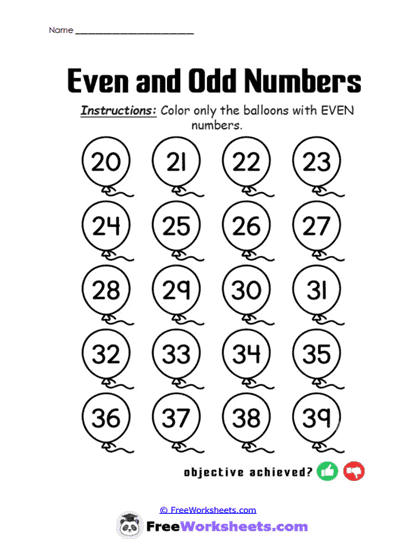
This worksheet gives first graders additional practice identifying even numbers by coloring only the correct balloons. Students work with the numbers 20 through 39, helping them extend their understanding beyond the earliest counting numbers. They begin to notice that the even-and-odd pattern continues no matter how high the numbers become. For example, 26 becomes an even number because it can be split into equal groups, while 27 is odd because one remains. The simple coloring activity reinforces number patterns through repetition.
Curriculum and Grade Alignment
This worksheet is designed for Grade 1 students who are becoming more confident with two-digit numbers. Learners should already recognize numbers through at least 40 before beginning. Practicing even and odd numbers with larger values builds a strong foundation for future arithmetic concepts. The activity supports introductory work connected to CCSS.MATH.CONTENT.2.OA.C.3 and aligns with TEKS 1.2.A by reinforcing number relationships. It helps students apply familiar rules to a wider range of numbers.
Student Tasks
On this worksheet, students will look carefully at every balloon and determine whether its number is even or odd. They color only the balloons showing even numbers while leaving the odd-numbered balloons blank. Students repeat this process until every balloon has been checked. When complete, the colored balloons reveal the repeating pattern of even numbers across the page.
Common Challenges and Misconceptions
Some students may believe larger numbers follow different rules than smaller ones. Others may accidentally color balloons in sequence instead of checking each number individually. A few learners confuse neighboring numbers because they read too quickly. Encourage students to look at the last digit of every number before deciding whether to color the balloon.
Implementation Guidance
Teachers can use this worksheet as an extension lesson after students master even and odd numbers through 20. It is effective for math centers, morning work, or independent review. Parents can complete the activity alongside their child by discussing why each balloon should or should not be colored. The worksheet also serves as a quick informal assessment of number classification skills.
Details and Features
The page features large numbered balloons arranged in neat rows for easy coloring. Numbers from 20 through 39 provide practice with higher values while keeping the task manageable. The printable format is easy to photocopy and suitable for classroom or homeschool instruction. Its uncluttered design allows students to focus entirely on identifying even numbers.