
About This Worksheet
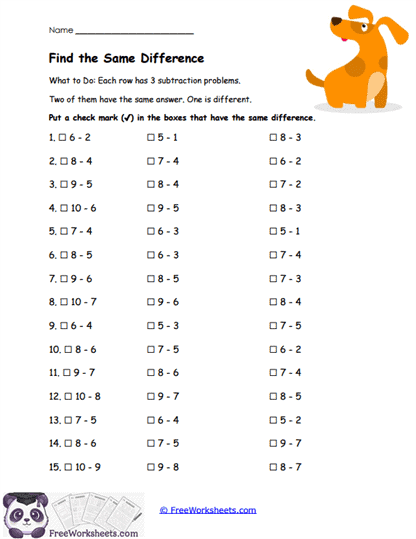
This worksheet is a really nice step up because it gets students thinking beyond just solving one problem at a time. Here, they’re comparing subtraction problems and noticing patterns. I like to think of this as helping kids become “math detectives.” They’re looking for which problems have the same answer and which one doesn’t belong. That kind of thinking builds deeper understanding, not just quick answers.
Curriculum and Grade Alignment
This activity supports Grade 1 subtraction skills within 10, with a focus on reasoning and comparing results. The goal is to help students see relationships between subtraction problems. Students should already be comfortable solving basic subtraction equations. It aligns with Common Core Standard 1.OA.A.1 and supports TEKS 1.3(A) by strengthening understanding through comparison and reasoning.
Student Tasks
Students look at rows of three subtraction problems. Two of them will have the same answer, and one will be different. Their job is to solve each problem and figure out which two match. Then they check those matching problems. This encourages them to slow down and really think about each equation.
Common Challenges and Misconceptions
Some students may try to guess instead of solving each problem. Others might solve correctly but forget to compare the answers carefully. You may also see students rush and miss small differences. I always remind them, “Solve first, then compare.” That simple habit helps a lot.
Implementation Guidance
This worksheet works great for small group discussion or partner work. Students can explain why they chose their answers, which builds confidence and understanding. I’d model one row together before letting them work independently. At home, parents can ask their child to explain how they knew which ones matched.
Details and Features
The worksheet includes comparison-style subtraction problems. It encourages reasoning and pattern recognition. The layout is simple and easy to follow. It builds deeper thinking alongside basic skills.