
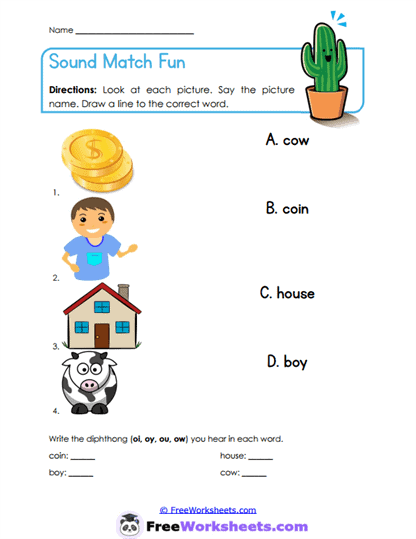
About This Worksheet
This worksheet is a phonics matching activity that helps students connect pictures to words with diphthong sounds. It focuses on early reading skills by combining visual recognition with sound identification for Grade 1 learners. Students must identify the object in each picture and match it to the correct written word. This supports vocabulary development alongside phonics understanding. For example, a picture of a coin becomes matched with the word coin, reinforcing the /oi/ sound.
Curriculum and Grade Alignment
This worksheet is appropriate for first grade students working on decoding and word recognition skills. The main learning goal is to strengthen the connection between spoken sounds and printed words using diphthongs. Students should already have some familiarity with basic phonics patterns and simple vocabulary. It aligns with Common Core Standard RF.1.2 and RF.1.3, focusing on phonemic awareness and decoding skills. In TEKS, it supports 1.2(B) for decoding words using phonics patterns.
Student Tasks
On this worksheet, students will look carefully at each picture and say the object’s name aloud. They then draw a line to match each picture to the correct word, reinforcing both reading and comprehension. After matching, they identify the diphthong in each word and write it in the provided blanks. This step helps students focus specifically on the vowel pattern within the word. The combination of visual, verbal, and written tasks strengthens multiple literacy skills at once.
Common Challenges and Misconceptions
Students may struggle to correctly name the picture, which can lead to incorrect matches. Some learners might recognize the word visually but not connect it to the correct sound pattern. Confusion between similar diphthongs, like ou and ow, can also occur during the writing portion. Another challenge is remembering to isolate just the vowel team instead of writing the whole word. Teachers can support students by modeling picture naming and practicing sound identification before independent work.
Implementation Guidance
This worksheet works well as a center activity or small group task during phonics instruction. Teachers can guide students through the first example to ensure understanding before independent practice. At home, parents can turn it into a discussion activity by asking children to explain their matches. It also serves as a quick formative assessment to check student understanding of diphthongs. Repeating similar activities over time helps build confidence and accuracy.
Details and Features
The worksheet includes clear, engaging images that are easy for young learners to recognize. It combines matching and writing tasks to support different learning styles. The layout is simple and uncluttered, helping students stay focused on the task. There is a built-in extension where students write the diphthong sounds, adding an extra layer of practice. It is designed for easy printing and classroom use.